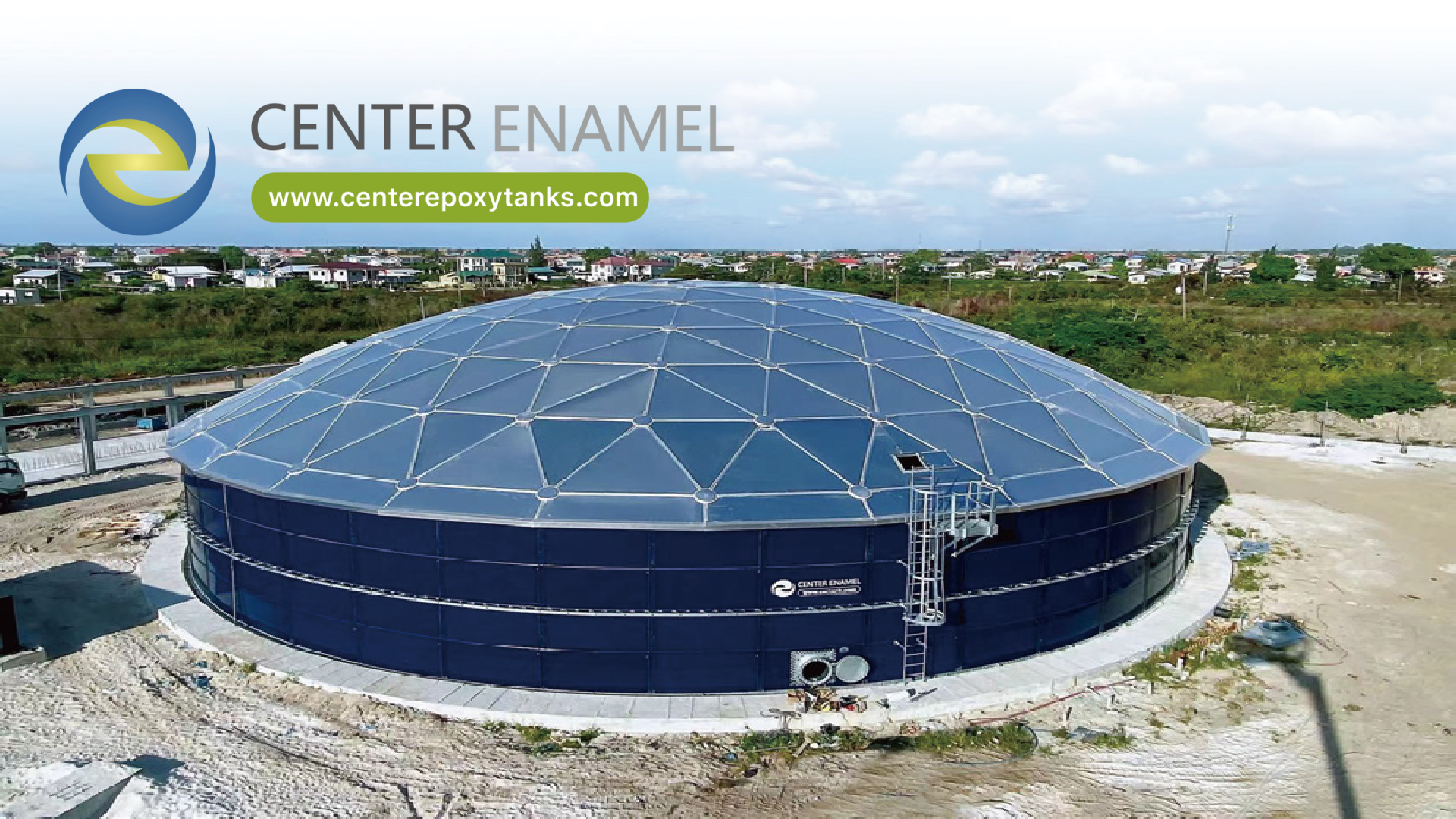
Aluminum Dome Roofs For Above-Grade Steel Tanks In Saudi Arabia
Saudi Arabia stores its water, its fuel and its process fluids in above-grade steel tanks under some of the most demanding service conditions a cover will see: sustained high temperature, intense UV, sand-laden wind and rare but violent storms. A dome specified for temperate service will survive — for a while — but the details that decide its life are the ones designed for the climate.
This article covers what changes when an aluminum dome roof is specified for Saudi service: temperature effects, sand and UV exposure, thermal movement in the structure, drainage for rare storms, and the execution realities of delivering into the Kingdom.
Above-Grade Storage In Arid Climates
Above-grade storage dominates in the Kingdom because it suits the flat terrain, the groundwater conditions and the project economics. The tanks are field-erected or bolted steel, and the covering decision is driven by evaporation, contamination and emission control rather than by rainfall.
The service conditions that matter for the cover are temperature, UV, sand and the storm profile. Each has a design consequence, and the dome specification that ignores them produces a structure that survives on margin rather than on design.
High-Temperature Design Considerations
Sustained high temperature changes the structural picture in four ways: material capacity is checked at the elevated temperature the surface will actually reach, thermal gradients through the structure create movement, daily cycling accumulates fatigue at connections, and elastomeric seals and gaskets age on an accelerated clock.
The material check is straightforward — alloy and temper selected so that member capacity at design temperature retains its margin — but it is often omitted in a temperate-climate specification carried across unchanged.
Temperature Effect | Structural Consequence | Design Response |
Peak surface temperature | Reduced member capacity | Alloy and temper selection |
Daily thermal cycling | Connection fatigue accumulation | Connection detailing and preload |
Thermal gradient through section | Differential movement | Expansion allowance at supports |
Seal and gasket aging | Cover tightness loss over time | Elastomer selection for heat service |
Sand, Dust And Abrasion
Sand-laden wind is an abrasion and a deposition problem at once. Wind-driven sand erodes exposed surfaces and finds every horizontal ledge, where it traps moisture and starts corrosion at exactly the connections the structure depends on. Details that shed dust and drain water are worth more in this climate than additional coating.
The detailing response is to avoid dust traps: sloped surfaces, sealed ledges, drainage paths that clear the structure rather than ponding on it.
UV Exposure And Material Selection
UV in the Gulf is among the most aggressive in the world, and it attacks polymers — sealants, gaskets, membrane materials and any coated surface — long before it affects bare aluminum. Material selection for the cover therefore separates the structure, which UV does not threaten, from the sealing and coating systems, which it does.
The practical rule is to specify UV-stable elastomers and coatings with documented Gulf service, and to treat seal life as a planned replacement item rather than an assumption.
Thermal Movement In The Dome Structure
Thermal movement is the defining Saudi structural detail. The dome heats and cools on a daily cycle, the tank shell heats and cools on a different cycle and a different gradient, and the interface between them has to accommodate the difference without binding, without over-stressing the anchorage and without opening the sealing line.
The engineering answer is a designed expansion provision at the support — slotted or bearing-type connections with defined movement capacity — combined with connection details that tolerate the cyclic loading. The movement is calculated, and the detail is built for it.
Wind And Sand Load Combinations
Wind design follows the site wind map and terrain category, but the sand changes the exposure: dust-laden flow adds an abrasion component and deposits load on ledges where it is least expected. The combination case — wind plus deposited sand — is checked where deposition can accumulate against the structure.
The dome’s aerodynamic behavior helps here: a curved surface sheds wind better than flat detailing, which is one reason domes suit exposed desert sites.
Drainage And Rare-Storm Detailing
Rainfall in the Kingdom is rare and, when it comes, intense — the drainage system is sized for a storm that arrives once in years, not for an average that never occurs. Scuppers and downpipes are sized for the intensity event, and the overflow path is designed so a blocked scupper is an inconvenience rather than a roof failure.
Dust is the enemy of that system: a scupper blocked by sand fails silently until the storm arrives. The maintenance regime therefore includes drainage clearing as a scheduled item, not a reactive one.
Maintenance Access In Remote Sites
Many Saudi installations are remote, and the cover has to be inspectable without a major mobilization: access hatches positioned for safe entry, walkways where inspection is a routine duty, and fasteners and seals reachable without dismantling structure.
Access is a design decision that pays back on every inspection for the life of the asset — and its absence is discovered the first time a crew has to invent a way onto the dome.
Project Execution In Saudi Arabia
Delivering into the Kingdom has its own rhythm: summer heat that reshapes the construction calendar, logistics through the major ports and inland sites, and a regulatory and standards environment — including product conformity requirements — that rewards early documentation. Projects that plan the approvals and the shipping together erect on schedule.
Local content and workforce expectations are part of the execution picture, and the erection methodology — no hot work, bolted assembly — suits a site where welding logistics are the constraint.
Corrosion Performance Over Decades
The corrosion picture for an aluminum dome in arid service is favorable at the structure and concentrated at the details: the alloy’s oxide film is stable in dry heat, while connections, fastener couples and trapped interfaces are where deterioration starts. The protection strategy is therefore detailing and fastener specification, not coating thickness.
Coastal and industrial sites change the exposure — chlorides and sulfides accelerate attack — and the material and fastener grades step up accordingly.
Exposure Zone | Corrosion Driver | Protection Approach |
External structure | UV, dry heat, abrasion | Alloy oxide film; UV-stable coatings |
Connections and fasteners | Dust deposition, chlorides | Stainless fasteners, galvanic isolation |
Ring beam interface | Dust and moisture trap | Sealed, drained, inspectable detail |
Covered headspace | Condensation, product vapor | Ventilation and drainage detailing |
Center Enamel Middle East Delivery
Center Enamel supplies aluminum dome roofs to Middle East projects with the climate adaptations this article describes: elevated-temperature material checks, designed thermal movement at the supports, UV-stable sealing systems and dust-shedding detailing. Our regional delivery record covers tank-and-roof packages engineered as one system.
For above-grade steel tanks in arid service, the cover is specified for the climate it will actually see — and delivered with the erection methodology that suits the site.
About Company
Shijiazhuang Zhengzhong Technology Co.,Ltd(Center Enamel) is a professional manufacturer dedicated to the design and fabrication of bolted storage tanks since 2008. Our products range includes Glass-Fused-to-Steel (GFS) tanks, fusion bonded epoxy tanks, stainless steel tanks, galvanized steel tanks and aluminum geodesic dome roofs. With professional enameling R&D team and nearly 200 enameling patents, Shijiazhuang Zhengzhong Technology Co.,Ltd has become the leader in bolted tanks industry of Asia. Our products are certified to ISO9001, NSF61, EN1090, ISO28765, WRAS ,FM, LFGB, BSCI, IS0 45001 and other international standards.
Shijiazhuang Zhengzhong Technology Co., Ltd is not only the first manufacturer in China which produces Glass-Fused-to-Steel tanks, but also the most experienced professional bolted tanks manufacturer in Asia.The engineering & design, product testing and quality system of Center Enamel Glass-Fused-to-Steel tanks is in strict accordance with AWWA D103-09, OSHA, ISO 28765, NSF/ANSI 61, NFPA and other international standards. Until 2023, Center Enamel bolted tanks have been exported to more than 100 countries including USA, Australia,Canada, Malaysia, Indonesia, Russia, UAE, Panama,Brazil and South Africa etc., the superior tank quality and prompt service gains us worldwide recognition.
As an outstanding containment and cover system provider with decades of industry experience, Shijiazhuang Zhengzhong Technology Co., Ltd sincerely expects to establish long-term cooperation with the local partners throughout the world and make continuous contribution to the development of the industry.
Suggested CTA
Center Enamel delivers aluminum dome engineered for tank covering in arid climates duty, with middle east delivery record, high-temperature design adaptations. Contact our engineering team for selection and procurement guidance on your next aluminum dome roofs Saudi Arabia project — including sizing, standards compliance and delivery scheduling.
Frequently Asked Questions
Q: What changes when an aluminum dome is specified for Saudi Arabia?
A: Four things: material capacity is checked at elevated temperature, thermal movement between dome and shell is designed with a defined expansion provision, sealing and coating systems are specified as UV-stable, and drainage is sized for rare intense storms rather than average rainfall.
Q: Does high temperature affect the aluminum structure itself?
A: Capacity checks are made at the design temperature the surface will reach, and the alloy and temper are selected to retain margin. Bare aluminum is otherwise stable in dry heat; the temperature-sensitive components are the seals, gaskets and coatings.
Q: Why is thermal movement the defining structural detail in hot climates?
A: The dome and the tank shell heat and cool on different cycles and gradients, so the interface has to accommodate the difference without binding, over-stressing the anchorage or opening the sealing line. The movement is calculated and the connection is built for it.
Q: How is sand handled in the design?
A: By detailing that sheds dust and drains water — sloped surfaces, sealed ledges and drainage paths that clear the structure — plus wind-plus-deposited-sand load checks where sand can accumulate against the structure.
Q: How often do drainage systems need clearing in desert service?
A: On a scheduled basis, because a scupper blocked by sand fails silently until the first intense storm. Drainage clearing is a planned maintenance item, not a reactive one.
Q: What execution advantages does bolted aluminum erection offer in the Kingdom?
A: No hot work — no welding, no fire watch, no gas-free requirement — which removes most of the permitting complexity from covering an operating tank and suits remote sites where welding logistics are the constraint.