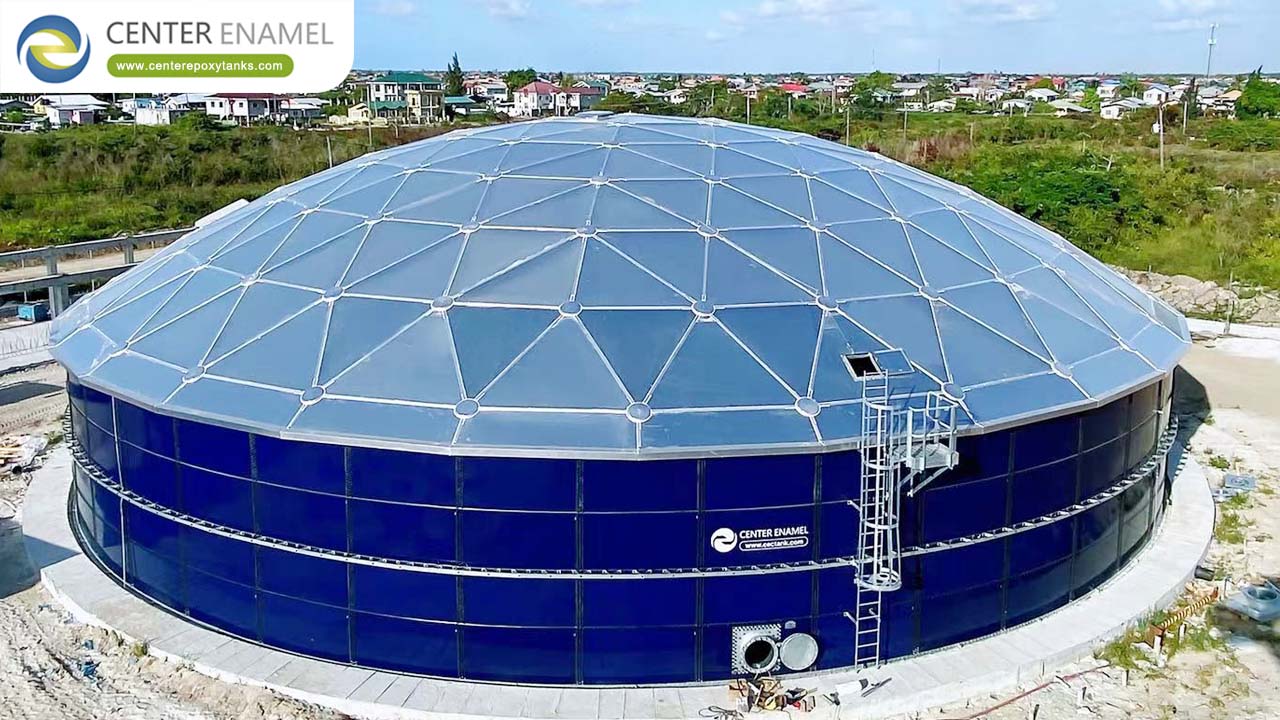
Aluminum Dome Roof vs. Steel Roof: Selecting the Right Tank Cover
Selecting the roof structure for a vertical storage tank is a lifecycle decision that balances upfront capital expenditure against long-term operational costs. While the Fixed Steel Roof has served as the industry default for decades, the Aluminum Geodesic Dome Roof has rapidly emerged as the modern standard for municipal and industrial applications.
This guide provides an engineering comparison between these two technologies to help project managers and engineers determine the optimal solution for their containment assets.
1. Aluminum Geodesic Dome Roofs: The Modern Standard
Aluminum domes are modular, space-frame structures engineered to meet the stringent requirements of API 650 Appendix G. They utilize a triangulated geodesic geometry that allows for clear-span coverage without internal support columns.
Key Engineering Advantages:
● Corrosion Immunity: Aluminum naturally develops a protective oxide layer, making it virtually immune to atmospheric corrosion in most environments, unlike steel which requires constant recoating.
● Self-Supporting Structure: Because the geodesic design transfers load to the tank perimeter, there is no need for internal support columns. This improves internal accessibility and prevents corrosion-prone column bases.
● Weight-to-Strength Ratio: Weighing roughly 1/3 of an equivalent steel roof, aluminum domes significantly reduce the structural load on the tank shell and foundation, often allowing for thinner shell walls in new designs.
● Operational Efficiency: The high reflectivity of aluminum reduces solar heat gain, minimizing product evaporation and emissions, which is critical for volatile hydrocarbon storage.
2. Fixed Steel Roofs: The Traditional Approach
The traditional fixed steel roof is typically a cone-supported structure consisting of carbon steel plates welded to structural rafter beams and supported by internal columns.
Typical Characteristics:
● Initial Cost: Historically lower in material acquisition cost compared to pre-engineered aluminum dome kits.
● Structural Limitations: For large-diameter tanks, steel roofs typically require interior support columns, which create potential leak points, interfere with internal floating roofs, and complicate tank cleaning/maintenance.
● Maintenance Burden: Steel is susceptible to oxidation. To maintain structural integrity, the roof must be periodically grit-blasted and coated/painted. In aggressive chemical or coastal environments, this maintenance cycle is frequent and expensive.
3. Direct Comparison Matrix
Engineering Metric | Aluminum Geodesic Dome | Fixed Steel Roof |
Material | Extruded Aluminum Alloys | Carbon Steel |
Corrosion Resistance | Excellent (Inherent) | Low (Requires Coatings) |
Maintenance | Minimal (None) | High (Regular Blasting/Painting) |
Internal Support | None (Clear Span) | Required (For large spans) |
Installation | Fast (Bolted/Modular) | Slow (Field Welding) |
Seismic/Load Stress | Low (Lightweight) | High (Heavy) |
Life Cycle Cost | Lowest | High (Due to maintenance) |
4. Critical Decision Factors
When choosing between these systems, evaluate the project against these four operational pillars:
1. Maintenance Cycles: If the tank is in a remote location or a harsh environment, the "no-maintenance" profile of aluminum is a massive operational advantage. Steel roofs require significant labor and downtime for recoating.
2. Product Compatibility: If the tank requires an Internal Floating Roof (IFR), the aluminum dome is superior. The clear-span nature prevents internal column interference, and the dome protects the IFR from wind, rain, and snow.
3. Construction Speed: Aluminum domes are factory-fabricated and bolted on-site, usually with small, semi-skilled crews using hydraulic jacking. Steel roofs involve intensive field welding, safety-critical hot-work, and heavy lifting.
4. Total Cost of Ownership (TCO): While the initial price tag of an aluminum dome may appear higher, the TCO over 20–30 years is almost universally lower due to the total elimination of painting and the reduction in potential tank-out-of-service time.
Why Aluminum is Winning
The shift from fixed steel roofs to Aluminum Geodesic Domes is driven by data-backed maintenance savings and operational reliability. For new large-diameter tanks, the elimination of internal columns and the reduction in foundation loads make aluminum the clear engineering choice. For existing tanks with aging steel roofs, "re-roofing" with an aluminum dome is a cost-effective way to extend asset life while simultaneously improving environmental compliance.


