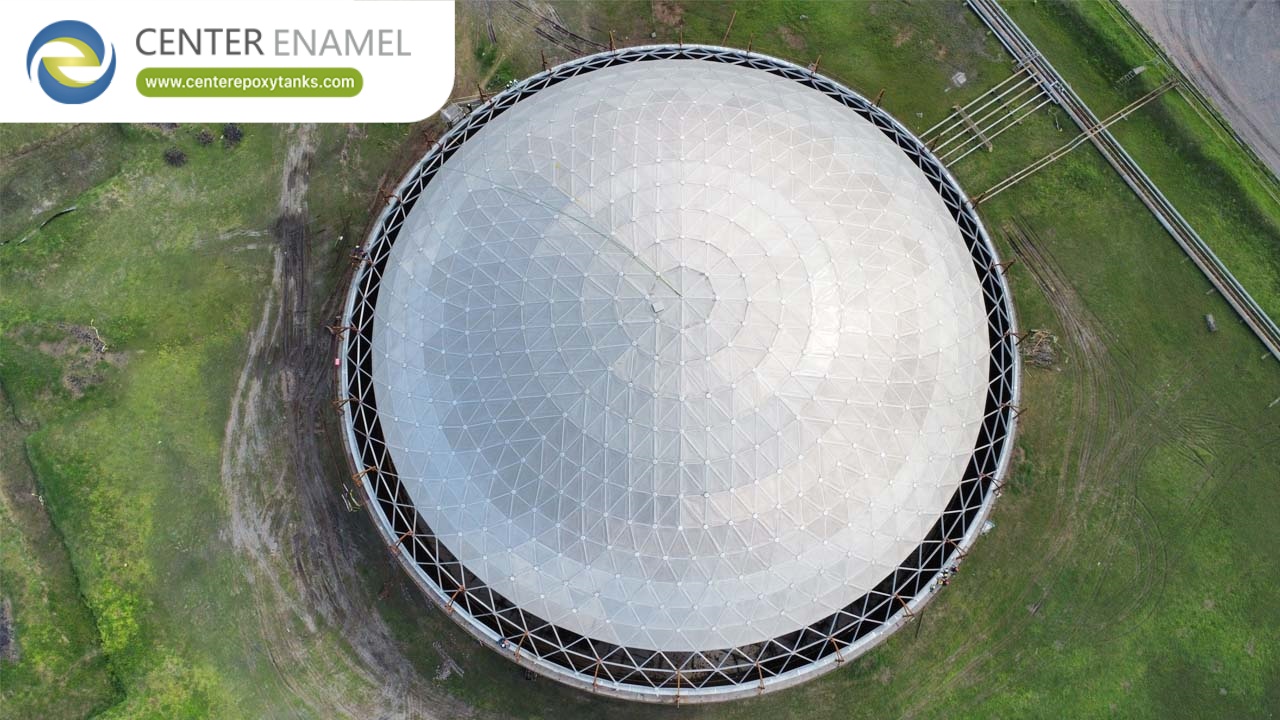
Aluminum Dome Roof Replacement
Replacement is the decision to remove an existing tank roof and install a new one — often an aluminum geodesic dome in place of a fixed cone or floating roof. This article covers when replacement is justified, how the roof-type comparison informs the choice, and the procedure and decision factors that keep a replacement from repeating the original problem.
Replacement Vs Repair Vs Retrofit
Replacement removes the old roof and installs a new one. Retrofit adds a dome onto a tank that did not have one (or had a different cover) and is covered separately. Repair fixes a localized fault. The three are different scopes with different costs.
Choosing replacement means the existing roof is beyond economic repair or no longer meets the service need. Confirm that with an assessment before committing to removal.
Why Replace With An Aluminum Dome
Common drivers: the existing fixed cone or floating roof has corroded, requires frequent repainting, vents vapor, or cannot support required penetrations. An aluminum dome offers clear-span coverage, no repainting, and a sealed cover that accepts access and vents.
The trade is cost and interface work: a dome must be connected to the tank rim correctly, and the tank must be capable of carrying the dome reaction. Replacement is not automatic just because a dome is 'better.'
Roof-Type Comparison For Replacement
Against a fixed cone roof, a dome gives clear span and lower maintenance but needs a sound rim. Against a floating roof (for volatile hydrocarbons), the dome solves vapor containment and access differently and is not a like-for-like substitute — the service determines the choice.
Match the replacement roof to the tank's actual service (potable, wastewater, hydrocarbon). A comparison that ignores service is a comparison of brochures, not of fit.
Assessing The Existing Tank
Before replacement, assess the tank shell, rim and foundation. A dome adds a reaction at the rim; if the rim or shell is degraded, it must be restored as part of the scope or the new dome will sit on a weak base.
Confirm diameter, rim geometry and any prior modifications. The replacement design depends on the as-is tank, not on the original drawing alone.
Replacement Procedure Outline
Sequence: isolate and empty/secure the tank, remove the old roof safely, repair the rim as needed, set the dome connection, assemble the dome (outside-in or inside-out), install penetrations and accessories, then inspect and accept.
Coordinate with tank operations and any confined-space or hot-work permits. The roof removal and dome set are the high-risk steps and deserve a separate method statement.
Replacement roof-type comparison
Factor | Fixed cone (old) | Aluminum dome (new) |
Span | May need columns | Clear span |
Maintenance | Repaint cycles | No repaint |
Vapor | Open/vented | Sealed cover |
Access | Limited | Walkable + penetrations |
Rim demand | Lower | Must be sound |
Penetrations During Replacement
Replacement is the moment to correct past penetration mistakes: reinstate them with proper reinforcement and a capacity check, and consolidate redundant openings. Do not carry forward a bad detail into the new roof.
Provide the penetration schedule with loads so the new dome is built for them, not modified for them after the fact.
Cost And Downtime Factors
Replacement cost includes removal, rim repair, the new dome, accessories and downtime. A dome's lower life-cycle cost can justify a higher capital outlay if the old roof's upkeep was heavy.
Quantify downtime against the old roof's recurring maintenance. The replacement decision should show a lifecycle argument, not just a capital one.
Acceptance Of The New Roof
Accept by document review (certs, calculations) and physical checks (fit-up, torque, seal continuity, connection to rim). Use the same criteria as a new-dome acceptance; replacement is still a new-structure install.
Retain the as-built and QA records with the tank file so future inspectors see a continuous story from old removal to new acceptance.
Avoiding A Like-For-Like Mistake
If the original roof failed because it was the wrong type for the service, replacing it with the same type repeats the failure. Let the service and assessment drive the choice.
A replacement is also an opportunity to add capacity or access the old roof lacked — but only if the tank can carry it. Specifying beyond the tank's capacity is a design error, not an upgrade.
When Replacement Is Not Warranted
If the existing roof is sound and meets service needs, repair or continued monitoring is the better use of budget. Replacement should answer a defined deficiency, not a preference.
Document the rationale either way. An unexplained replacement spends capital; an unexplained decision to keep a failing roof spends it later, as an emergency.
Replacement decision factors
Factor | Favors replacement | Check first |
Old roof | Corroded / frequent paint | Rim condition |
Service | Needs sealed cover | Tank capacity |
Lifecycle | High upkeep old | Downtime cost |
Penetrations | Many / wrong | Reinforce plan |
Planning The Replacement Project
Treat replacement as a small project: scope, assessment, design, permits, removal method, dome supply, installation, inspection and handover. Each step has an owner and a check.
The payoff is a tank whose new roof matches its service and whose records support the next decade of operation.
Frequently Asked Questions
Q: Is replacement the same as retrofit?
A: No. Replacement removes the old roof and installs a new one; retrofit adds a dome to a tank that lacked one or had a different cover.
Q: Why replace a cone roof with a dome?
A: For clear-span coverage, no repainting, a sealed cover and support for penetrations — if the tank rim can carry the dome reaction.
Q: Can a dome replace a floating roof?
A: Only if the service suits a dome; a floating roof controls vapor space for volatile hydrocarbons, which a dome addresses differently. Service decides.
Q: What must be assessed before replacement?
A: The tank shell, rim and foundation, because the dome adds reaction at the rim that a degraded tank cannot carry.
Q: How is the new roof accepted?
A: By document review (certs, calculations) and physical checks (fit-up, torque, seal continuity, rim connection), like a new-dome install.
Q: When is replacement not warranted?
A: When the existing roof is sound and meets service needs; then repair or monitoring is the better use of budget.
Conclusion
Aluminum geodesic dome roofs are selected, designed and maintained as structural systems, not as standalone covers. The articles in this batch treat each angle — from OEM sourcing and tender specification to retrofit, corrosion, loads, accessories, applications and manufacturing — as a distinct user task with its own evidence and boundaries.
Work With Center Enamel
Center Enamel (Shijiazhuang Zhengzhong Technology Co., Ltd) has manufactured bolted and welded storage tanks since 2008 from its base in Shijiazhuang, China. The company produces GFS (Glass-Fused-to-Steel), FBE-coated, galvanized, stainless-steel and welded tanks, aluminum geodesic dome roofs, floating roofs, pressure vessels, and wastewater and biogas engineering packages. Its quality system carries ISO 9001, and aluminum dome roofs are designed to AWWA D108, API 650, ADM 2015, ASCE 7-10 and IBC 2012. With an installed base of 30,000+ projects and 300,000 enamel steel plates produced annually, Center Enamel supports drinking-water, municipal, industrial, petroleum, dry-bulk and architectural applications.
Considering replacing a tank roof? Contact Center Enamel to assess the tank rim and service, and to size an aluminum dome replacement that fits rather than repeats the old problem.
Project Case Reference
Reference (cover-only, not a verified tank case): Brazil Drinking water (cover-only reference) — aluminum dome roof, Ø20.64 m diameter. This is a dome-cover reference with diameter and application on record; it is disclosed as a C-grade reference and is not cited as a full tank-project delivery.


