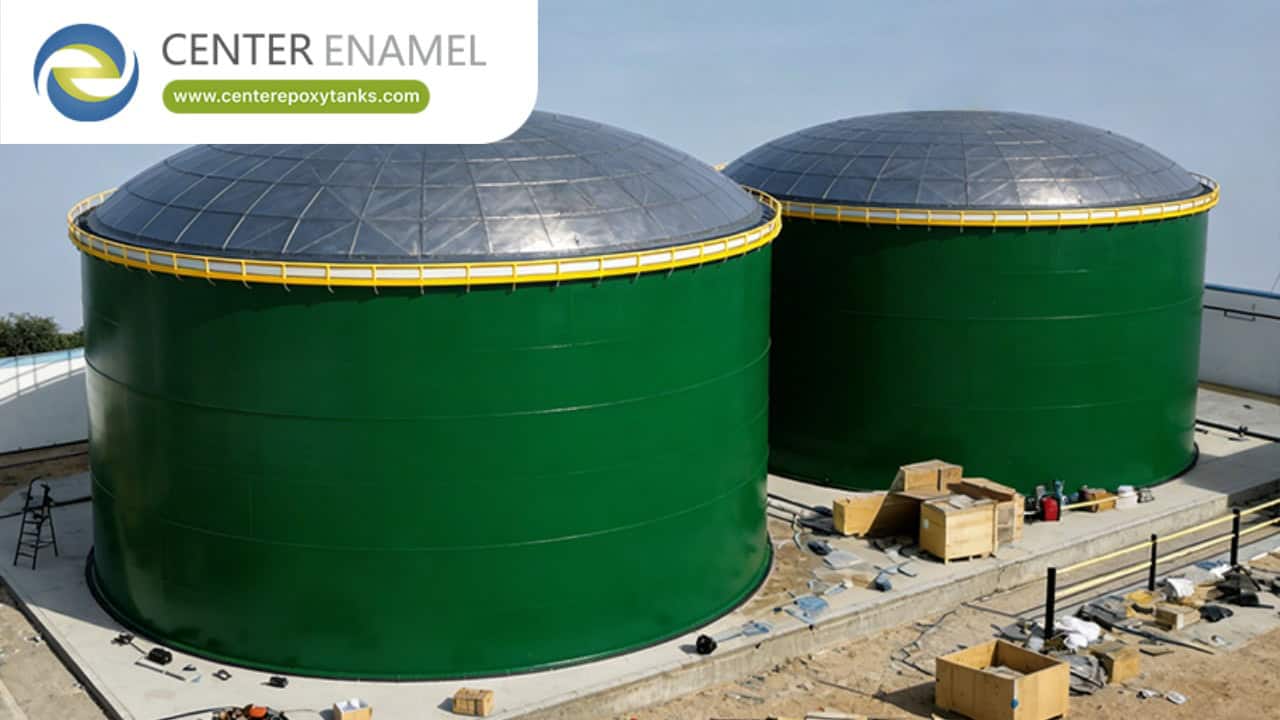
Aluminum Dome Roof For Storage Tanks: Compatibility And Installation Interface
An aluminum dome roof is supplied as a cover that connects to the top of a storage tank rather than a standalone vessel. This article covers how the dome interfaces with bolted, welded and concrete tank shells, the fitment details that matter, and what to confirm before specifying one.
Dome As A Tank Cover, Not A Tank
The aluminum dome is the top closure of a tank. The tank body — GFS, FBE, stainless, galvanized, welded or concrete — provides the primary containment; the dome provides weather, vapor and access control above the design water or product level.
This separation matters for specification: the dome supplier and the tank supplier must coordinate shell tolerance, rim elevation and load path.
Compatibility With Tank Types
Domes are used on bolted (GFS/FBE), welded and concrete tanks. The connection method differs: bolted tanks may use a bolted curb or adapter ring, while concrete tanks use cast-in or post-installed anchors.
Center Enamel has supplied aluminum dome roofs on GFS drinking-water tanks — for example an Indonesia drinking-water project (2025) with a single Ø42.04 m × 15.2 m GFS tank of 21,099 m³ fitted with an aluminum dome roof.
The Curb / Adapter Ring Interface
A perimeter curb or adapter ring transfers dome thrust into the tank shell. Its geometry must match the dome radius and the tank rim; misalignment causes panel fit-up problems on site.
The ring also provides the primary air/vapor seal plane. Detailing here prevents leaks and controls the tank's breathable or sealed behavior.
Ventilation And Vapor Management
Domes accommodate roof vents, vacuum/ pressure relief and, where needed, gas collection. Penetrations are framed with aluminum curbs and sealed with the same gasket system.
For covered anaerobic or sludge tanks, the dome can support biogas piping; for atmospheric water tanks it supports screened vents that exclude debris and birds.
Access, Hatches And Penetrations
Manways, walkways, nozzles and mixer or gauge penetrations are framed into the dome. Because the dome is clear-span, access can be placed anywhere without column conflict.
Each penetration is a custom aluminum fabrication, so the layout should be fixed early to avoid field modifications.
Seismic And Wind Considerations
The dome's low profile reduces wind catch versus a tall cone or open frame. Seismic loads are carried through the triangulation to the perimeter ring and then the tank shell/foundation.
Design must follow ASCE 7-10 and IBC 2012 for the site; the tank and dome are analyzed as one system where they share the rim.
Installation Interface Sequence
Typical sequence: verify rim elevation and tolerance, set the curb/adapter ring, then build the dome outside-in or inside-out using the proprietary jack/hoist system.
Coordination with tank erection is essential — the dome is best installed after the shell is plumb and the rim is confirmed.
Load Path Into The Tank
Gravity and environmental loads travel along struts to the perimeter ring, then into the tank shell and foundation. The tank must be designed for the dome reaction at the rim.
For existing tanks, a structural check confirms the shell and foundation can accept the dome thrust before supply.
Fitment Verification Checklist
Confirm tank rim diameter and tolerance, shell material and thickness, design liquid/product level, required freeboard, penetrations, and local wind/snow/seismic loads.
A supplier should return a fitment drawing and stamped calculations before fabrication begins.
Common Fitment Mistakes
Underestimating rim tolerance, omitting the curb ring, and placing penetrations without early coordination are the usual causes of site delay.
Resolving these in the design phase avoids field cutting of aluminum, which is difficult and weakens the structure.
When A Dome Is The Right Choice
Choose a dome when you need a low-maintenance, corrosion-resistant, clear-span cover with controlled vapor and access — common for water, wastewater, fuel and bulk storage.
For very small or temporary tanks, a simpler cap may be more economical; the dome pays off on larger spans and demanding service environments.
Retrofitting An Existing Tank
For an existing tank, the first step is a structural re-check of the shell and foundation for the dome thrust at the rim. Older tanks may need a stiffer curb or local reinforcement before a dome is supplied.
The adapter ring is then detailed to the as-built rim. Field measurement of the actual diameter and out-of-roundness is essential; do not rely on the original drawing alone.
Commissioning And Handover
At handover, verify the seal continuity at the rim and every node, confirm penetrations are framed and gasketed, and review the as-built drawings and calculations.
A simple water-tightness or visual seal check closes out the work. Document the gasket type and spare-part list for future inspection.
Verifying The Load Path
Before supply, confirm the rim reaction is within the tank shell and foundation capacity. The dome thrust is concentrated at the perimeter, so this check is non-negotiable for an existing tank.
A supplier should return a load summary at the curb ring that the tank engineer can verify against the as-built structure.
Specification Errors To Avoid
Common errors are omitting rim tolerance, placing penetrations without early coordination, and assuming the dome needs no tank-side check. Each causes site delay or field cutting of aluminum.
Capturing these in the specification prevents the most frequent rework on dome retrofits.
Coordinate Early With The Tank Supplier
The single biggest success factor is early coordination: the dome supplier needs the tank rim diameter, tolerance, shell material and design level, while the tank supplier needs the dome reaction at the rim. Exchanging these before fabrication prevents mismatched parts on site.
A joint fitment drawing signed by both parties is the practical output of this coordination and should be a contract deliverable, not an afterthought discovered during erection.
Practical Fitment Checklist
Confirm, in writing: rim diameter and out-of-round tolerance, shell thickness and material, design liquid or product level, required freeboard, all penetrations with sizes and positions, and local wind, snow and seismic parameters. Each item drives a detail in the dome or curb design.
With this checklist closed, the dome arrives as a kit that assembles to the tank without field modification - the outcome every owner wants.
Tank type | Interface method | Key check |
Bolted GFS/FBE | Bolted curb / adapter ring | Rim tolerance, shell plumb |
Welded steel | Welded or bolted ring | Shell thickness, load path |
Concrete | Cast-in / post anchors | Embed plate location |
Existing tank | Structural re-check | Rim capacity for dome thrust |
Interface item | What to specify |
Curb ring | Geometry matching dome radius |
Vents | Type, size, location |
Penetrations | Count, size, early fix |
Seal | Gasket plane at rim |
Project Case Reference
Indonesia — Drinking water. Tank: GFS (Glass-Fused-to-Steel) bolted tank. Configuration: 1 unit, Ø42.04 m × 15.2 m. Total volume: 21,099 m³. Year: 2025.
Reference from case_anchors.py: the aluminum dome roof was the supplied cover on this GFS drinking-water tank (B-grade evidence — dome is the cover, tank body is GFS).
Frequently Asked Questions
Can an aluminum dome fit an existing tank?
Yes, provided a structural check confirms the rim and foundation can accept the dome thrust; a curb or adapter ring bridges the shell to the dome.
Does the dome replace the tank?
No. The dome is the cover; the tank body provides primary containment.
How is the dome sealed to the tank?
Through a perimeter curb/adapter ring and silicone gaskets at the rim, forming the primary vapor seal plane.
Can I add vents and hatches?
Yes, penetrations are framed in aluminum and sealed; they should be fixed early in design.
What about wind and seismic?
The low-profile triangulated dome follows ASCE 7-10 and IBC 2012; loads pass to the tank shell and foundation.
What is the fitment checklist?
Rim diameter/tolerance, shell material, liquid level, freeboard, penetrations, and local wind/snow/seismic loads.
Work With Center Enamel
Center Enamel (Shijiazhuang Zhengzhong Technology Co., Ltd) is a Chinese manufacturer of bolted storage tanks and aluminum geodesic dome roofs, established in 2008. Its product range covers Glass-Fused-to-Steel (GFS) tanks, Fusion-Bonded Epoxy (FBE) tanks, galvanized and stainless-steel tanks, welded tanks, pressure vessels, and aluminum dome roofs. The company holds ISO 9001, NSF, WRAS, FM, CE/EN 1090 and ISO 28765 certifications for its tank lines and designs aluminum domes to AWWA D108, API 650, ADM 2015, ASCE 7-10 and IBC 2012. It operates automated enamel-plate production and has supplied engineering projects across drinking-water, wastewater, biogas, fire-water and industrial-storage applications.
For aluminum geodesic dome roofs engineered to AWWA D108, API 650, ADM 2015, ASCE 7-10 and IBC 2012, contact Center Enamel to discuss your tank cover, span and site requirements. Reach the team at sales@cectank.com or through cectank.com for a project-specific proposal.


