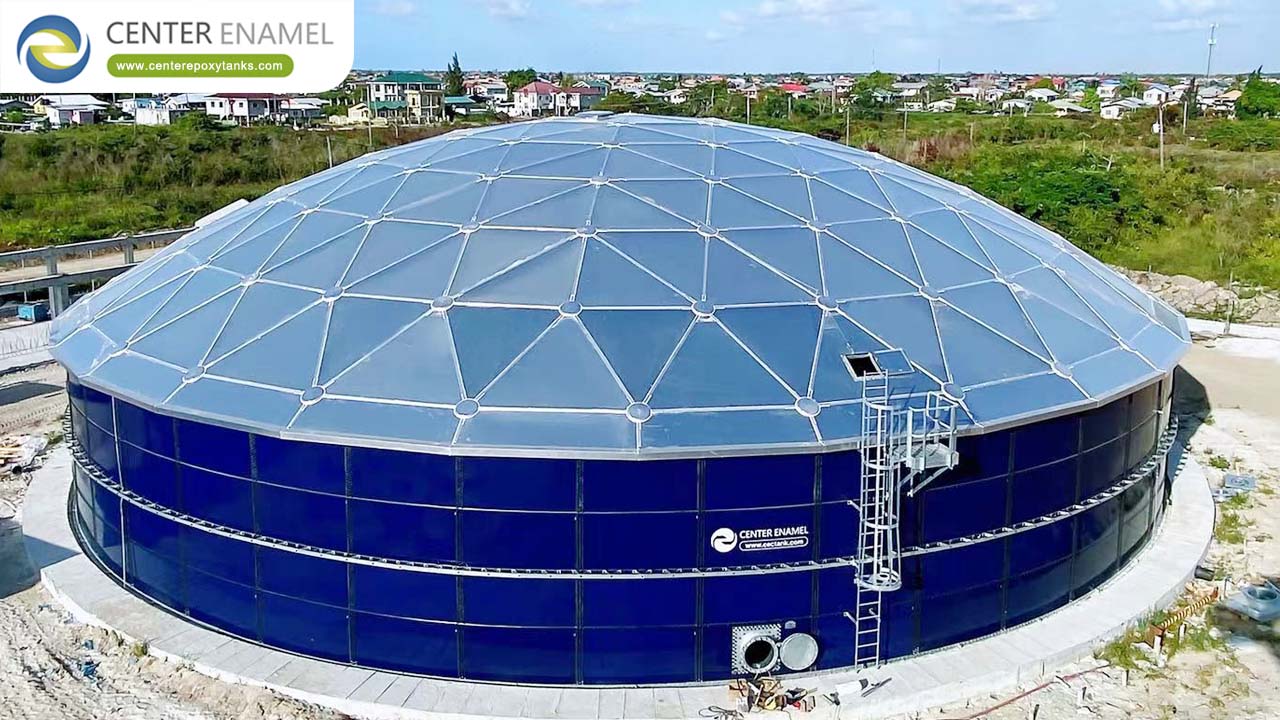
Aluminium Geodesic Domes for Fuel Oil Storage: Engineering & Procurement Guide
For bulk liquid storage, the "roof" of the tank is the primary defense against environmental contamination and product loss. Aluminium geodesic domes have become the industry standard for external fuel oil storage. Unlike traditional cone-roof tanks that require internal support columns, geodesic domes provide a lightweight, clear-span structure that is naturally corrosion-resistant, significantly reducing maintenance costs and ensuring long-term regulatory compliance for VOC (Volatile Organic Compound) emission control.
1. Why Aluminium Domes for Fuel Storage?
Fuel oil storage requires infrastructure that can withstand harsh environments without compromising the integrity of the fuel. Aluminium geodesic domes offer three critical advantages over traditional steel or concrete roofs:
● Corrosion Resistance: Aluminium naturally forms a protective oxide layer. In fuel storage applications, where moisture often collects on the tank roof, the self-healing properties of aluminium prevent the scaling and rust that plague carbon steel roofs, effectively eliminating the need for periodic painting.
● Clear-Span Design: The geodesic geometry allows the structure to support itself without internal columns. This is critical for fuel storage, as it allows for the installation of floating internal roofs or floating membranes without interference from structural supports.
● Weight Efficiency: The lightweight nature of aluminium reduces the load on the tank shell and foundation, which often allows for thinner tank wall specifications (based on seismic and dead-load calculations), reducing overall project CAPEX.
2. Engineering Standards & Design compliance
When specifying a geodesic dome for a fuel tank, strict adherence to global safety and design standards is non-negotiable.
Core Standards
● API 650 (Appendix G): The primary benchmark for "Structurally Supported Aluminium Dome Roofs." It governs the design, materials, fabrication, and erection of these structures.
● Structural Load Calculations: The dome must be designed to withstand local environmental loads, including snow, wind, and seismic activity. The structural stability is determined by:
VOC Emission Control
Geodesic domes act as a total physical barrier to the elements. When paired with an internal floating roof or membrane, they create a "double-seal" effect, virtually eliminating evaporative loss of light fuel oils.
3. Comparative Performance: Dome vs. Traditional Roofs
Feature | Aluminium Geodesic Dome | Fixed Steel Cone Roof | Concrete Dome Roof |
Corrosion Resistance | Excellent (Inherent) | Low (Requires coating) | High (Requires lining) |
Clear-Span | Yes | No (Needs columns) | Yes |
Installation Speed | Fast (Prefabricated) | Slow (Field Welding) | Very Slow |
Maintenance | Minimal | High (Repainting) | Moderate |
Seismic Performance | High (Lightweight) | Moderate | Low (High mass) |
4. Procurement Vetting Matrix
To ensure the quality of your dome infrastructure, audit your manufacturer using the following procurement benchmarks:
● Alloy Specification: Verify the use of high-strength structural aluminium alloys (e.g., 6061-T6 or 6063-T6).
● Fastener Material: Insist on 300-series stainless steel fasteners with EPDM gaskets. Using carbon steel bolts in an aluminium frame is a primary cause of galvanic corrosion and structural failure.
● Panel Tolerances: Ensure the dome panels are machine-formed to strict tolerances; deviations here lead to leaks and "oil canning" (warping) of the roof surface.
● Sealing Systems: Check for "flush-batten" or high-quality gasket designs that provide an airtight seal to prevent the ingress of rainwater, which is the leading cause of tank bottom sludge buildup.
Frequently Asked Questions (FAQ)
Q: Can a geodesic dome support walkways and equipment?
A: Yes. Aluminium geodesic domes are modular structures. Loads from walkways, level sensors, and ventilation systems are distributed across the entire frame. However, these loads must be defined during the design phase so the structural frame can be engineered to accommodate the additional weight.
Q: How does the dome behave in high-wind regions?
A: Geodesic domes have an aerodynamic shape that naturally sheds wind loads. Unlike flat-top roofs, they are highly resistant to uplift forces. Reputable manufacturers will provide a wind-load report specific to the tank's location (e.g., ASCE 7 or local building codes).
Q: Is it cost-effective for smaller tanks?
A: While geodesic domes are the standard for large bulk storage ($>20text{m}$ diameter), they can be cost-effective for smaller tanks when you factor in the 40+ year maintenance savings compared to carbon steel roofs.
Are you currently in the design phase for a new storage facility, or are you looking to retrofit existing fixed-roof tanks to comply with stricter environmental emission regulations?


