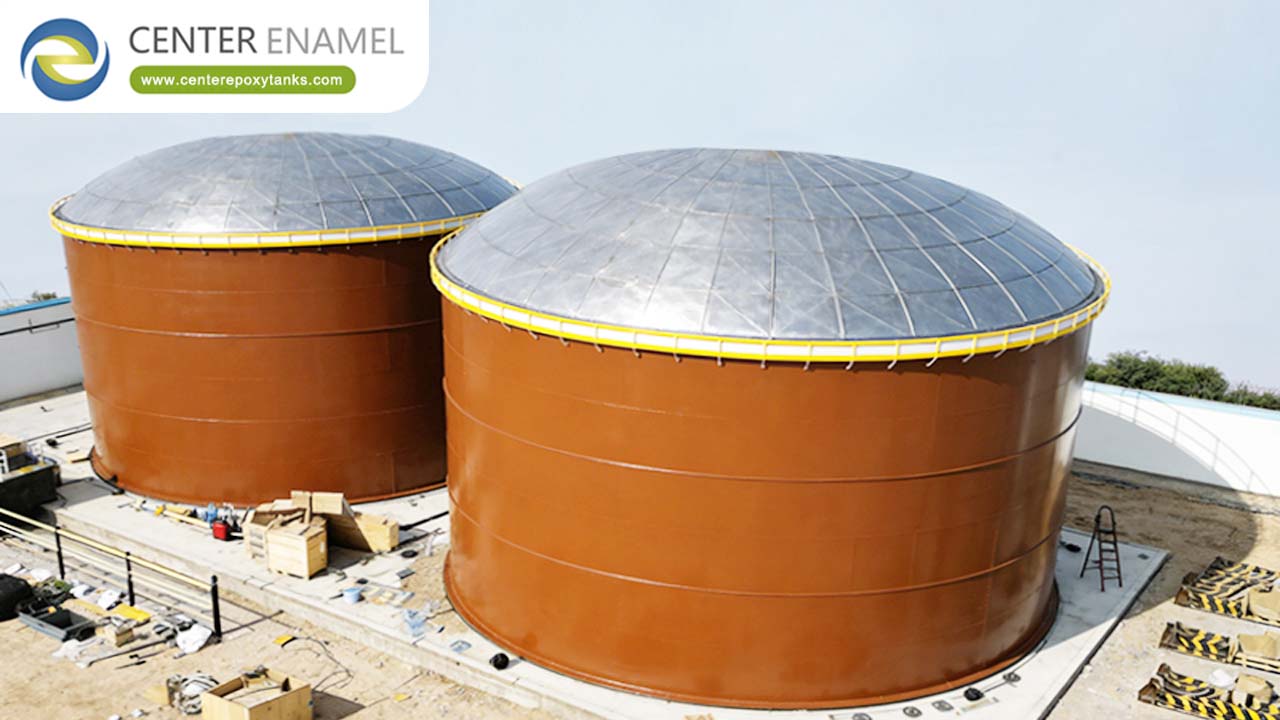
Protecting Agricultural Assets: Silos with Aluminum Dome Roofs
In large-scale agricultural storage, the roof is the most vulnerable point for structural fatigue, moisture ingress, and environmental degradation. As global demands for food security increase, facility managers are upgrading to Aluminum Dome Roofs for their grain and feed silos. Exported globally by Center Enamel, these structures offer a maintenance-free, clear-span solution that shields valuable agricultural harvests from extreme weather and contamination.
The Engineering Advantage of Aluminum Geodesic Domes
Traditional silo roofs—often made of carbon steel or concrete—frequently struggle with corrosion, require expensive periodic painting, and rely on internal columns that obstruct storage volume. Center Enamel’s aluminum dome roofs solve these challenges through geodesic engineering.
1. Immunity to Corrosion
Aluminum naturally forms a protective, self-healing oxide layer, making it immune to atmospheric rust and highly resistant to the corrosive fertilizers or high-humidity environments common in agricultural settings. Unlike carbon steel roofs that demand costly recoating cycles, aluminum domes are virtually maintenance-free.
2. Clear-Span Structural Efficiency
The geodesic design distributes structural loads to the perimeter of the silo, removing the need for internal support columns. This clear-span geometry maximizes usable storage space, simplifies discharge systems, and eliminates "dead zones" where moisture or pests typically accumulate.
3. Lightweight Yet Robust
Despite their high strength-to-weight ratio, these roofs significantly reduce the dead load on the silo walls and foundation. This lightweight construction allows for easier retrofitting onto existing agricultural infrastructure without requiring major foundation upgrades.
Performance Matrix: Silo Roof Technologies
Feature | Aluminum Dome Roof | Conventional Steel Cone Roof | Concrete Roof |
Corrosion Resistance | Excellent (Inert) | Low (Requires Coating) | Moderate (Crack-prone) |
Maintenance | Minimal/None | High (Periodic Painting) | High (Crack Sealing) |
Internal Supports | Clear Span (None) | Columns Required | Columns Required |
Installation Speed | Fast (Modular) | Slow (Field Welding) | Very Slow (Civil Works) |
Moisture/Pest Control | High (Tight Seals) | Low | Moderate |
Why Choose Center Enamel for Global Export?
Center Enamel is not just a manufacturer; we are a global storage partner. Our expertise in EPC (Engineering, Procurement, and Construction) project management ensures that every agricultural silo and dome component meets international safety standards.
Precision Manufacturing: Our modular components are fabricated using advanced computer-controlled machinery, ensuring a precise fit that guarantees an airtight seal against moisture and pests.
Customized Engineering: We tailor every dome design to the specific silo diameter and local environmental loads—accounting for extreme wind speeds, heavy snow loads, and seismic activity.
Global Export Expertise: We have successfully exported storage solutions to over 100 countries. Our logistics team specializes in efficient, secure crating and shipping, ensuring that your dome components arrive on-site ready for rapid assembly.
Frequently Asked Questions (FAQ)
Q: Are aluminum dome roofs suitable for extreme weather (high wind/snow)?
A: Yes. The geodesic triangulated geometry is mathematically optimized to distribute vertical and lateral loads. They are engineered to withstand extreme weather conditions, including high wind speeds and significant snow accumulation, often far surpassing conventional steel designs.
Q: How do you prevent galvanic corrosion when mounting an aluminum dome on a steel silo?
A: This is a standard procedure in our engineering process. We utilize isolation gaskets, nylon washers, and specialized hardware at all connection points to break the electrical contact between the aluminum dome and the steel silo wall, effectively preventing any galvanic reaction.
Q: Can aluminum dome roofs be retrofitted onto existing agricultural silos?
A: Absolutely. Their lightweight design makes them ideal for modernizing aging silos that may not support the dead load of a heavy steel or concrete replacement roof. Our modular construction allows for assembly on the ground and lifting into place, minimizing facility downtime.
Q: How do these roofs help with grain quality?
A: By providing a weather-tight, vapor-controlled environment, aluminum domes prevent moisture ingress—which causes clumping and mold—and minimize UV heat absorption, maintaining a more stable temperature inside the silo compared to metallic roofs.
Are you evaluating a large-scale agricultural storage project requiring durable, low-maintenance roofing? [Contact the Center Enamel engineering team] today for a technical consultation or a custom design proposal tailored to your facility's requirements.
Expert Follow-Up Question: To best assist with your technical planning, are you currently looking to design a new greenfield grain terminal or are you retrofitting an existing storage facility to extend its operational lifespan?


