Affordable Biogas Holders For Rural Energy Projects: Cost Engineering Guide
Rural biogas projects fail on economics more often than on engineering. The technology works; the capital budget is the constraint. Every cost reduction that does not compromise safety or tightness therefore matters — and the biggest lever is standardization. A holder engineered once and replicated across a size range carries a fraction of the engineering cost of a bespoke design, and it can be specified, priced and financed as a product.
This article covers the cost engineering of rural biogas holders: the cost drivers, the standardization strategy, and the package structure that makes projects financeable.
Cost Drivers In Holder Supply
Holder cost is driven by membrane area, steel structure, control system scope and engineering hours. Membrane area scales with capacity; control scope scales with instrumentation and integration; engineering hours scale with how bespoke the design is. The first two are physics; the third is a business decision.
For rural projects, the control scope is where over-specification hides. A holder serving a simple boiler needs pressure control and relief — not a full plant-control integration.
Cost Driver | Scales With | Standardization Lever |
Membrane area | Storage capacity | Geometric scaling of a base design |
Steel structure | Capacity and load cases | Shared member sizes across the range |
Control system | Instrumentation count | Standard control package per class |
Engineering hours | Design bespoke-ness | Documented design range, verified per step |
The Standardization Strategy
Standardization means a design range: a family of holder sizes sharing geometry, materials, details and documentation. Engineering is done once per family member and replicated, fabrication tooling is amortized across the range, and the documentation package is templated.
The design range must still cover the capacity band rural projects actually need — typically from a few hundred to a few thousand cubic meters — with enough size steps that projects can select rather than commission.
Scaled Designs And Capacity Steps
The practical approach is geometric scaling: a base design scaled through the capacity band with verified load cases at each step. Each step is a documented design, not an interpolation — the load checks, relief sizing and membrane stress analysis are run per size.
The output is a catalog the project can select from, which converts a bespoke engineering exercise into a specification exercise — and that conversion is where the cost reduction lives.
Design Range Element | Standardized Content | Verified Per Step |
Membrane geometry | Scaled panel layout | Stress at working pressure |
Relief sizing | Standard relief set | Setpoints vs membrane limits |
Control package | One package per tightness class | Band across full stroke |
Documentation | Templated dossier | Actual size and site data |
Financing-Friendly Packages
Rural projects are frequently financed — by development banks, energy programs or farmer cooperatives — and financiers price scope clarity. A package that specifies the complete system (holder, digester interface, controls, commissioning) as one deliverable with one performance specification is easier to finance than a components list.
The package structure also simplifies procurement: one supplier, one specification, one performance guarantee, one documentation set. The coordination risk that multi-supplier projects carry disappears from the project’s risk register.
Simplicity As A Cost Strategy
The cheapest holder to own is the one farm staff can operate. Simplicity is therefore a cost strategy, not a compromise: fewer instruments, clearer setpoints, maintenance procedures that fit a farm’s capability rather than a plant’s.
This does not mean compromising safety systems. Relief, detection and pressure control are non-negotiable; it means specifying them at the level the application needs and no further.
Erection And Site Cost
Site cost is dominated by erection duration and equipment. Membrane systems erect quickly with light equipment, and standardized designs come with erection procedures the crew can follow without engineering support on site. The erection plan is part of the standardized design.
For rural sites with limited access, the delivery packaging is part of the design: panels and membrane kits sized for the available transport and lifting.
Maintenance Cost Over The Life
Lifecycle cost includes membrane replacement, blower service and seal replacement. Standardized designs carry documented spare-parts lists and maintenance procedures, so the operating cost is predictable rather than discovered.
Predictable operating cost is what makes rural projects bankable: the financier models the lifecycle, and a documented maintenance regime is a better input than an estimate.
Lifecycle Cost Item | Standardized Design Benefit |
Membrane replacement | Documented panel and seam details |
Blower service | Standard unit, documented spares |
Seal replacement | Standard seal detail, procedure |
Relief testing | Documented setpoints and test method |
Government And Program Context
Rural biogas programs — agricultural waste utilization, rural energy access, emission reduction schemes — frequently come with technical standards and subsidy structures. Designing to the program’s standards from the start is what makes the project eligible, and the documentation requirements are part of the design scope.
Center Enamel’s rural project experience spans these program contexts, and our documentation packages are structured to satisfy program review as well as engineering review.
Case For Modular Expansion
Rural energy projects rarely know their final scale on day one: the herd grows, the feedstock contracts arrive, the cooking-gas demand spreads through the village. A holder sized for the initial feedstock strands capacity later; a holder sized for the hoped-for scale strands capital now. The modular answer starts with the volume the current feedstock supports and engineers the site for the units the plan anticipates.
Modular expansion works because the incremental unit is a repeat of the first: the same standardized design, the same fabrication line, the same erection procedure. The cost of the second unit is lower than the first, and the site works — foundations, piping, gas train — are laid out at the start so the expansion is a connection exercise rather than a rebuild.
Training And Operating Discipline
The cheapest holder to own is the one operated as designed, and in rural settings that means the operator has been trained on the pressure band, the relief system and the blower, and knows which readings mean what. Most membrane failures in small installations trace to operating errors — an untended blower, a relief setpoint defeated because it was noisy — rather than to fabrication defects.
The training deliverable is part of the supply, not an extra: operating procedures in the operator’s language, a laminated setpoint card at the control panel, and a defined escalation contact for the first season. Projects that budget for this from the start spend their maintenance money on gaskets; projects that do not spend it on membranes.
Center Enamel Standardized Holder Designs
Center Enamel supplies standardized biogas holder designs with rural project experience across agricultural scopes, from a documented capacity range with verified load cases at each step. Our packages specify the complete system — holder, digester interface, controls and commissioning — as one deliverable.
For rural energy projects, we engineer for the farm’s economics: standardized designs, predictable maintenance and documentation that satisfies both the engineer and the financier.
Project Case Study
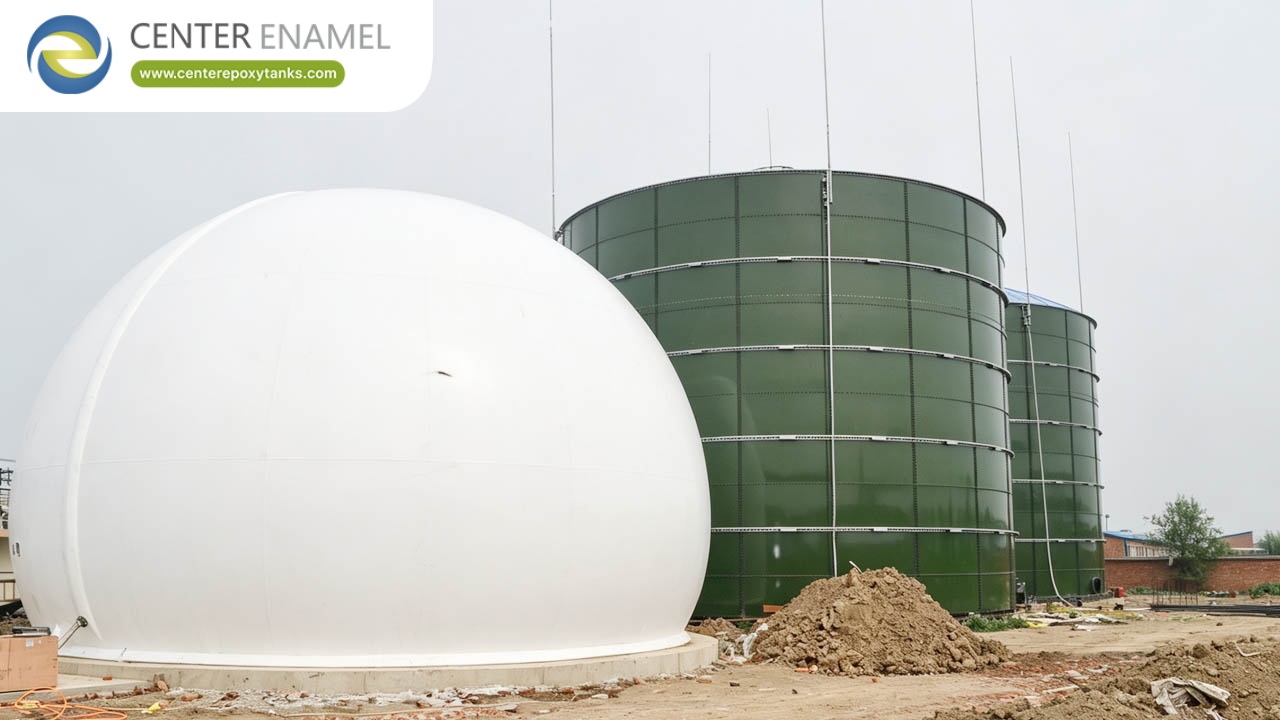
A Jiangsu livestock operation required digestion and gas storage capacity for a rural-scale energy project, with capital efficiency as a governing constraint. Center Enamel supplied a glass-fused-to-steel bolted tank at 20.63 m diameter by 8.4 m height, totaling 2,808 m3, configured for the project’s digestion and gas storage duty.
The GFS tank system provides the vitreous enamel interior that livestock wastewater chemistry demands, with the double membrane roof system delivering controlled-pressure gas storage for the energy recovery train. The project was delivered complete in December 2021 with coating inspection records for the operating baseline.
Project Reference | 01 China Jiangsu Livestock Wastewater 202112 |
Location | China |
Application | Livestock Wastewater |
Product / Technology | Glass-Fused-to-Steel (GFS) Bolted Tank |
Tank Count | 1 |
Tank Dimensions | φ20.63*8.4m(H), 1 unit |
Total Volume | 2808 m3 |
Completion | Delivered and completed 2021-12 |
Supply Scope Note | A relevance grade to this topic |
About Company
Shijiazhuang Zhengzhong Technology Co.,Ltd(Center Enamel) is a professional manufacturer dedicated to the design and fabrication of bolted storage tanks since 2008. Our products range includes Glass-Fused-to-Steel (GFS) tanks, fusion bonded epoxy tanks, stainless steel tanks, galvanized steel tanks and aluminum geodesic dome roofs. With professional enameling R&D team and nearly 200 enameling patents, Shijiazhuang Zhengzhong Technology Co.,Ltd has become the leader in bolted tanks industry of Asia. Our products are certified to ISO9001, NSF61, EN1090, ISO28765, WRAS ,FM, LFGB, BSCI, IS0 45001 and other international standards.
Shijiazhuang Zhengzhong Technology Co., Ltd is not only the first manufacturer in China which produces Glass-Fused-to-Steel tanks, but also the most experienced professional bolted tanks manufacturer in Asia.The engineering & design, product testing and quality system of Center Enamel Glass-Fused-to-Steel tanks is in strict accordance with AWWA D103-09, OSHA, ISO 28765, NSF/ANSI 61, NFPA and other international standards. Until 2023, Center Enamel bolted tanks have been exported to more than 100 countries including USA, Australia,Canada, Malaysia, Indonesia, Russia, UAE, Panama,Brazil and South Africa etc., the superior tank quality and prompt service gains us worldwide recognition.
As an outstanding containment and cover system provider with decades of industry experience, Shijiazhuang Zhengzhong Technology Co., Ltd sincerely expects to establish long-term cooperation with the local partners throughout the world and make continuous contribution to the development of the industry.
Suggested CTA
Center Enamel delivers double membrane / gasholder engineered for rural biogas storage duty, with standardized holder designs, rural project experience. Contact our engineering team for selection and procurement guidance on your next biogas holder rural energy project — including sizing, standards compliance and delivery scheduling.
Frequently Asked Questions
Q: What drives biogas holder cost?
A: Membrane area (scales with capacity), steel structure, control system scope, and engineering hours. The first two are physics; the engineering hours are a business decision — and standardization is the lever that reduces them.
Q: How does standardization reduce cost?
A: Engineering is done once per design-family member and replicated, fabrication tooling amortizes across the range, and documentation is templated. It converts a bespoke engineering exercise into a specification exercise.
Q: What makes a biogas project financeable?
A: Scope clarity: a package specifying the complete system — holder, digester interface, controls, commissioning — as one deliverable with one performance specification. One supplier, one specification, one guarantee, one documentation set.
Q: Does simplicity compromise safety?
A: No. Relief, detection and pressure control are non-negotiable. Simplicity means specifying them at the level the application needs — a boiler-duty holder does not need plant-control integration — and documenting maintenance procedures the farm can execute.
Q: What is the typical capacity range for rural biogas holders?
A: From a few hundred to a few thousand cubic meters, which is the band standardized design ranges cover. The capacity step selection comes from the gas balance between digestion and utilization.
Q: How does program eligibility affect design?
A: Rural biogas programs come with technical standards and subsidy structures. Designing to the program standard from the start is what makes the project eligible — and the documentation requirements are part of the design scope, not an afterthought.


