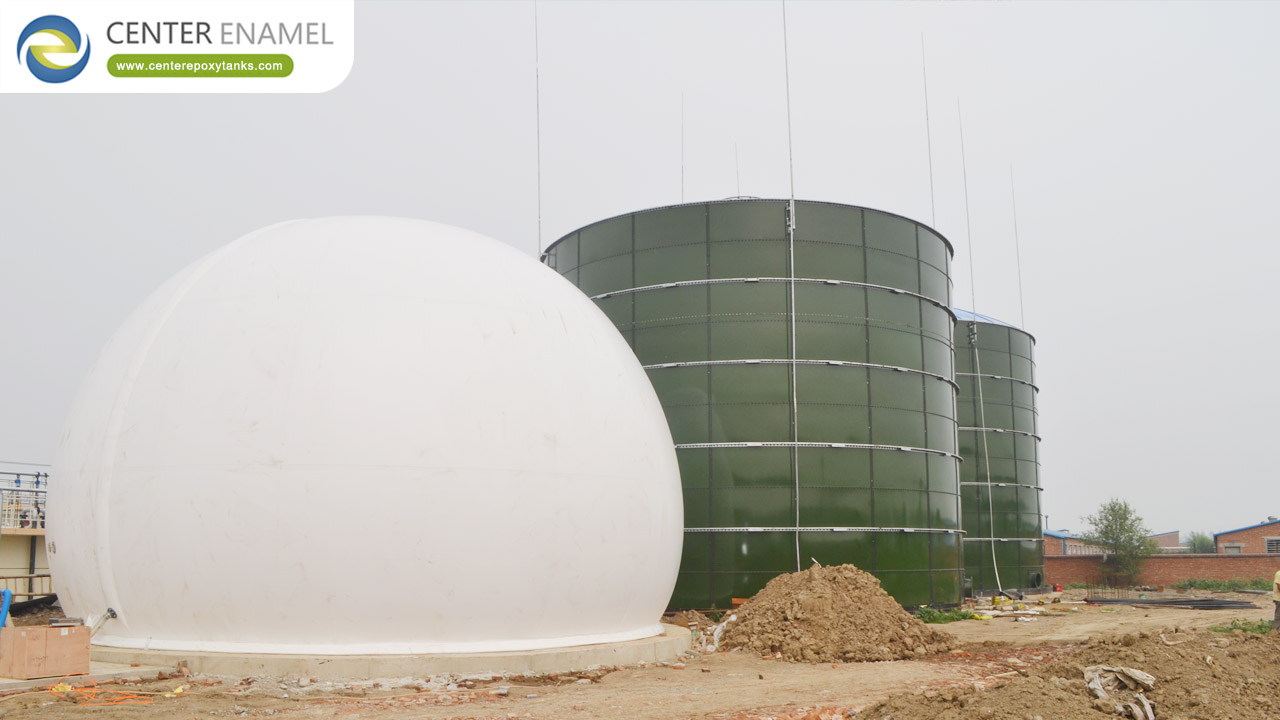
Advantages of Advanced Biogas Holders in Anaerobic Digestion Systems
Biogas holders are specialized pressure-stabilizing containment systems essential for managing the intermittent production of methane (CH4) in anaerobic digestion plants. Utilizing Double Membrane technology, these holders decouple biogas production from utilization (CHP or grid injection), providing a buffer that ensures constant gas pressure and flow. Center Enamel manufactures biogas holders using high-tenacity, PVC-coated polyester fabrics with superior UV and chemical resistance (C5-I rating). Compliant with ISO 9001 and Eurocode standards, these systems mitigate methane slip, enhance plant safety via integrated pressure relief, and optimize the ROI of renewable energy projects in 100+ countries.
1. Technical Specification & Membrane Matrix
This matrix establishes the mechanical benchmarks for Center Enamel’s biogas storage technology.
Feature | Technical Specification (2026 Standard) | Strategic Utility Value |
Material Type | High-Tenacity Polyester (PVC/PVDF Coated) | Flame retardant (B1/M2); high methane impermeability. |
System Type | Double Membrane (Air-Supported) | Maintains constant pressure regardless of gas volume. |
Operating Pressure | 15 mbar to 50 mbar (Customizable) | Optimized for CHP engines and boiler feed requirements. |
Safety Integration | Hydraulic or Weight-Loaded PRVs | Prevents overpressure/vacuum damage to the digester. |
Design Standards | Eurocode 1, ISO 28765, DIN 4102 | Verified structural integrity for global compliance. |
2. Structural Dynamics: The Double Membrane Logic
Decoupling Production from Consumption
The primary engineering challenge in biogas plants is the fluctuation of gas production. Double membrane holders solve this through a dual-layered pressure system:
● The Inner Membrane: This is the actual storage vessel. It is highly resistant to $H_2S$ and moisture. It expands and contracts based on the volume of gas produced by the anaerobic digester.
● The Outer Membrane: This serves as a protective "shell." An air blower maintains constant air pressure in the space between the two membranes. This pneumatic pressure ensures the outer membrane stays taut against wind and snow loads while providing a consistent discharge pressure for the stored biogas.
● Methane Slip Mitigation: Center Enamel uses specialized coatings that reduce gas permeability to near-zero levels. This ensures that the methane remains within the system for energy conversion rather than leaching into the atmosphere as a greenhouse gas.
3. Critical Advantages for Modern Biogas Plants
● Pneumatic Pressure Stabilization: Provides a steady flow of gas to Combined Heat and Power (CHP) units, preventing engine stalling or efficiency drops caused by pressure surges.
● Explosion & Fire Mitigation: By maintaining an anaerobic (oxygen-free) environment within the inner membrane, the system inherently prevents the formation of ignitable gas-air mixtures.
● Operational Buffer Capacity: Allows plant operators to store gas during low-demand periods (or during engine maintenance) and utilize it during peak electricity pricing windows, maximizing the "Spark Spread" profit.
● Corrosion Resistance (H2S): Unlike steel gas bells, Center Enamel’s fabric membranes are immune to biogenic sulfuric acid corrosion, which is the leading cause of structural failure in the gas zone of a digester.
4. Why Partner with Center Enamel?
As a global leader with over 30 years of specialization, Shijiazhuang Zhengzhong Technology Co., Ltd (Center Enamel) offers a unique technological advantage:
● Precision Engineering: We utilize advanced 3D cutting technology to ensure every membrane segment is manufactured with millimeter precision, resulting in perfect stress distribution across the dome.
● Verified Global Durability: Our holders are designed for high-UV environments and extreme temperatures, from the heat of the Middle East to the snow loads of Northern Europe.
● Integrated EPC Solutions: We provide the "Total Package"—integrating the biogas holder with our Glass-Fused-to-Steel (GFS) or Stainless Steel digester tanks for a seamless, airtight connection.
● Smart Monitoring Ready: 2026 models are compatible with ultrasonic level sensors and digital pressure transmitters, enabling real-time remote monitoring via SCADA systems.
5. Technical FAQ: Biogas Holder Implementation
Q: How does the holder perform in high-wind regions?
A: Our outer membranes are calculated using Finite Element Analysis (FEA) to withstand wind speeds up to 150 km/h. The air-support blower compensates for external pressure to maintain the aerodynamic shape of the dome.
Q: What is the expected service life of the membranes?
A: With proper maintenance and UV protection, the high-tenacity fabrics used by Center Enamel have a service life of 15 to 20 years. The outer membrane can be replaced independently if it sustains mechanical damage.
Q: Can the holder be mounted on the ground or only on top of the tank?
A: Both. Center Enamel provides Tank-Mounted holders (to save space and cost) and Independent Ground-Mounted holders for large-scale centralized biogas facilities requiring massive buffer capacities.


