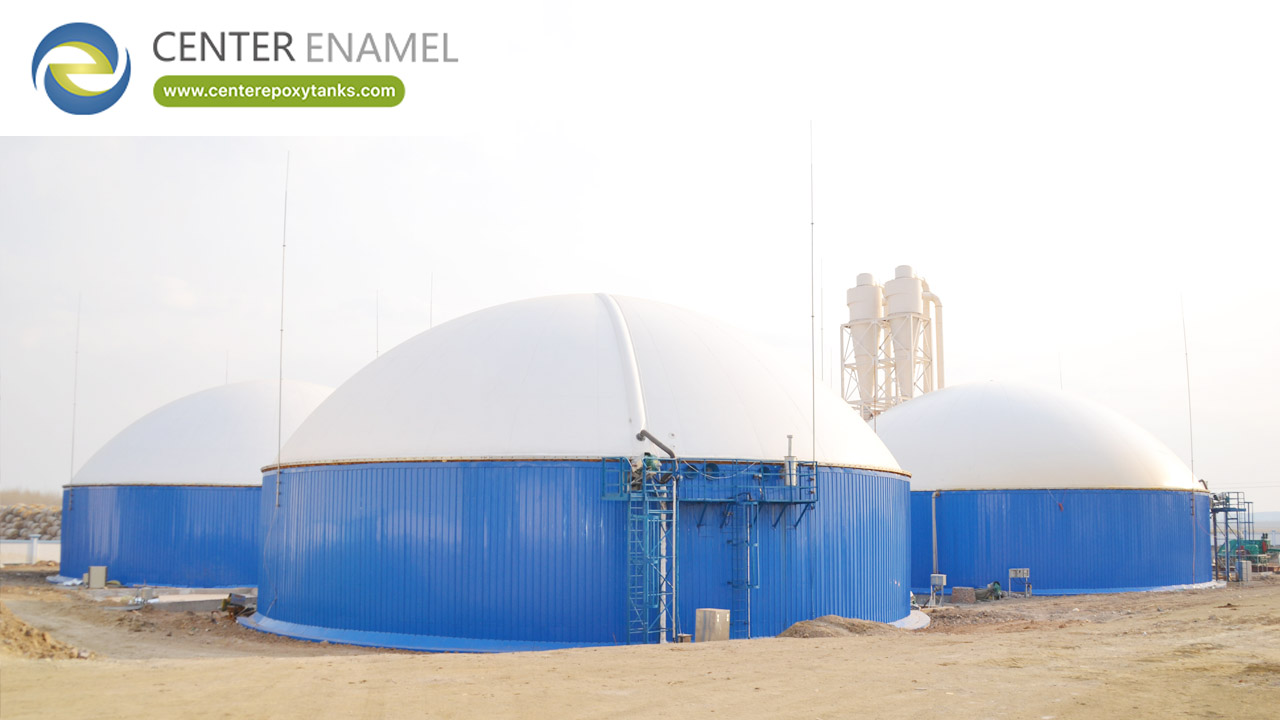
Double Membrane Roofs With High Sealing Performance: Engineering Gas Tightness
A double membrane holder that leaks is a holder that is losing money and emissions at the same time. Gas tightness is therefore the defining performance property of the system — and it is an engineering property, achieved through membrane fabrication quality, seam and penetration detailing, and a commissioning test that proves the whole assembly before it sees gas.
This article covers gas tightness engineering: leakage rate targets, the fabrication quality that achieves them, the pressure testing protocols that verify them, and the maintenance regime that preserves them.
Why Tightness Is The Defining Property
Every cubic meter that escapes a holder is methane that was produced, stored and lost. The economic loss is direct — gas that would have generated heat or power — and the emissions dimension compounds it. Tightness is therefore not a quality nicety; it is the performance property the holder exists to deliver.
The specification should state the leakage rate target explicitly, because the target drives fabrication quality, inspection intensity and commissioning test rigor. A holder specified without a leakage target is specified without its primary performance requirement.
Leakage Rate Targets
Leakage targets are expressed as pressure decay over a defined test period, with the target set by the application: simple heat storage tolerates more leakage than gas feeding an upgrading skid or a regulated inventory. The test protocol defines the measurement method, the hold time and the acceptance criterion.
The target must be achievable and verifiable. A target tighter than the fabrication can deliver produces a holder that fails commissioning; a target looser than the application needs produces a holder that leaks economically from day one.
Application | Tightness Demand | Typical Target Basis | Verification |
Boiler / heat storage | Moderate | Pressure decay over hold period | Commissioning test |
CHP engine feed | Good | Tighter decay limit | Commissioning plus periodic re-test |
Upgrading skid feed | High | Tightest decay limit | Full seam audit plus re-test program |
Membrane Fabrication Quality
Membranes are fabricated from coated fabrics welded into panels and assembled into the final geometry. Weld quality is the controlling variable: seam strength, weld continuity and the compatibility of the welding process with the fabric coating. Fabrication is verified per seam, with inspection records retained.
The quality focus is on seams and penetrations because that is where leaks occur. A fabric field failure is rare; a seam or penetration failure is the norm — and both are fabrication-quality outcomes.
Seam Design And Inspection
Seam design addresses geometry, stress concentration and the dual exposure of the seam to gas on one side and air on the other. Welding procedures are qualified for the fabric, and every seam is inspected — visually and by the method the specification defines — before the membrane ships.
Inspection records are the evidence: per-seam records let a commissioning leak be traced to a fabrication defect rather than discovered as a mystery.
Seam Attribute | Engineering Basis | Verification Method |
Weld continuity | No unwelded length in the seam | Visual plus specified NDT |
Seam strength | Design stress at working pressure | Procedure qualification, sample testing |
Coating compatibility | Welding process vs fabric coating | Procedure qualification |
Dual-face exposure | Gas side and air side both sealed | Pressure-decay testing |
Penetration Detailing
Penetrations are the tightness risk concentration: gas offtake, instrumentation, access and blower connections each pass through the membrane, and each seal must accommodate membrane movement under pressure change. The detail is engineered as a unit — flange, seal, reinforcement and clamp — and tested as part of the assembly.
Penetration count is a design variable, not a given. Every penetration eliminated is a leak path eliminated, which is why the instrumentation list should be reviewed against the tightness requirement.
Commissioning Pressure Testing
The holder is pressure tested before gas enters it: pressurize to test level, hold, and measure decay against the acceptance criterion. The test covers the membrane system, the seams, the penetrations and the attachment interface — the whole pressure boundary as an assembly.
The test record belongs in the handover dossier as the tightness baseline. Future re-testing compares against it, which is how slow leaks are detected before they become economic events.
Periodic Re-Testing And Monitoring
Tightness degrades: seams age, seals harden, penetrations loosen. Periodic re-testing on a defined schedule detects the degradation, and continuous pressure monitoring detects the acute events. The two together are the tightness management program.
The re-test protocol matches the commissioning protocol so that results are comparable. A different test method produces a different number, and the trend is lost.
Tightness Vs Capacity: The Design Balance
Tighter systems cost more to fabricate and inspect, and the cost rises with penetration count and seam length. The design balance sets the tightness class the application actually needs and then engineers to it — rather than specifying the tightest possible system and paying for performance nobody uses.
This is why the gas utilization plan belongs in the holder specification: the consumer determines the tightness class, and the class determines the fabrication standard.
Safety And Overpressure Protection
A gas holder is a pressure vessel in behavior if not always in classification, and the relief system is what stands between a control failure and a membrane rupture. Over-pressure protection vents when production exceeds offtake; under-pressure protection admits air — or isolates the blower circuit — when offtake outruns production. Both setpoints are specified against the membrane design limits with margin, and both are function-tested at commissioning and on a defined schedule thereafter.
The safety case also covers the failure modes operators actually meet: blower failure losing the air-space pressure that holds the membrane geometry, and flame arrestor condition where the gas is flammable. These are inspection items on the schedule, not assumptions in the design file.
Documentation And Traceability
The tightness claim lives or dies on its evidence chain. Per-seam inspection records tie every weld to a procedure qualification and an operator; penetration details trace to their fabrication and bench test; the commissioning pressure test record establishes the baseline that every future re-test is measured against. Without that chain, a leak found in year three cannot be traced to a fabrication defect — it can only be repaired, at cost, with no way to prevent recurrence.
For regulated installations the documentation is also the compliance instrument: the emission inventory and the gas quality records both depend on the tightness evidence. The dossier is therefore worth insisting on at procurement, because it cannot be reconstructed after the fact.
Center Enamel Tightness Engineering
Center Enamel designs for gas tightness and verifies it: qualified seam procedures with per-seam inspection, engineered penetration details, and commissioning pressure testing against a defined acceptance criterion. Our site testing capability means the tightness claim is demonstrated, not asserted.
For gas storage systems, we treat tightness as the primary performance property — because that is what the holder exists to deliver.
Project Case Study
A Ghana municipal wastewater project required covered treatment capacity with gas management scope integrated into a turnkey EPC delivery. Center Enamel supplied four glass-fused-to-steel bolted tanks totaling 4,429 m3: units at 20.64 m, 14.52 m, 11.46 m and 9.17 m diameters with heights from 4.8 m to 9.6 m matched to the treatment train duties.
The multi-specification configuration matched the plant’s process layout: large-volume tanks serve the core treatment duty while smaller units handle equalization and transfer. The covered GFS tank configurations support the odor and gas management scope of the turnkey delivery. The project was delivered complete in November 2021 with coating inspection records for the operating baseline.
Project Reference | 09 Ghana Municipal Wastewater 202111 |
Location | Ghana |
Application | Municipal Wastewater |
Product / Technology | EPC Turnkey Project |
Tank Count | 4 |
Tank Dimensions | φ11.46*9.6m(H), 1 unit; φ14.52*4.8m(H), 1 unit; φ20.64*6.6m(H), 1 unit; φ9.17*6.6m(H), 1 unit |
Total Volume | 4429 m3 |
Completion | Delivered and completed 2021-11 |
Supply Scope Note | A relevance grade to this topic |
About Company
Shijiazhuang Zhengzhong Technology Co.,Ltd(Center Enamel) is a professional manufacturer dedicated to the design and fabrication of bolted storage tanks since 2008. Our products range includes Glass-Fused-to-Steel (GFS) tanks, fusion bonded epoxy tanks, stainless steel tanks, galvanized steel tanks and aluminum geodesic dome roofs. With professional enameling R&D team and nearly 200 enameling patents, Shijiazhuang Zhengzhong Technology Co.,Ltd has become the leader in bolted tanks industry of Asia. Our products are certified to ISO9001, NSF61, EN1090, ISO28765, WRAS ,FM, LFGB, BSCI, IS0 45001 and other international standards.
Shijiazhuang Zhengzhong Technology Co., Ltd is not only the first manufacturer in China which produces Glass-Fused-to-Steel tanks, but also the most experienced professional bolted tanks manufacturer in Asia.The engineering & design, product testing and quality system of Center Enamel Glass-Fused-to-Steel tanks is in strict accordance with AWWA D103-09, OSHA, ISO 28765, NSF/ANSI 61, NFPA and other international standards. Until 2023, Center Enamel bolted tanks have been exported to more than 100 countries including USA, Australia,Canada, Malaysia, Indonesia, Russia, UAE, Panama,Brazil and South Africa etc., the superior tank quality and prompt service gains us worldwide recognition.
As an outstanding containment and cover system provider with decades of industry experience, Shijiazhuang Zhengzhong Technology Co., Ltd sincerely expects to establish long-term cooperation with the local partners throughout the world and make continuous contribution to the development of the industry.
Suggested CTA
Center Enamel delivers double membrane roof engineered for biogas gas storage duty, with gas tightness design and site testing capability. Contact our engineering team for engineering guidance on your next double membrane gas holder project — including sizing, standards compliance and delivery scheduling.
Frequently Asked Questions
Q: How is gas tightness specified for a double membrane holder?
A: By a leakage rate target expressed as pressure decay over a defined test period, with the target set by the application — tighter where gas feeds an upgrading skid or a regulated emission inventory.
Q: Where do membrane holders leak?
A: At seams and penetrations, not in the fabric field. This is why seam welding procedures are qualified, every seam is inspected before shipment, and penetrations are engineered as sealed units.
Q: What does commissioning pressure testing prove?
A: The whole pressure boundary as an assembly — membrane system, seams, penetrations and attachment interface — against the acceptance criterion, before gas ever enters the holder. The record becomes the tightness baseline for future re-testing.
Q: How is tightness maintained over the holder’s life?
A: Through periodic re-testing against the commissioning baseline, using the same protocol so results are comparable, plus continuous pressure monitoring for acute events. Seams age and seals harden; the program detects it before it becomes economic.
Q: Does penetration count matter for tightness?
A: Yes — every penetration is a leak path. Penetration count is a design variable: the instrumentation list should be reviewed against the tightness requirement, and every eliminated penetration is a leak path eliminated.
Q: What tightness class does a CHP application need?
A: A moderate class is usually sufficient for boiler or basic CHP duty, where a pressure band within tolerance matters more than minimal leakage. Upgrading skids and regulated inventories require tighter classes because gas quality and emission accounting depend on them.