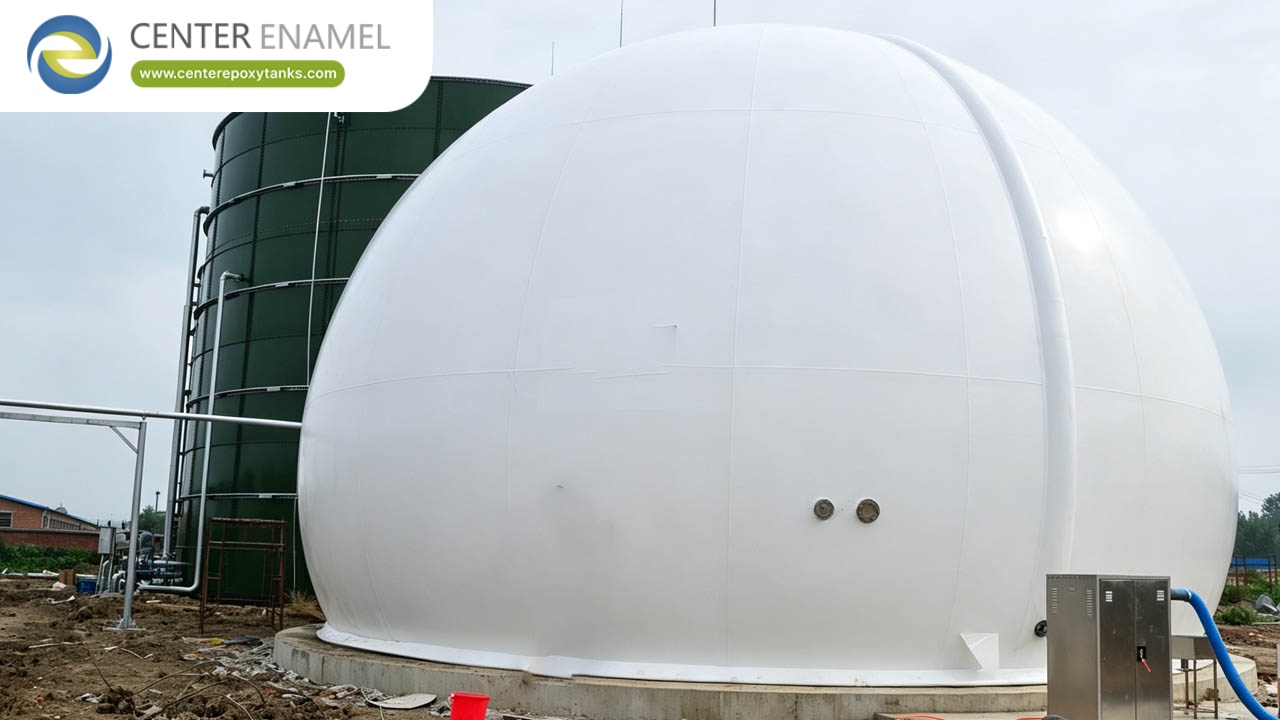
Advanced Biogas Holders From China For Industrial And Agricultural Waste Management
The biogas holder is where anaerobic digestion meets energy use. The digester makes gas; the holder stores it at controlled pressure so that the utilization equipment — boiler, engine or upgrading skid — sees a steady supply rather than a production curve. Holder selection is therefore an energy-system decision as much as a storage decision, and the families available trade simplicity against pressure stability, capacity and instrumentation.
This article surveys the holder portfolio: the membrane and gasholder families, their capacity and pressure envelopes, and the selection logic for industrial versus farm scale.
The Holder’s Job
A biogas holder buffers production variability against consumption variability. Digester gas production fluctuates with feed rate, temperature and biology; consumption fluctuates with equipment demand. The holder absorbs the difference, storing surplus and releasing deficit, while maintaining the pressure the downstream equipment requires.
This buffering duty — not capacity alone — sets the holder specification. A holder sized only for daily production volume but unable to hold pressure will starve the utilization equipment every time production dips.
Double Membrane Holders
The double membrane holder is the workhorse of modern AD plants: an outer membrane provides weather protection and shape, an inner membrane stores the gas, and the space between is pressurized with air to set the operating pressure. Capacity scales from hundreds to tens of thousands of cubic meters, and the system adds no water or steel mass to the plant.
The pressure band is set by the air blower and weight system, with relief protecting against over-pressure. The engineering checks are membrane material selection, sealing at every penetration, and the control loop that keeps pressure within band as volume changes.
Single Membrane And Balloon Holders
Single membrane holders and balloon-type gas bags serve the simplicity end of the market: low cost, minimal structure, pressure controlled by added weight or a light blower system. They suit farm-scale and pilot installations where capital restraint dominates and instrumentation can be minimal.
The trade-off is durability and pressure stability: membrane materials must be selected for UV exposure and gas composition, and the pressure band is narrower and less stable than double membrane or gasholder systems.
Water-Sealed Gasholders
The water-sealed gasholder is the traditional low-pressure solution: a telescoping or floating vessel held in a water seal, with pressure set by the vessel weight. Capacity reaches very large volumes, and the technology is mature and well understood. The cost is the water system, freeze protection and the footprint.
Water-sealed holders remain the right answer for very large storage volumes and for plants that already have water infrastructure, and they deliver stable pressure across the full stroke.
Capacity And Pressure Envelopes
Holder sizing starts from the gas balance: production curve, consumption curve and the buffer required between them. A common design basis is 25-50 percent of daily production for combined heat and power duty, higher where upgrading skids demand steady feed. Pressure envelopes differ by family: double membrane systems commonly deliver a few mbar of controllable pressure; water-sealed holders deliver stable low pressure across a wide stroke.
The downstream equipment sets the pressure requirement; the gas balance sets the capacity. Both must be solved before the family selection.
Holder Family | Capacity Range | Pressure Stability | Capital And Operating Profile |
Double membrane | Hundreds to tens of thousands m3 | Good — blower and weight control | Moderate capital, low operating |
Single membrane / balloon | Hundreds to low thousands m3 | Fair — narrower band | Lowest capital, membrane replacement |
Water-sealed gasholder | Thousands to very large | Excellent — stable across stroke | Higher capital, water system upkeep |
Membrane Material Selection
Membrane materials are selected against the gas composition — H2S and moisture content drive material aging — and against UV exposure for outer membranes. Coated fabrics with compatible polymer layers are standard, with weld quality verified per seam. The material selection is a life-cycle decision, not a first-cost decision.
Seam integrity is the failure mode that matters: membranes fail at seams and penetrations, which is why seam inspection and penetration detailing are the quality focus of holder fabrication.
Pressure Control And Safety Systems
The pressure control system is the holder’s brain: blower and weight control for double membrane systems, relief valves for over-pressure, vacuum relief for under-pressure, and flame protection where the gas train requires it. The control loop must handle the full stroke — from empty to full — without hunting or exceeding the relief setpoints.
Safety systems round out the package: over/under-pressure relief, flame arrestors where specified, and gas detection tied to the plant control system. The holder is a pressure vessel in function if not always in code classification, and it is engineered accordingly.
Holder Accessories
The holder package extends beyond the membrane: access hatches and manways for internal inspection, instrumentation ports for pressure and level, sight glasses where visual inspection is specified, and lighting for internal work. Each penetration is a seal, and each seal is an inspection item.
Accessory specification is where holder projects find their rework: a missing instrumentation port or an undersized access hatch is cheap at design and expensive after fabrication.
Industrial Vs Farm Scale Selection
Farm-scale AD plants prioritize simplicity and capital restraint: single membrane or balloon holders, minimal instrumentation, local maintenance. Industrial plants — food processing, wastewater, landfill — prioritize pressure stability, instrumentation and integration with plant control: double membrane or water-sealed holders with full safety systems.
The selection logic is really about the utilization equipment: a boiler tolerates pressure variation that an upgrading skid does not, and the holder specification follows the strictest consumer on site.
Attribute | Farm Scale | Industrial Scale |
Typical holder family | Single membrane or balloon | Double membrane or water-sealed |
Instrumentation | Minimal — pressure and level | Full — control system integration |
Pressure stability need | Moderate (boiler or basic CHP) | High (engine fleet or upgrading) |
Maintenance model | Farm staff, simple procedures | Plant maintenance, scheduled program |
Safety system scope | Relief and basic detection | Full relief, detection, interlocks |
Integration With The Digester
The holder sits on top of or beside the digester, and the interface is a design item: gas offtake positioning, condensate management (biogas is saturated, and condensate must drain without pooling in the gas train), and thermal interaction between the holder and the digester atmosphere.
Condensate management is the detail most often under-designed: biogas cools as it rises, water condenses, and undrained condensate blocks gas flow and corrodes piping.
Center Enamel Biogas Holder Capability
Center Enamel designs and fabricates biogas holders for industrial and agricultural clients across the double membrane, single membrane and accessory scope, with membrane material selection, seam quality verification and pressure control engineering as part of the delivered system. Our AD project experience spans food waste, livestock and wastewater feedstocks.
From the gas balance through commissioning, we treat the holder as part of the energy system — because that is the only way it delivers.
About Company
Shijiazhuang Zhengzhong Technology Co.,Ltd(Center Enamel) is a professional manufacturer dedicated to the design and fabrication of bolted storage tanks since 2008. Our products range includes Glass-Fused-to-Steel (GFS) tanks, fusion bonded epoxy tanks, stainless steel tanks, galvanized steel tanks and aluminum geodesic dome roofs. With professional enameling R&D team and nearly 200 enameling patents, Shijiazhuang Zhengzhong Technology Co.,Ltd has become the leader in bolted tanks industry of Asia. Our products are certified to ISO9001, NSF61, EN1090, ISO28765, WRAS ,FM, LFGB, BSCI, IS0 45001 and other international standards.
Shijiazhuang Zhengzhong Technology Co., Ltd is not only the first manufacturer in China which produces Glass-Fused-to-Steel tanks, but also the most experienced professional bolted tanks manufacturer in Asia.The engineering & design, product testing and quality system of Center Enamel Glass-Fused-to-Steel tanks is in strict accordance with AWWA D103-09, OSHA, ISO 28765, NSF/ANSI 61, NFPA and other international standards. Until 2023, Center Enamel bolted tanks have been exported to more than 100 countries including USA, Australia,Canada, Malaysia, Indonesia, Russia, UAE, Panama,Brazil and South Africa etc., the superior tank quality and prompt service gains us worldwide recognition.
As an outstanding containment and cover system provider with decades of industry experience, Shijiazhuang Zhengzhong Technology Co., Ltd sincerely expects to establish long-term cooperation with the local partners throughout the world and make continuous contribution to the development of the industry.
Suggested CTA
Center Enamel delivers double membrane / gasholder engineered for biogas storage duty, with biogas holder design and fabrication for industrial and agricultural clients. Contact our engineering team for selection and procurement guidance on your next biogas holder project — including sizing, standards compliance and delivery scheduling.
Frequently Asked Questions
Q: What are the main types of biogas holders?
A: Double membrane holders (outer weather membrane plus inner gas membrane with pressurized air space), single membrane and balloon holders, and water-sealed gasholders. Selection follows capacity, pressure stability requirements and capital constraints.
Q: How is a biogas holder sized?
A: From the gas balance — production curve against consumption curve. A common design basis is 25-50 percent of daily production for CHP duty, higher where upgrading skids demand steady feed. Pressure requirements follow the strictest downstream consumer.
Q: What sets the operating pressure in a double membrane holder?
A: The air blower and weight system pressurizing the space between the membranes, with relief valves protecting against over-pressure and vacuum relief against under-pressure. The control loop must hold the band across the full stroke.
Q: Why does condensate management matter in biogas systems?
A: Biogas is saturated; it condenses as it cools, and undrained condensate blocks gas flow and corrodes piping. Condensate drains must be positioned and detailed so that water leaves the gas train without pooling.
Q: What is the difference between farm-scale and industrial holder selection?
A: Farm-scale prioritizes simplicity and capital restraint (single membrane or balloon, minimal instrumentation); industrial prioritizes pressure stability, instrumentation and control integration (double membrane or water-sealed with full safety systems).
Q: What drives membrane material selection?
A: Gas composition — H2S and moisture content drive material aging — plus UV exposure for outer membranes. Coated fabrics with compatible polymer layers are standard, and seam integrity is the quality focus since membranes fail at seams and penetrations.