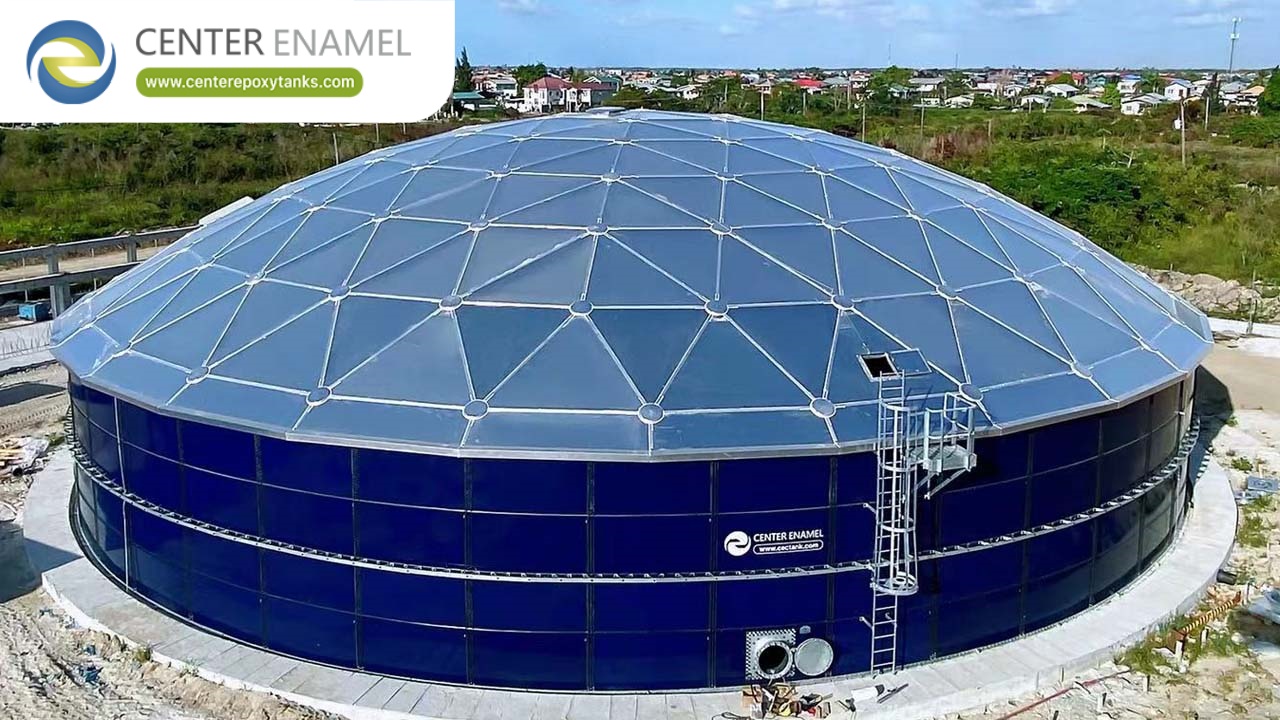
Advanced Aluminum Geodesic Domes For Oil, Gas And Water Storage Tanks
An aluminum geodesic dome is one of the few tank components that improves both the structure and the operation. Structurally, it spans the tank without columns, keeping the full diameter usable and eliminating the internal congestion that complicates mixing and inspection. Operationally, it closes the tank atmosphere — controlling emissions on fuel service, containing odors on wastewater duty, and keeping rain out of everything it covers.
This article covers geodesic dome engineering across oil, gas and water service: the clear-span advantage, the corrosion case for aluminum, and the emission and odor control that domes deliver.
Clear-Span Structure
A geodesic dome is a triangulated space frame that carries its loads through geometry rather than through deep beams. Because it is self-supporting at the perimeter, the tank interior stays free of columns — which matters for mixing coverage, internal inspection access and the installation of internal floating roofs.
The triangulated geometry also distributes loads efficiently, which is why domes span large diameters with relatively light structures. The trade-off is fabrication complexity: many nodes, many member lengths, and a geometry that must be engineered rather than catalogued.
Why Aluminum
The atmosphere above a stored liquid is corrosive: hydrogen sulfide and moisture over wastewater, VOCs and condensation over fuels, humid salt air over coastal water tanks. Steel roofs in these environments are a maintenance item; aluminum roofs are not. Aluminum’s passive oxide layer handles the chemistry that strips paint from steel.
The weight advantage matters too: aluminum domes impose less dead load on the tank shell, which simplifies foundation and shell design — particularly relevant for retrofit domes on existing tanks.
Roof Material | Corrosion Behavior | Maintenance Cycle | Weight |
Aluminum | Passive oxide resists tank atmosphere | Inspection only — no recoating | Lightest — retrofit-friendly |
Coated steel | Requires intact coating system | Recoating every 10-20 years | Heavy — shell capacity check |
Stainless steel | Excellent resistance | Inspection only | Heavy — cost premium |
Dome Engineering Across Three Services
Oil and gas service: domes close the vapor space, reducing breathing losses and supporting vapor recovery systems, while the clear span accommodates internal floating roofs. Water service: domes protect water quality by excluding rain, sunlight and contamination, and they carry the AWWA D108 framework. Wastewater service: domes contain odors at the source, allowing the covered tank atmosphere to be routed to treatment.
The same structure serves three very different duties — what changes is the sealing, penetration and accessory specification, not the dome geometry.
Service | Primary Driver | Sealing Requirement | Accessory Scope |
Oil and gas storage | Emission and vapor control | Gas-tight perimeter seal | Vent path, IFR clearance |
Water storage | Water quality protection | Weather-tight, rain exclusion | Access hatch, AWWA D108 alignment |
Wastewater | Odor containment | Gas-tight with vent to treatment | Scrubber/biofilter connection |
Emission And Odor Control
A closed dome converts an open tank into a controlled atmosphere. On fuel service, reduced breathing translates directly into reduced VOC emissions and product loss. On wastewater service, the contained atmosphere routes to scrubbers or biofilters instead of dispersing across the plant — and the odor complaint disappears before it arrives.
The engineering detail is the seal: dome-to-shell joint design, penetration seals for instrumentation and access, and the vent path for the controlled atmosphere. A dome that leaks at the perimeter controls nothing.
Loads And Detailing
Dome design checks snow, wind (including internal suction during emptying), seismic and live loads for maintenance access. Detailing covers the perimeter ring beam, node connections, access hatches, instrument penetrations and roof drains. Each detail is engineered against the load cases, not copied from a previous project.
The perimeter interface deserves specific attention: the ring beam must transfer dome loads into the tank shell without introducing stress concentrations, and the seal must accommodate differential movement.
Retrofit Domes On Existing Tanks
Dome retrofits are among the most cost-effective tank upgrades available: an existing open tank gains emission control, odor containment and water quality protection without replacement. The engineering work is the interface — shell capacity for the new loads, ring beam design and the seal detail.
Aluminum’s light weight makes retrofit domes practical on tanks whose shells were never designed for a steel roof, which is why the retrofit market has standardized on aluminum geodesic systems.
Fabrication And Erection
Domes are fabricated as members and nodes, shipped as kits and erected on site — frequently while the tank remains in service where the scope allows. Erection is measured in days to weeks, and the lightweight members mean lighter lifting equipment and smaller site footprint.
Quality control is dimensional: member lengths and node geometry are verified in the shop, and the erected dome is surveyed against the design geometry. The survey record belongs in the handover file.
Dome Economics
The dome is a capital decision with an operating return. The capital cost is the structure and its interface works; the return comes from eliminated breathing losses, avoided roof maintenance, protected product quality and — on wastewater — the odor-complaint risk that never materializes. Over a twenty-year horizon, the return usually wins on fuel and water service and always wins on odor-regulated service.
The retrofit case is the strongest: a dome added to an existing open tank buys emission control and water quality protection at a fraction of replacement cost, with the aluminum weight making the interface works manageable.
Standards And Certification
Dome engineering follows the tank code for structural loads — API 650 Annex for wind and seismic, AWWA D108 for water storage domes — with owner specifications governing sealing, penetrations and accessories. The certification package includes material certificates for members and fasteners, dimensional verification of the fabricated kit, and the erected-geometry survey.
For export projects, the certification format must satisfy the owner’s jurisdiction and insurer, which is a documentation-planning decision made before fabrication.
Access, Safety And Maintenance
Dome access provisions — hatches, ladder mounts and fall-arrest anchors — are engineered, not improvised. Internal inspection access through the dome must be planned against the mixing and floating-roof equipment below. Maintenance is minimal: aluminum needs no recoating cycle, and the inspection items are seals, fasteners and penetrations.
The maintenance model is the economic argument: a steel roof carries a recoating cycle every decade or two; an aluminum dome carries inspection.
Center Enamel Dome Capability
Center Enamel designs and fabricates aluminum geodesic dome roofs with AWWA D108 alignment, across oil, gas, water and wastewater service. Our domes are engineered for the site load cases, detailed for the service atmosphere and documented with erection surveys that support the tank’s integrity file.
From new-build domes to retrofits on existing tanks, our engineering team treats the dome as part of the tank system — because that is the only way it performs.
About Company
Shijiazhuang Zhengzhong Technology Co.,Ltd(Center Enamel) is a professional manufacturer dedicated to the design and fabrication of bolted storage tanks since 2008. Our products range includes Glass-Fused-to-Steel (GFS) tanks, fusion bonded epoxy tanks, stainless steel tanks, galvanized steel tanks and aluminum geodesic dome roofs. With professional enameling R&D team and nearly 200 enameling patents, Shijiazhuang Zhengzhong Technology Co.,Ltd has become the leader in bolted tanks industry of Asia. Our products are certified to ISO9001, NSF61, EN1090, ISO28765, WRAS ,FM, LFGB, BSCI, IS0 45001 and other international standards.
Shijiazhuang Zhengzhong Technology Co., Ltd is not only the first manufacturer in China which produces Glass-Fused-to-Steel tanks, but also the most experienced professional bolted tanks manufacturer in Asia.The engineering & design, product testing and quality system of Center Enamel Glass-Fused-to-Steel tanks is in strict accordance with AWWA D103-09, OSHA, ISO 28765, NSF/ANSI 61, NFPA and other international standards. Until 2023, Center Enamel bolted tanks have been exported to more than 100 countries including USA, Australia,Canada, Malaysia, Indonesia, Russia, UAE, Panama,Brazil and South Africa etc., the superior tank quality and prompt service gains us worldwide recognition.
As an outstanding containment and cover system provider with decades of industry experience, Shijiazhuang Zhengzhong Technology Co., Ltd sincerely expects to establish long-term cooperation with the local partners throughout the world and make continuous contribution to the development of the industry.
Suggested CTA
Center Enamel delivers aluminum geodesic dome engineered for tank covers duty, with dome design and fabrication line, awwa d108 alignment. Contact our engineering team for selection and procurement guidance on your next aluminum geodesic dome roof project — including sizing, standards compliance and delivery scheduling.
Frequently Asked Questions
Q: What is the main structural advantage of a geodesic dome?
A: Clear span: the triangulated space frame supports itself at the perimeter, so the tank interior stays free of columns — which preserves mixing coverage, internal inspection access and space for internal floating roofs.
Q: Why aluminum rather than steel for tank domes?
A: The tank atmosphere is corrosive — H2S and moisture over wastewater, VOCs over fuels, salt air on coastal sites. Aluminum’s passive oxide layer resists this environment without recoating cycles, and its lower weight simplifies shell and foundation design, especially for retrofits.
Q: Can a dome be added to an existing tank?
A: Yes. Retrofit domes are a standard upgrade: the engineering work is the interface — shell capacity for new loads, ring beam design and the perimeter seal. Aluminum’s light weight makes retrofits practical on shells never designed for a steel roof.
Q: What standards apply to aluminum dome roofs?
A: AWWA D108 covers aluminum dome roofs for water storage. Oil, gas and wastewater domes are engineered to the tank code (API 650 or equivalent) with owner-specified sealing and accessory requirements.
Q: How do domes control odors on wastewater tanks?
A: By closing the tank atmosphere at the source. The contained air is routed to scrubbers or biofilters rather than dispersing across the plant — provided the dome-to-shell seal and penetration seals are correctly detailed.
Q: What maintenance does an aluminum dome require?
A: Inspection, not recoating: seals, fasteners and penetrations on a scheduled basis. This is the economic argument against steel roofs, which carry a recoating cycle every decade or two.


