3 mm Boiler Feedwater Tank Shell: Thickness and Reason
Boiler feedwater tanks must resist oxygen corrosion and thermal cycling while holding treated water at temperature. For 3mm boiler feedwater the shell thickness, lining, and thermal details matter more than the stored volume alone.
What Is 3Mm Boiler Feedwater?
A boiler feedwater tank stores conditioned water ahead of the boiler, often deaerated and heated. It is typically a steel or enamel-lined vessel sized for surge and deaerator buffering, built to handle warm, oxygen-controlled water without corroding.
How Does It Work?
Feedwater enters after chemical and thermal treatment; the tank buffers flow and levels before the feed pump. Where glass lining is used, the inert enamel resists oxygen attack on the steel. Thermal cycling from load changes is managed by proper nozzle reinforcement and support so the shell does not fatigue.
Key Types, Components, and Features
· Enamel (GFS) feedwater:glass lining resists oxygen corrosion.
· Carbon steel with coating:painted/internal coating for milder duty.
· 3 mm shell design:thin-shell logic with stiffeners and vacuum protection.
· Thermal-integrity tank:detailed for expansion and nozzles under cycling.
Applications
· Power plant and industrial boiler feed systems
· Cogeneration and district-heating buffer tanks
· Process plants with deaerated water surge
· Food and beverage steam generation
Technical Considerations
· Shell:3 mm typical for small surge duties; stiffeners and vacuum breakers prevent collapse.
· Corrosion:oxygen removal plus an inert lining (enamel) extends steel life.
· Thermal:expansion joints or flexible nozzles handle cycling; supports allow movement.
· Standards:pressure-vessel and boiler codes by jurisdiction; WAQ integrity for water side.
Key Engineering Parameters
Design Parameter | Typical Value / Range | Why It Matters |
Shell thickness | 3 mm typical, stiffened | Surge-duty design |
Vacuum protection | Breakers + stiffeners | Prevent collapse |
Lining | Enamel / coating | Oxygen-corrosion resistance |
Thermal | Expansion joints / nozzles | Cycling durability |
Deaeration | Upstream | Oxygen removal |
Standards | Boiler / pressure-vessel code | Compliance |
Surge volume | By pump / boiler swing | Stable control |
Temperature | Warm, treated | Material choice |
Project Case Study
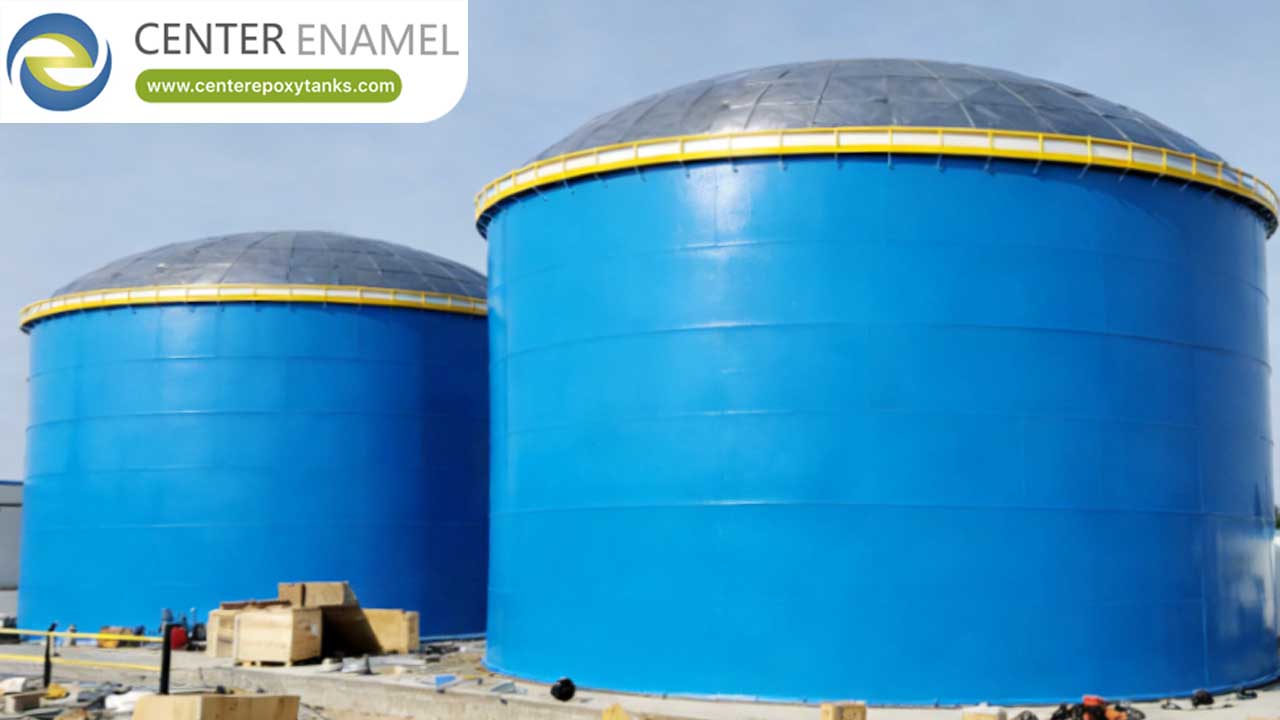
The following verified installation demonstrates the containment engineering discipline behind 3mm boiler feedwater. (Application shown is the tank's actual delivered service; the same bolted, coated, or stainless engineering underlies oil-storage designs discussed here.)
Project Information | Details |
Location | China |
Year | 2023 |
Industry / Application | Industrial wastewater treatment |
Product / Tank type | GFS bolted |
Configuration | 6 tanks, φ 9.94 × 22.8 m and φ 11.85 × 25.2 m |
Capacity | 14,655 m³ |
Standards | ISO 28765 / AWWA D103-09 |
Status | Completed |
This reference is cited for its documented liquid-containment and corrosion-control engineering; it is not represented as an oil tank where it was a water or wastewater installation.
Advantages and Limitations
Advantages
· Lining resists oxygen and warm-water corrosion
· Buffers deaerator and feed-pump swings
· Compact surge volume supports stable boiler control
Limitations
· Warm, oxygenated upset still attacks any uncoated steel
· Thermal cycling needs careful nozzle design
· Enamel can chip if mechanically abused
Comparison
Aspect | Enamel (GFS) | Epoxy-coated | Stainless |
Oxygen-corrosion resistance | High (inert glass) | Good (coating) | High (passive film) |
Thermal cycling | Good with detailing | Good | Excellent |
Relative cost | Medium | Medium | High |
Hygiene | Good | Good | Best |
Best duty | Warm, oxygenated water | Milder duty | Clean / high-purity water |
How to Select the Right Solution
· Size for surge and deaerator buffering, not just volume
· Specify lining vs coating by oxygen level
· Add vacuum protection and stiffeners for thin shells
· Detail nozzles for thermal expansion
· Confirm boiler-code compliance for the site
3mm boiler feedwater are defined by corrosion control and thermal stability more than capacity. A lined, properly detailed tank protects the boiler feed train.
Frequently Asked Questions (FAQ)
What is a boiler feedwater tank?
It stores conditioned, often deaerated water ahead of the boiler, buffering flow and level before the feed pump.
Why line or coat it?
Warm, oxygen-bearing water corrodes steel; an enamel lining or coating resists oxygen attack and extends the tank's life.
What does a 3 mm shell mean?
A thin surge-grade shell is valid only with stiffeners and vacuum protection to prevent collapse under external pressure.
How is thermal cycling handled?
Nozzles are reinforced and supports allow movement so repeated heating and cooling do not fatigue the shell.
Which standard applies?
Boiler and pressure-vessel codes by jurisdiction, with water-side integrity managed through treatment and lining.
When is enamel better than steel?
When oxygen corrosion, not pressure, is the dominant threat — enamel gives an inert barrier.
For 3mm boiler feedwater, share your product, capacity, vapor pressure, corrosivity, and site loads with an engineering team to receive a specification and quotation aligned to API 650, EN 14015, ISO 28765, or AWWA D103-09.


