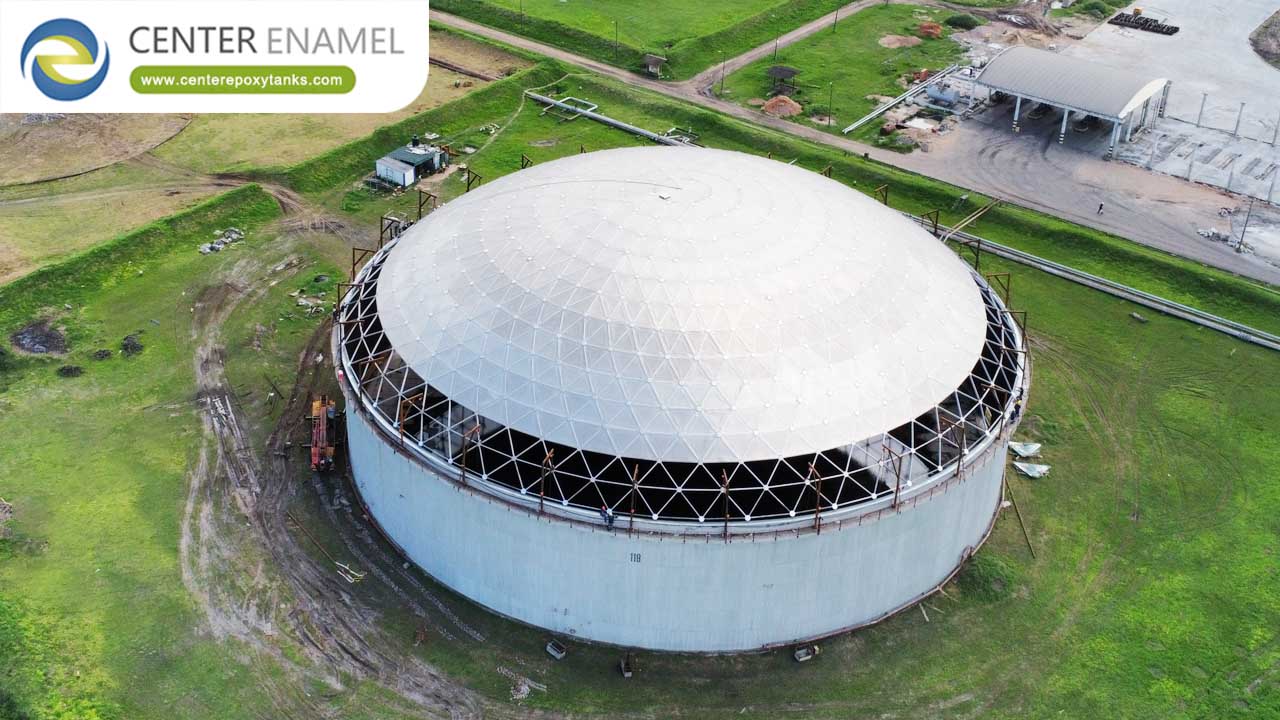
Why Choosing a Customizable External Floating Roof Manufacturer is the Right Decision
In the global chemical and petroleum industries, "standard" solutions often lead to operational compromises. As environmental regulations—such as the 2026 VOC emission mandates—tighten, the ability to customize an External Floating Roof (EFR) becomes a strategic necessity.
Shijiazhuang Zhengzhong Technology Co., Ltd (Center Enamel), a leading Chinese manufacturer with over 30 years of expertise, specializes in bespoke EFR solutions that provide globally competitive quality with localized engineering precision.
1. Technical Authority: The Value of Customization in EFR Engineering
An External Floating Roof is a dynamic safety component. Unlike off-the-shelf covers, a customizable EFR is engineered to the specific thermodynamics and chemical properties of the stored media.
EFR Customization & Performance Matrix
Customization Variable | Technical Standard | Strategic Operational Value |
Material Selection | Marine-Grade Alum / 316L SS | Prevents galvanic corrosion in aggressive chemical environments. |
Seal Configuration | Mechanical Shoe / Secondary Wiper | Achieves 99% VOC reduction even in "out-of-round" tanks. |
Drainage Logic | Articulated / Flexible Pipe | Custom-rated for local peak rainfall (up to 250mm/hr). |
Buoyancy Design | Pontoon / Double-Deck | Optimized for specific gravity (SG) fluctuations of diverse chemicals. |
Seismic Resilience | ASCE 7-22 / Eurocode | Bespoke structural bracing for high-risk geographical zones. |
2. Advantages of Tailored External Floating Roofs
Selecting a manufacturer capable of high-level customization, such as Center Enamel, directly impacts the three pillars of storage management:
A. Maximum VOC Mitigation and Product Recovery
Generic roofs often leave gaps at the rim. A customized EFR utilizes precision laser-measured shell data to design rim seal systems that provide a "zero-gap" fit. This virtually eliminates "breathing losses," allowing the system to pay for itself through product reclamation within 12 to 24 months.
B. Enhanced Fire Safety and Explosion Prevention
Customization allows for the integration of advanced safety features like stainless steel shunts for lightning dissipation and automated foam-pourer interfaces (compliant with NFPA 11). By eliminating the vapor space, the risk of ignition is reduced to near-zero.
C. Strategic Retrofitting and Adaptability
Whether for a new API 650 tank or an existing facility, customizable manufacturers can engineer modular, "knock-down" components. These are designed to enter through standard manways, enabling rapid installation without the need for hazardous hot-work or heavy cranes.
3. The Strategic Role of Chinese Manufacturing Excellence
China’s rapid industrial expansion has turned it into a global hub for chemical storage innovation. Center Enamel leverages this environment to offer:
● Proximity to Urban Centers: Many plants operate near residential areas. Our EFRs are engineered with high-efficiency PVDF coatings to ensure zero-odor and zero-emission compliance, protecting local communities and avoiding government penalties.
● Material Superiority: We utilize high-tenacity, corrosion-resistant alloys that offer a 30-year service life, even in the aggressive atmospheres of coastal refineries.
● Certifications & Global Trust: Center Enamel is certified to ISO 9001, 14001, and 45001. Our designs are validated against AWWA D103 and API 650 Appendix H standards.
4. Why Shijiazhuang Zhengzhong Technology Co., Ltd is the Preferred Partner
With a project footprint in over 100 countries, Center Enamel offers a unique synergy of manufacturing scale and bespoke engineering:
1. Finite Element Analysis (FEA): We subject every custom design to stress simulations, ensuring the roof maintains buoyancy even if two pontoon compartments are breached.
2. Vertically Integrated Production: From CNC precision cutting to automated welding, we control the entire supply chain, ensuring cost-effectiveness without compromising on quality.
3. Global Service Network: We provide end-to-end support, including site-specific structural assessments, global shipping logistics, and on-site installation supervision.
5. Technical FAQ
Q: Can a customizable EFR handle both crude oil and specialty chemicals?
A: Yes. By adjusting material grades (e.g., swapping Aluminum for 316L Stainless Steel) and seal elastomers (Viton or EPDM), Center Enamel can adapt an EFR for virtually any liquid hydrocarbon.
Q: How does customization improve the ROI of a storage tank?
A: A bespoke fit significantly reduces the "working losses" during filling and emptying. For high-value chemicals, the reduction in fugitive emissions represents a direct increase in sellable inventory.
Q: What is the benefit of a "modular" EFR design?
A: Modular designs allow for "bolt-together" assembly inside the tank. This eliminates on-site welding, significantly reducing fire risk and project timelines during maintenance shutdowns.


