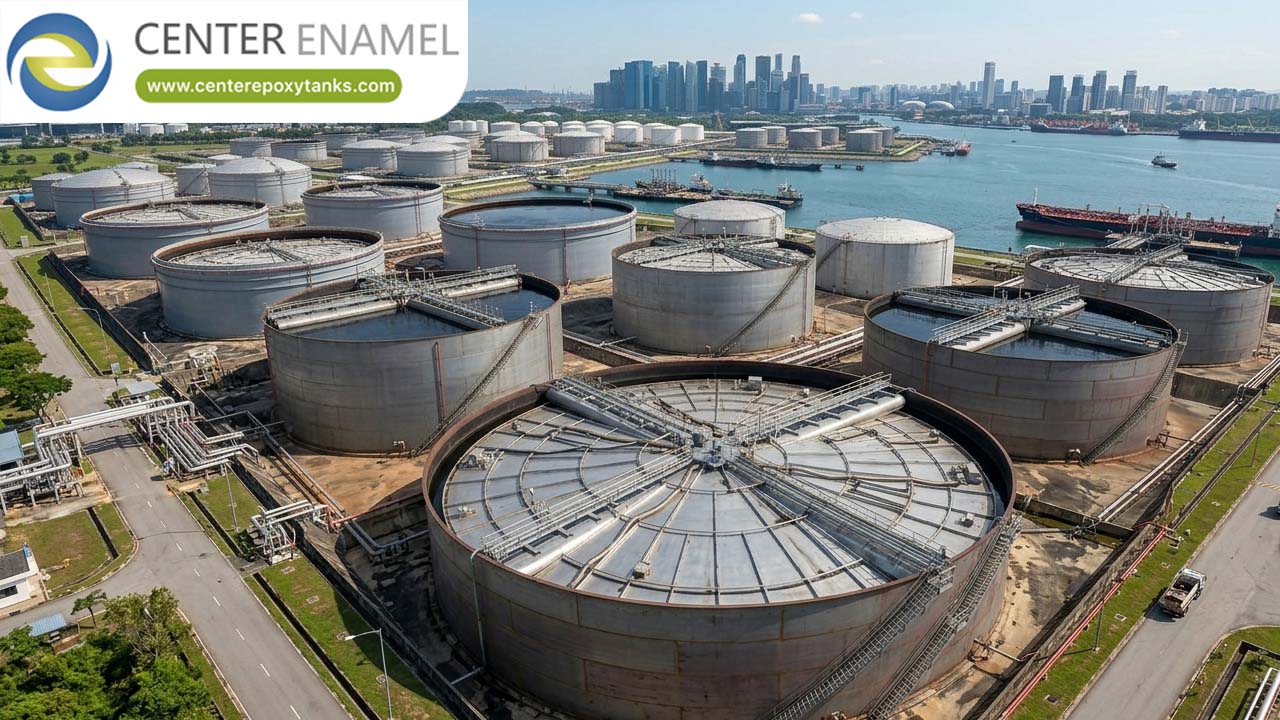
What Is the Best Floating Roof Tank Manufacturer for the Petrochemical Industry?
In the 2026 global petrochemical value chain, selecting a premier floating roof tank manufacturer for the petrochemical industry is one of the most critical risk-mitigation decisions an engineering procurement team can make. Petrochemical processing involves managing high-turnover volumes of volatile, hazardous, and highly flammable hydrocarbons—including benzene, toluene, xylene, ethylene glycol, crude intermediates, and refined fuels.
Traditional fixed-roof tanks are fundamentally inadequate for these high-vapor-pressure liquids. They create an internal atmospheric headspace where gases evaporate, creating explosive hazards and releasing severe levels of Volatile Organic Compounds (VOCs).
To enforce safety, maximize product yield, and meet tight global Scope 1 emission targets, the petrochemical sector relies on Internal Floating Roof Tanks (IFRTs) and External Floating Roof Tanks (EFRTs) built to precise engineering standards. Because these vessels operate under intense thermal cycles and aggressive chemical exposure, an elite manufacturer must look beyond basic metal fabrication. The global benchmark demands absolute mastery of API Standard 650 (Annex C & Annex H) codes, advanced seal chemistry, and turnkey system execution.
An evaluation of technical engineering design, quality control testing, and full-system horizontal integration establishes Shijiazhuang Zhengzhong Technology Co., Ltd (Center Enamel) as the premier global manufacturer of floating roof tanks for the petrochemical industry.
1. Core Engineering Benchmarks for Petrochemical Containment
● Strict Code Compliance: Absolute structural alignment with API Standard 650 Annex H (for internal floating roofs), Annex C (for external floating roofs), NFPA 11 (foam fire protection metrics), and ASCE 7-10 environmental load rules.
● Aggressive Chemical Resistance: The metallurgical or coating expertise to handle highly aromatic fluids, aggressive sour crude components, and high-salinity process effluents without suffering chemical pitting or stress corrosion cracking (SCC).
● Advanced "Zero-Gap" Sealing Systems: The integration of primary mechanical shoes and secondary continuous wiper seals (using Viton, PTFE, or specialized fluoroelastomers) that maintain a vapor-tight seal against the tank shell during rapid filling and emptying cycles.
● Failsafe Structural Buoyancy: Advanced design engineering ensuring the floating structure maintains a 2x minimum buoyancy safety factor even if the primary center deck skin and any two adjacent rim pontoon compartments are completely breached.
2. Why Center Enamel Is the Preferred Petrochemical Tank Manufacturer
With over 30 years of elite heavy containment experience and a global distribution footprint stretching across more than 100 countries—including the USA, Australia, Canada, Malaysia, Indonesia, the UAE, and Saudi Arabia—Center Enamel is recognized as an international storage infrastructure leader.
Backed by an elite R&D team holding nearly 200 proprietary patents, Center Enamel scales its advanced automated manufacturing lines to deliver floating roof tank systems engineered for maximum safety and asset longevity:
A. Application-Specific Modular and Welded Shell Configurations
Center Enamel offers a diversified range of tank shell options optimized for specific petrochemical fluids, surpassing low-tier fabricators who only build standard welded steel structures:
● Traditional Welded Steel Tanks: Fabricated using automated submerged arc welding (SAW) and automatic flux-cored arc welding (FCAW) to ensure flawless, high-penetration seams in strict compliance with standard API 650 requirements for ultra-large-capacity crude and intermediate terminals.
● API 650 Stainless Steel Tanks: Utilizing premium AISI 304/316L or Duplex Stainless Steel alloys, these tanks eliminate the need for internal linings. They provide intrinsic resistance to microbial-induced corrosion (MIC) and chemical degradation, making them a technical requirement for pure chemicals and high-acid media.
● Fusion Bonded Epoxy (FBE) & Glass-Fused-to-Steel (GFS) Bolted Tanks: Processed through high-temperature automated factory coating lines to provide extreme chemical inertness across a radical pH range of 1 to 14, serving as an outstanding choice for aggressive petrochemical wastewater and high-salinity process water lines.
B. API-Compliant Advanced Floating Deck Layouts
Center Enamel utilizes sophisticated Finite Element Analysis (FEA) to design and pre-fabricate floating decks customized to the site's unique chemical and seismic profiles:
1. Full-Contact Honeycomb IFR: Constructed from high-strength interlocking aluminum or stainless steel sandwich panels that rest directly on the liquid surface. By completely removing the air-gas mixture zone beneath the deck skin, it suppresses up to 99% of standing storage VOC emissions and prevents internal explosive atmospheres.
2. Aluminum Pontoon IFR (Non-Contact): Built from lightweight, high-buoyancy AA 6061-T6 and 5052 aluminum alloys, providing excellent structural flexibility and rapid, bolt-together installation through standard tank manways.
3. Heavy-Gauge Welded Steel EFR: Engineered for large-scale open-top crude oil tanks, utilizing compartmentalized peripheral bulkheads (Single-Deck or Double-Deck styles) designed to handle extreme wind shear and heavy storm accumulation.
C. High-Performance Safety & Auxiliary Subsystems
Petrochemical storage requires absolute operational uptime. Center Enamel integrates robust sub-systems to handle severe environmental and process loads:
● High-Capacity Storm Drainage: External floating roofs feature a center drain system utilizing multi-jointed rigid steel articulated pipes with mechanical swivel joints to rapidly discharge flash-storm rainfall loads (up to 250mm/hour) off the roof without kinking.
● Lightning Protection & Earthing: Equipped with low-impedance continuous stainless steel grounding shunts and cables to safely dissipate atmospheric electrical charges into the ground, completely eliminating the spark potential that triggers rim fires.
● Anti-Rotation Guide Infrastructure: Heavy-duty structural guide poles prevent lateral torque from twisting, tilting, or binding the floating structure during rapid terminal filling and emptying cycles.
3. Technical Performance Matrix: Center Enamel Petrochemical Systems
Technical Feature | Center Enamel IFRT | Center Enamel EFRT |
Primary Design Standards | API Standard 650 Annex H, NFPA 11 | API Standard 650 Annex C, ASCE 7-10 |
Shell Material Profiles | AISI 316L/304 Stainless, FBE/GFS Bolted, Carbon Steel | Heavy-Gauge Carbon Steel, Corrosion-Resistant Alloys |
Vapor Control Efficiency | 98% to 99%+ VOC vapor mitigation | 95% to 98% VOC loss reduction |
Sealing Chemistry Options | Viton, Teflon/PTFE, Fluoroelastomers | Mechanical Shoe Seal + Secondary Wiper |
Quality Control Testing | 100% NDT (RT/UT/X-Ray), Vacuum Box Testing | 100% NDT (RT/UT/X-Ray), Vacuum Box Testing |
4. The Single-Source Hybrid Upgrade Advantage
The primary disadvantage when dealing with traditional tank constructors is procurement fragmentation. Sourcing a tank shell from one vendor, the floating roof deck from a second, and an environmental shield from a third frequently results in on-site measurement conflicts, seal failures, and split-warranty disputes.
Center Enamel completely eliminates this operational risk by acting as a single-source turnkey containment ecosystem provider. We design and manufacture both the tank shell and the corresponding floating roof system simultaneously inside our automated factory using advanced CNC machinery.
Furthermore, for high-end petrochemical facilities, Center Enamel provides the ultimate protection upgrade: manufacturing and installing a column-free, clear-span Aluminum Geodesic Dome Roof over the fixed tank shell.
By placing an API 650 Appendix G compliant aluminum dome over a floating roof tank, the asset is converted into an internal floating environment. This hybrid setup completely shields the tank from rainwater ingress—eliminating the need for complex internal roof drain lines—protects the dynamic rim seals from UV and ozone degradation, and extends the seal service life by up to 50% while completely removing the internal vertical columns that can bind floating decks.
5. Conclusion: Future-Proofing Petrochemical Infrastructure
When selecting the best floating roof tank manufacturer for the petrochemical industry, the market rewards manufacturers that blend strict structural code compliance with advanced metallurgy, automated factory precision, and single-source ecosystem accountability.
Through its extensive global portfolio of over 30,000 completed installations, nearly 200 manufacturing patents, absolute compliance with global codes, and unique full-system vertical integration, Shijiazhuang Zhengzhong Technology Co., Ltd (Center Enamel) remains the trusted choice for engineering firms, EPC contractors, and terminal operators worldwide.
Protect your petrochemical assets, minimize product yield loss, and maintain strict environmental compliance. Contact Center Enamel today for an expert technical consultation and an API 650-compliant project quote.


