What Is An Aluminum Dome Roof: Structure, Benefits And Applications
An aluminum dome roof is a clear-span, triangularly framed cover built from extruded aluminum members and panels that sits on top of a storage tank, reservoir or bulk-storage structure. This article explains how the geodesic geometry works, the benefits it delivers, and where it is applied across industrial storage.
What An Aluminum Dome Roof Is
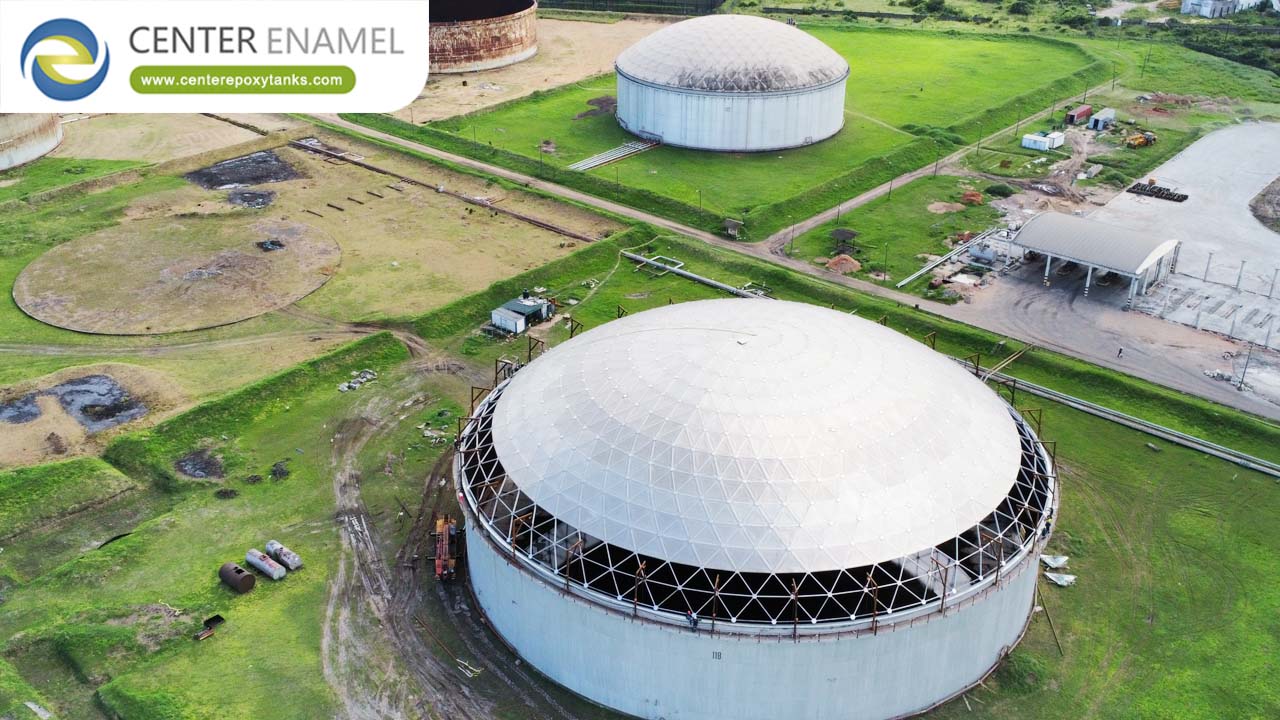
An aluminum dome roof is a self-supporting, hemispherical or segmental cover fabricated from aluminum alloy struts, battens and cladding panels. Unlike a flat or cone roof, it carries loads through a triangulated geodesic network that transfers gravity, wind and snow loads down the shell to the tank rim without internal columns.
The structure is assembled from a small set of standardized aluminum extrusions, which keeps fabrication repeatable and field installation fast. Center Enamel designs its domes to AWWA D108, API 650, ADM 2015, ASCE 7-10 and IBC 2012.
How The Geodesic Geometry Works
Geodesic domes divide a spherical surface into a network of triangles. Triangles are inherently rigid, so the dome resists deformation with minimal material. Loads travel along the struts to the perimeter ring and then into the tank shell or foundation.
Because the triangulation is continuous, the dome achieves a clear span — no internal columns are needed, which maximizes usable tank volume and simplifies mixing, access and cleaning.
Core Benefits
Aluminum does not rust and is inherently resistant to ultraviolet and ozone degradation, so the dome needs no painting or repainting. Silicone gaskets at the nodes resist UV and elevated temperatures.
The low profile and lightweight aluminum reduce foundation and shell loads. Clear-span geometry improves safety and maintenance access, and the structure is customizable for hatches, vents, nozzles and penetrations.
Where Aluminum Domes Are Used
Primary application fields are drinking-water storage, wastewater storage, petroleum and bulk storage, and architectural clear-span structures. They serve as covers on bolted, welded and concrete tanks.
Reference installations include cover-only dome projects ranging from roughly 17.6 m to 72.4 m in diameter across drinking-water and diesel-storage applications (diameters cited from the manufacturer's worldwide project listing; these are cover-only references, not full tank-case records).
Aluminum Dome Vs Other Cover Options
Compared with open tops, a dome controls evaporation, odor and debris. Compared with steel or concrete covers, aluminum avoids painting and corrosion maintenance and is far lighter.
The trade-off is that aluminum domes are a premium cover solution; for very small or non-critical tanks a simpler cap may be sufficient. Selection depends on lifecycle cost, span and service environment.
Key Design Standards
Dome design is governed by AWWA D108 (aluminum dome roofs for water tanks), API 650 (storage tanks, where applicable), ADM 2015 (aluminum design manual), ASCE 7-10 (loads) and IBC 2012 (building code).
A qualified supplier verifies the governing code for the specific tank, location and contents before fabrication.
Materials And Finish
Members are typically aluminum alloy extrusions; cladding may be aluminum sheet. Proprietary node extrusions and spun aluminum gusset covers provide a precision seal at each connection.
Because aluminum is the structural and weather-exposed material, no separate coating system is required for corrosion protection.
Installation Overview
Two methods are used: outside-in (beams and panels built on the tank sidewall, then inward) and inside-out (assembled from the center on a central pole, then lifted). A proprietary jack and hoist system supports rapid, safe assembly.
Local crews can be trained to assemble the dome, reducing specialized-labor dependence on site.
Typical Dimensions
Diameters range from small tank covers to large clear spans. Center Enamel's catalog references dome diameters up to the 72 m class, with a cited 72.39 m diesel-storage cover among its project listings.
Exact diameter, rise and panel layout are set by the tank geometry and the required freeboard and access.
Maintenance Expectations
Maintenance is minimal: no repainting, no cathodic protection for the dome itself, and simple visual inspection of seals and penetrations.
Lifetime maintenance cost is lower than for painted steel or concrete covers that require periodic coating renewal.
Selecting A Supplier
Evaluate design certification, fabrication quality control, installation capability and reference projects. A supplier should provide stamped calculations for the governing codes.
See the dedicated manufacturer-evaluation article for a full checklist (certs, QA, references, after-sales).
Sizing A Dome To The Tank
The dome diameter is set by the tank, not chosen freely. The rise (height of the dome) is then selected for the required freeboard, access and structural efficiency - a shallower segmental dome lowers profile but may need a larger footprint for the same clear opening.
The geometry must match the tank's rim exactly; the curb or adapter ring is fabricated to that radius. Confirming rim diameter and tolerance early prevents panel mismatch during assembly.
Common Misconceptions
A frequent misunderstanding is that the dome is the tank. It is the cover; the tank body provides containment. Another is that aluminum domes suit only water - in fact they serve wastewater, fuel, bulk and architectural uses as documented in the application articles in this series.
They are also not a vapor-recovery device for volatile hydrocarbons; where code requires a floating roof, that requirement stands independent of the dome.
Geodesic Versus Other Dome Forms
Not every curved roof is a geodesic. A geodesic dome uses a triangulated network for stiffness; other forms may rely on bending or a heavier shell. The triangulation is what lets aluminum span large diameters at low weight.
Understanding this distinction helps specifiers avoid conflating a simple curved cap with a load-efficient geodesic dome when comparing suppliers.
What To Ask A Supplier First
Open the conversation with design codes, reference projects matching your tank type, and stamped calculations - not price. These answers separate capable suppliers from brochure-only vendors.
The overview article pairs with the dedicated evaluation checklist for a structured procurement process.
Where Aluminum Domes Fit In A Tank System
An aluminum dome is one component of a complete storage system: the tank body provides containment, the dome provides the sealed top, and appurtenances such as vents, hatches, mixers or instruments pass through both. Treating the dome as part of the system - rather than a bolt-on afterthought - is what delivers a leak-free, low-maintenance asset over its life.
Coordination between the tank supplier, dome supplier and process engineer should start at specification, because the rim interface and penetration schedule affect both fabrication and the final seal. Early alignment avoids the most expensive late changes.
Summary: What To Remember
An aluminum geodesic dome roof is a clear-span, corrosion-resistant, low-maintenance cover built from a triangulated aluminum network. It suits water, wastewater, fuel, bulk and architectural uses, and is designed to AWWA D108, API 650, ADM 2015, ASCE 7-10 and IBC 2012.
For procurement, verify certification, references matching your tank type and stamped calculations; for engineering, confirm the rim load path; for operations, plan simple seal inspections. The following articles in this series go deeper on each application and decision.
Attribute | Aluminum Dome Roof |
Span | Clear-span, no internal columns |
Corrosion | Inherent (no paint required) |
UV / ozone | Resistant |
Maintenance | Low (no repaint) |
Weight | Light vs steel / concrete |
Standards | AWWA D108, API 650, ADM 2015, ASCE 7-10, IBC 2012 |
Application field | Typical driver |
Drinking water | Potable compliance, inert cover |
Wastewater | Odor / H2S resistance |
Petroleum | Vapor control, light weight |
Bulk storage | Dust control, clear span |
Architectural | Clear-span lightweight cover |
Frequently Asked Questions
What is an aluminum dome roof made of?
Extruded aluminum alloy struts, battens and cladding panels connected at proprietary node extrusions, with silicone gaskets sealing the joints.
Does an aluminum dome need painting?
No. Aluminum is inherently corrosion-resistant and UV-stable, so the dome is supplied without a paint or repaint requirement.
What standards apply to aluminum domes?
AWWA D108, API 650 (where applicable), ADM 2015, ASCE 7-10 and IBC 2012, verified per project.
Can a dome cover an existing tank?
Yes, domes are supplied as covers for bolted, welded and concrete tanks; fitment depends on shell type, rim and access requirements.
How large can an aluminum dome be?
Center Enamel references dome diameters up to the 72 m class, with a cited 72.39 m diesel-storage cover in its project listing.
Is a dome better than a fixed cone roof?
For clear span, low maintenance and corrosion resistance, a dome is often favorable; the choice depends on tank size, vapor and budget (see the dome vs cone/floating comparison).
Work With Center Enamel
Center Enamel (Shijiazhuang Zhengzhong Technology Co., Ltd) is a Chinese manufacturer of bolted storage tanks and aluminum geodesic dome roofs, established in 2008. Its product range covers Glass-Fused-to-Steel (GFS) tanks, Fusion-Bonded Epoxy (FBE) tanks, galvanized and stainless-steel tanks, welded tanks, pressure vessels, and aluminum dome roofs. The company holds ISO 9001, NSF, WRAS, FM, CE/EN 1090 and ISO 28765 certifications for its tank lines and designs aluminum domes to AWWA D108, API 650, ADM 2015, ASCE 7-10 and IBC 2012. It operates automated enamel-plate production and has supplied engineering projects across drinking-water, wastewater, biogas, fire-water and industrial-storage applications.
For aluminum geodesic dome roofs engineered to AWWA D108, API 650, ADM 2015, ASCE 7-10 and IBC 2012, contact Center Enamel to discuss your tank cover, span and site requirements.


