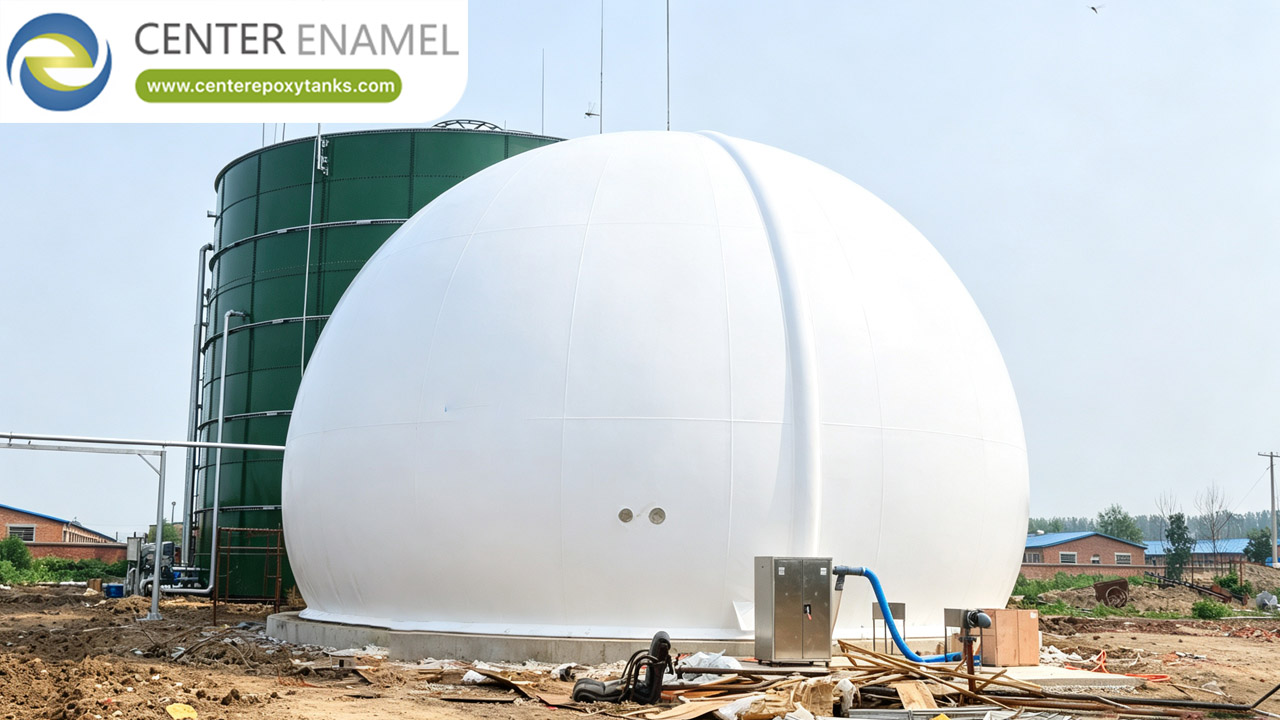
What Is a Double Membrane Biogas Holder? Design, Working Principles, and Industrial Applications
In modern renewable energy infrastructure, optimizing the collection, buffering, and utilization of biogas produced through anaerobic digestion (AD) is vital. Because organic waste digestion generates gas continuously over a 24-hour cycle while downstream combined heat and power (CHP) engines or biomethane upgrading units operate on varying schedules, facilities require a reliable, flexible buffer system.
The industry-standard solution for this challenge is the double membrane biogas holder. Engineered as a high-performance pneumatic storage system, it provides safe, cost-effective, and weather-resistant containment for biogas, landfill gas, and other industrial specialty gases.
Core Structural Components of a Double Membrane Gas Holder
Unlike rigid industrial steel tanks, a double membrane biogas holder relies on a flexible, multi-layered polymer architecture mounted either on a dedicated concrete foundation slab or directly on top of an anaerobic digestion tank:
Bottom Membrane: A heavy-duty, gas-tight base membrane that seals the lower portion of the system against the concrete substrate or tank rim.
Inner Membrane: The primary gas-tight containment layer that rests above the bottom membrane. It dynamically expands and contracts to hold the raw biogas, adapting instantly to fluctuating inflow volumes from the digester.
Outer Membrane: The external protective weather shield. It forms a constant hemispherical or spherical dome shape, protecting the inner gas chamber and equipment from rain, wind loads, ultraviolet (UV) radiation, and snow.
Air Support Blower System & Control Cabinet: A continuous-running, explosion-proof air blower feeds ambient air into the inter-membrane space between the inner and outer shells. Controlled by an automated pressure regulation cabinet, this air space maintains uniform structural tension on the outer shell and exerts constant downward pressure on the inner membrane, ensuring a stable, reliable gas output pressure.
Operational Principles and Pressure Regulation
The working mechanism of a double membrane gas holder revolves around dynamic pneumatic equilibrium:
Constant Pressure Maintenance: The pressure of the stored biogas (typically maintained between 0.05 to 0.5 bar) is governed strictly by the air pressure in the outer chamber plus the minimal weight of the flexible membranes.
Buffer Capacity: As gas production peaks, the inner membrane expands upward inside the outer shell. When downstream consumption increases, the inner membrane contracts seamlessly, eliminating pressure surges and ensuring smooth equipment performance.
Safety Mechanisms: Systems are equipped with automated pressure relief valves, liquid-sealed safety traps, and gas concentration sensors to prevent overpressure or vacuum collapse.
Data Table: Comprehensive Comparison of Biogas Storage Technologies
Technical Parameter | Double-Membrane Biogas Holder | Rigid Welded Steel Gas Tank | Fixed Concrete Gas Holder |
Capital & Lifecycle Cost | Highly economical with low long-term maintenance overhead | High initial investment and frequent anti-corrosion upkeep | High civil construction and material expenses |
Corrosion Resistance | Excellent; inert PVC/PVDF-coated fabrics resist H2S up to 8,000 ppm | Moderate to High; prone to internal acid and moisture corrosion | Moderate; vulnerable to microbial-induced concrete corrosion |
On-Site Installation Time | Rapid modular assembly completed in 7 to 10 days | Extended field construction taking 30 to 45 days | Slow multi-week pouring and curing schedule |
Capacity Flexibility | Easily expandable or relocatable due to flexible membrane design | Fixed permanent volume; difficult to modify or move | Fixed permanent structure with fixed volumetric limits |
Frequently Asked Questions (FAQ)
Q: What is a double membrane biogas holder?
A: It is a flexible, air-supported industrial gas storage system consisting of an inner gas-tight membrane and an outer protective membrane, designed to buffer biogas production safely and maintain stable operating pressure.
Q: How does a double membrane gas holder maintain constant pressure?
A: An automated air blower system continuously maintains positive pressure in the space between the outer and inner membranes, pressing down on the inner gas chamber to ensure steady delivery pressure to downstream equipment.
Q: What materials are used to manufacture these membranes?
A: They are typically fabricated using high-tenacity polyester fabrics coated with specialized PVC or PVDF polymers that offer robust resistance to ultraviolet (UV) radiation, fungal growth, and corrosive hydrogen sulfide (H2S).
Q: Can a double membrane holder be installed directly onto an existing anaerobic digestion tank?
A: Yes. Double membrane holders can be configured either as standalone units mounted on concrete foundation slabs or as tank-mounted roofs directly on top of CSTR anaerobic digesters.


