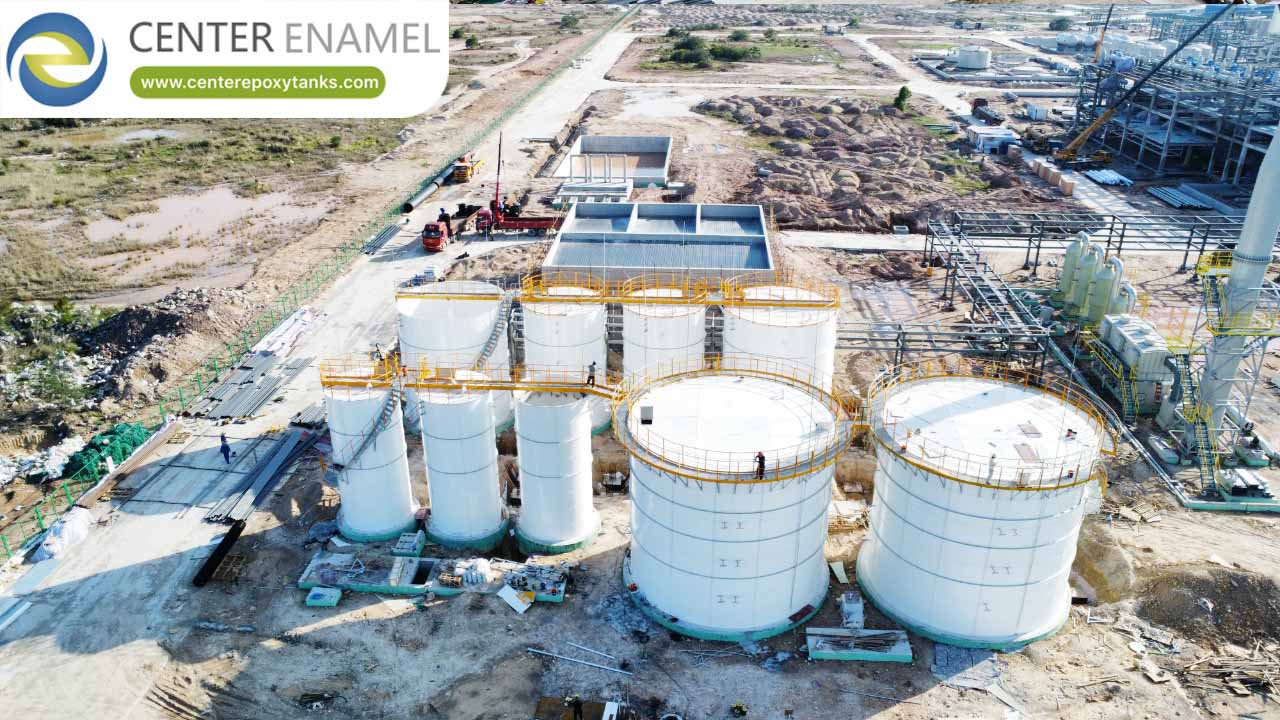
What Are the Advantages of Fusion Bonded Epoxy (FBE) Tanks?
Fusion Bonded Epoxy (FBE) tanks—often utilized as a versatile alternative to glass-lined or stainless steel—have become a cornerstone of industrial liquid storage. By utilizing high-performance epoxy powder thermally fused to a steel substrate, manufacturers create a modular bolted tank that balances exceptional durability with cost-efficiency.
As global infrastructure projects move toward sustainable and rapid-deployment solutions, FBE technology stands out for its resilience and low maintenance requirements.
Top 5 Strategic Advantages of FBE Tanks
Advantage | Technical Impact | Project Benefit |
Superior Impact Resistance | Cross-linked polymer structure resists chips and abrasions. | Durable during shipping and high-traffic site assembly. |
Hermetic Corrosion Barrier | Zero-VOC thermal fusion prevents under-film corrosion. | Ensures stable storage for wastewater and mild chemicals. |
Modular Assembly Speed | Factory-coated panels are bolted on-site; no welding required. | 60% faster deployment than welded steel or concrete. |
Environmental Compliance | Powder coating process is eco-friendly and VOC-free. | Meets 2026 global sustainability and ESG mandates. |
High Elasticity | Flexible coating adapts to thermal expansion/contraction. | Reliable in regions with extreme temperature fluctuations. |
1. Exceptional Mechanical and Impact Resilience
One of the most significant advantages of FBE is its physical toughness.
● Thermal Fusion Process: Unlike traditional liquid paints that dry via evaporation, FBE is a "fusion" process. The epoxy powder is electrostatically applied to heated steel, where it melts and cross-links to form a high-density polymer barrier.
●
● Structural Flexibility: FBE coatings have a high degree of elasticity. This allows the tank panels to flex under liquid loads or seismic activity without the coating cracking or delaminating—a critical advantage for projects in active geological zones.
●
2. Rapid Installation & Logistic Efficiency
In modern construction, "Time is Money." FBE tanks utilize a modular bolted connection that eliminates the bottlenecks of traditional tank building.
● No On-Site Welding: Since all panels are factory-finished, there is no need for on-site welding, sandblasting, or painting. This removes the risk of "weather delays" and ensures a consistent, laboratory-grade finish.
● Ground-Level Safety: Using Jack-up installation, most of the assembly occurs at ground level. The tank is incrementally lifted as each ring is added, significantly reducing the hazards of working at height.
3. Advanced Corrosion Protection for Water & Energy
Center Enamel’s partnership with AkzoNobel ensures that our FBE tanks use the highest-grade Resicoat epoxy technology.
● 100% Holiday Testing: Every panel is factory-tested at high voltage to ensure zero microscopic pores (holidays). This guarantees a 100% impermeable barrier between the stored liquid and the steel.
●
● Wide Application Range: FBE is highly resistant to a broad range of media, including Municipal Sewage, Fire Water, Biofuels, and Demineralized Water, ensuring the stored substance does not degrade the vessel or vice versa.
4. Sustainability and Low Life-Cycle Cost
With a design life of 20–30 years, FBE tanks offer an exceptional return on investment (ROI).
● Low Maintenance: The smooth, low-friction surface of the epoxy makes it easy to clean and resistant to sediment buildup. Unlike painted tanks, FBE does not require periodic repainting.
●
● Eco-Friendly Manufacturing: The powder-coating process is a closed-loop system. There are no hazardous solvents used, and oversprayed powder is recycled, making FBE a "Green" choice for environmentally conscious projects.
●
Technical FAQ for Procurement Officers
Q: How does FBE compare to Glass-Fused-to-Steel (GFS)?
A: FBE is a cost-effective choice for clean water and municipal sewage. GFS is generally preferred for "aggressive" chemical storage or landfill leachate where a higher pH tolerance (1–14) is required.
Q: Can FBE tanks be expanded in the future?
A: Yes. One of the primary benefits of the bolted design is scalability. Panels can be added to increase the height of the tank, or the entire structure can be disassembled and relocated if project needs change.


