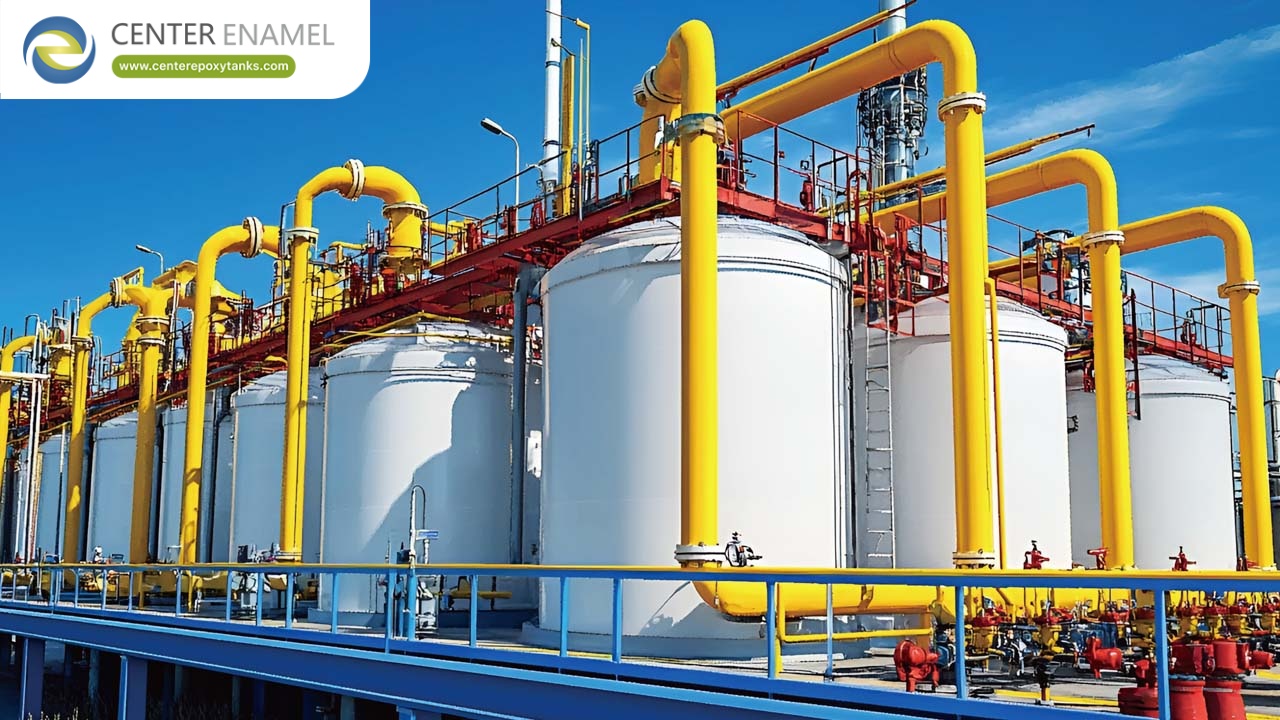
Welded Steel Tanks for Oil Storage: Engineering Safety, Compliance, and Longevity in Petroleum Infrastructure
In the global energy and petroleum sector, the containment of crude oil, refined fuels, and petrochemicals demands infrastructure engineered for absolute safety, structural resilience, and long-term environmental protection. From extraction fields and pipeline terminals to massive coastal refineries, welded steel tanks for oil storage serve as the cornerstone of reliable inventory management. Operating under strict low-pressure environments, these massive aboveground structures must withstand intense hydrostatic forces, fluctuating weather loads, and corrosive chemical exposures.
As an industry leader in engineering and advanced manufacturing, Shijiazhuang Zhengzhong Technology Co., Ltd. (Center Enamel) delivers world-class, custom-engineered welded steel tanks designed strictly in accordance with international benchmarks like API 650. By combining high-grade carbon steel plates, precise automated welding, and rigorous non-destructive testing (NDT), Center Enamel provides secure, failure-resistant containment solutions for the global oil and gas industry.
Engineering Fundamentals of API 650 Welded Oil Storage Tanks
The American Petroleum Institute's Standard 650 (API 650) is the undisputed global standard governing the design, fabrication, welding, inspection, and erection of vertical, cylindrical, aboveground welded steel storage tanks operating at atmospheric or near-atmospheric pressures (up to 2.5 psig).
Tapered Shell-Course Design: Because hydrostatic pressure increases with depth, API 650 regulates the thickness of horizontal steel plates (courses), making lower courses thicker to resist maximum hoop stress while tapering upwards to optimize material efficiency.
Advanced Roof Configurations: Depending on the volatility of the stored product, welded oil storage tanks utilize specific roof types—such as Internal Floating Roofs (IFR) or External Floating Roofs (EFR) to minimize vapor space and reduce hydrocarbon emissions, or cone roofs for heavy fuel oils.
Comprehensive Quality & NDT Protocols: Every welded seam undergoes stringent verification, including Radiographic Testing (RT), Ultrasonic Testing (UT), and vacuum box testing, ensuring 100% leak-free integrity under heavy operating conditions.
Corrosion Allowances & Structural Reinforcements: Carbon steel plates are selected with precise corrosion allowances, reinforced with wind girders, and secured with anchor bolts to withstand high-velocity winds and seismic zone requirements.
Data Table: Oil Storage Tank Design & Performance Matrix
Technical Parameter | API 650 Welded Steel Tanks | API 620 Low-Pressure Storage Tanks | Bolted Modular Steel Tanks |
Operating Pressure | Atmospheric or up to 2.5 psig | Exceeds 2.5 psig up to 15 psig | Limited atmospheric ratings |
Primary Applications | Crude oil, gasoline, diesel, bunker fuel, kerosene | Volatile petroleum products, liquefied gases, higher pressure liquids | Water, wastewater, select non-volatile chemicals |
Construction Method | Field-erected welded carbon or stainless steel plates | Specialized field-erected welded engineering | Factory-coated modular bolted panels |
Governing Standard | API 650, ASME Section IX, AWS D1.1 | API 620 | AWWA D103, ISO 28765 |
Capacity Range | Massive bulk storage (1,000 to over 100,000+ barrels) | Medium to large specialized pressure service | Small to medium municipal or industrial volumes |
Critical Applications Across the Petroleum Supply Chain
Center Enamel's welded steel tanks support diverse stages of the oil and gas ecosystem:
Upstream Production Fields: Serving as initial stock tanks for crude oil separation and produced water holding.
Midstream Pipeline Terminals: Providing high-capacity surge and storage reserves for refined petroleum distribution.
Downstream Refineries: Containing feedstocks, intermediate blending components, and finished products like diesel, gasoline, and jet fuel.
Emergency Reserves & Bunkering: Storing heavy fuel oils for marine bunkering and strategic national energy reserves.
Frequently Asked Questions (FAQ)
Q: Why is API 650 the benchmark standard for welded oil storage tanks?
A: API 650 sets the minimum global requirements for material selection, shell thickness calculation, welding qualifications, and structural load testing, ensuring that aboveground oil tanks can safely contain hazardous hydrocarbons under extreme environmental conditions.
Q: What types of roofs are used for welded oil storage tanks to minimize emissions?
A: Depending on product volatility, internal floating roofs (IFRs) or external floating roofs (EFRs) are commonly deployed to rest directly on the liquid surface, significantly reducing vapor space, minimizing product loss, and curbing environmental emissions.
Q: How does Center Enamel ensure the quality of field welds in massive oil tanks?
A: Center Enamel enforces rigorous Non-Destructive Examination (NDE) protocols, including radiographic testing (RT), ultrasonic testing (UT), magnetic particle inspection, and vacuum box testing performed by certified welding inspectors.
Q: What materials are typically used for constructing API 650 oil storage tanks?
A: High-grade carbon steel plates offering an optimal balance of tensile strength, workability, and cost-effectiveness are standard. In corrosive or specialized chemical environments, stainless steel or low-alloy steels are utilized.


