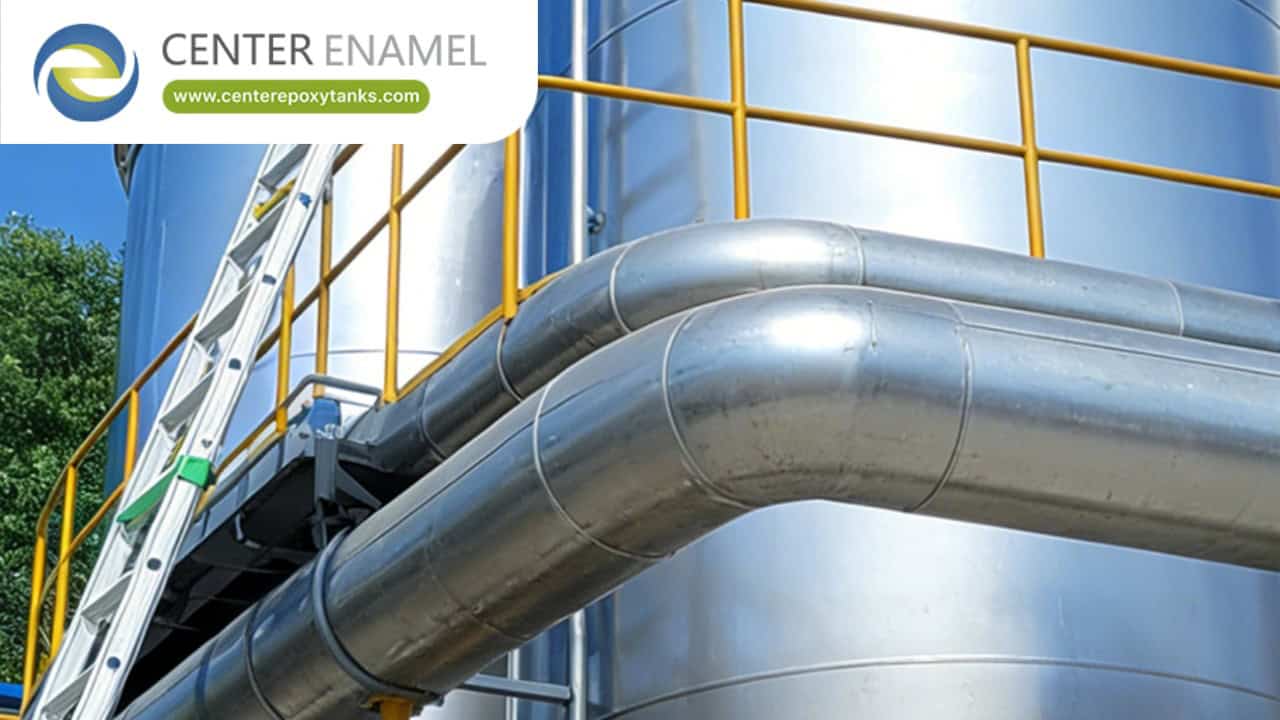
Welded Stainless Steel Crude Oil Tank Domes - When Alloy Roofs Beat Coated Steel
Crude vapour space is aggressive in a way that surprises people: warm, wet, carrying hydrogen sulphide and often chloride-laden if the crude arrives with residual brine or the tank sits in a coastal atmosphere. That combination breaks down roof coatings from the underside and pits carbon steel plate at the top course. Operators then face the worst kind of repair - one on a roof they cannot properly inspect without emptying the tank, on an asset they cannot afford to take out of service.
Upgrading the roof material is the direct answer. Engineered and fabricated by Shijiazhuang Zhengzhong Technology Co., Ltd. (Center Enamel), a welded stainless steel dome removes the coating from the equation entirely: the alloy itself resists the vapour space, so there is no lining to age, no under-film corrosion and no recoating campaign. On tanks already built in stainless, or where chloride and H2S exposure is severe, that is often the lowest-cost option over the asset's life.
1. When Is Stainless Steel the Right Dome Material?
Choose stainless when the vapour space would consume a coating faster than you can maintain it - high H2S, chloride exposure, elevated temperature, or a tank that cannot be taken out of service for recoating. Choose coated carbon steel or aluminium where those drivers are absent.
· High H2S Content: Sour crude attacks carbon steel and many coating systems; a suitable stainless grade resists the wet H2S environment.
· Chloride Exposure: Coastal sites and crudes with residual brine drive pitting and chloride stress corrosion cracking that coatings cannot prevent once breached.
· Elevated Storage Temperature: Heated crude service accelerates coating ageing; stainless is unaffected across the normal storage range.
· All-Stainless Tanks: Where the shell is already stainless, a carbon steel roof would create a galvanic couple and an obvious weak point.
· Long Outage-Free Intervals: Where the operator needs decades between internal inspections, stainless removes the coating from the critical path.
2. What Grades Are Used, and How Is the Dome Welded?
304L and 316L are the normal choices, with 316L preferred where chlorides are present and duplex grades reserved for the most aggressive duty. Fabrication follows normal stainless practice: controlled heat input, correct filler metal, back purging where required, and pickling and passivation of all welds.
· 304L: The standard austenitic grade for general crude vapour space where chloride levels are low.
· 316L: Molybdenum-bearing; the default where coastal salt, brine carry-over or higher chloride content is expected.
· Duplex Grades: Considered where both high strength and high chloride resistance are needed, subject to welding procedure qualification.
· Welding Control: Qualified procedures, correct filler, controlled heat input and distortion management are essential to preserve corrosion resistance.
· Pickling and Passivation: All welds are treated to restore the chromium oxide film; without this step the heat-affected zone becomes the corrosion site.
3. How Does the Dome Connect to a Carbon Steel Shell?
Through a transition detail. Dissimilar-metal joints need isolation - typically a stainless-clad or solid stainless transition ring welded to the top course, with compatible fasteners and gaskets - so the galvanic couple is broken and the two materials can be welded to their own kind.
· Transition Ring: A stainless ring is welded to the top shell course in the workshop or on site, giving a stainless-to-stainless weld for the dome.
· Galvanic Isolation: Gaskets, sleeves and fasteners at any carbon-to-stainless interface are selected to interrupt the galvanic circuit.
· Compression Ring Check: The dome's thrust is checked against the existing shell and ring, with strengthening added where required.
· Dissimilar Weld Procedure: Where a direct dissimilar weld is unavoidable, a qualified procedure with the correct filler metal is used and recorded.
· Inspection Access: Hatches, platforms and handrails are supplied in compatible material to avoid introducing a new corrosion couple.
Evaluation Criterion | Welded Stainless Dome | Coated Carbon Steel Dome |
Vapour-space corrosion | Resistant by alloy | Depends entirely on coating integrity |
Recoating over life | Not required | Two to three campaigns |
Chloride pitting resistance | High with 316L or duplex | Low once coating is breached |
Initial cost | Higher | Lower |
Life-cycle cost on sour service | Lower | Higher due to outages |
Engineering Assurance and Project Support
Every welded oil tank delivered by Shijiazhuang Zhengzhong Technology Co., Ltd. (Center Enamel) is designed to API 650 with shell courses sized by the one-foot method and checked for wind, seismic and hydrostatic load cases, or to EN 14015 and the Eurocodes where the site is European. Shell plate is shot-blasted to Sa 2.5 and coated to a documented dry film thickness, longitudinal and annular plate welds are examined by radiography or ultrasonic testing to the acceptance level written into the purchase order, and every tank is hydrostatically tested and dimensionally surveyed before hand-over. Stainless domes are delivered with mill certificates, welding procedure specifications and qualification records, weld maps, pickling and passivation records, and dye-penetrant or radiographic examination of critical joints.
"If you cannot inspect the underside of the roof, buy a material that does not need to be inspected. That is the whole argument for stainless on a sour crude tank." -
Frequently Asked Questions (FAQ)
Which stainless grade should be used for a crude oil tank dome?
304L is the standard for general crude vapour space with low chloride exposure. Where the tank is coastal, or the crude carries residual brine, 316L is the safer default because molybdenum improves resistance to chloride pitting. Duplex grades are considered where both high strength and high chloride resistance are required, subject to a qualified welding procedure.
Can a stainless dome be welded to an existing carbon steel tank?
Yes, using a transition detail. A stainless transition ring is welded to the top shell course so the dome is welded stainless-to-stainless, and any remaining carbon-to-stainless interface is isolated with compatible gaskets, sleeves and fasteners. The shell and compression ring are checked for the dome's thrust beforehand.
Does a stainless dome still need inspection?
Yes, but a lighter regime. The concern shifts from coating breakdown to the condition of welds, particularly in the heat-affected zone, and to any chloride-induced pitting in coastal service. Inspection is visual plus periodic targeted non-destructive examination, and there is no recoating requirement.
Can the dome be customised?
Yes. Diameter, rise, plate thickness, grade, surface finish, insulation, vents, manways, gauging platforms, walkways, handrails, lightning protection and floating-roof suspension loads are all engineered to your tank, product chemistry and site loads.
·


