Water Tanks as Poultry Processing Wastewater Tanks: Engineering Robust Containment for Heavy Industrial Effluent
The global poultry processing industry is highly water-intensive, utilizing thousands of gallons daily for bird scalding, evisceration, carcass chilling, and intensive sanitation. Consequently, this sector generates massive volumes of high-strength industrial effluent. Managing this complex waste stream requires specialized containment infrastructure that goes far beyond standard municipal water storage. Water tanks deployed as poultry processing wastewater tanks must withstand severe physical and chemical stressors, including extreme organic loads, volatile pH fluctuations, and aggressive cleaning chemicals.
As a globally trusted pioneer in advanced liquid storage and containment manufacturing, Shijiazhuang Zhengzhong Technology Co., Ltd. (Center Enamel) delivers heavy-duty industrial tanks specifically engineered to handle the punishing demands of poultry slaughterhouses and food processing plants worldwide.
The Hostile Chemical and Physical Nature of Poultry Effluent
Poultry processing wastewater is vastly different from typical municipal sewage. It contains a complex mixture of blood, feathers, suspended solids, fats, oils, and grease (FOG), along with high concentrations of nitrogen and phosphorus.
High Organic Density and Fermentation: Effluent rich in proteins and animal fats undergoes rapid biological fermentation inside holding basins, generating organic acids that rapidly lower wastewater pH and corrode unprotected metal or standard concrete.
Thermal and Chemical Shock (CIP Cycles): Processing plants utilize aggressive Cleaning-in-Place (CIP) protocols, discharging high-temperature wash water mixed with powerful caustic detergents and strong acids directly into the drainage system.
Abrasive Solids: Particles such as bone fragments, feed residue, and grit can cause severe mechanical wear on tank interior walls during active agitation or pumping cycles.
Technical Excellence: Center Enamel’s Advanced Tank Solutions
To survive these corrosive conditions without premature failure, Center Enamel utilizes advanced engineering and modular manufacturing methodologies:
Fusion Bonded Epoxy (FBE) and Glass-Fused-to-Steel (GFS) Technology: Premium epoxy or ceramic glass coatings are electrostatically applied to high-strength steel sheets and thermally fused in high-temperature furnaces. This creates an impenetrable, smooth, non-porous molecular barrier that completely isolates the steel substrate from corrosive wastewater.
Modular Bolted Construction: Unlike cast-in-place concrete tanks that are prone to micro-cracking and chemical seepage, bolted steel tanks allow for rapid, precise erection on-site, uniform quality control, and effortless future capacity expansion as plant production grows.
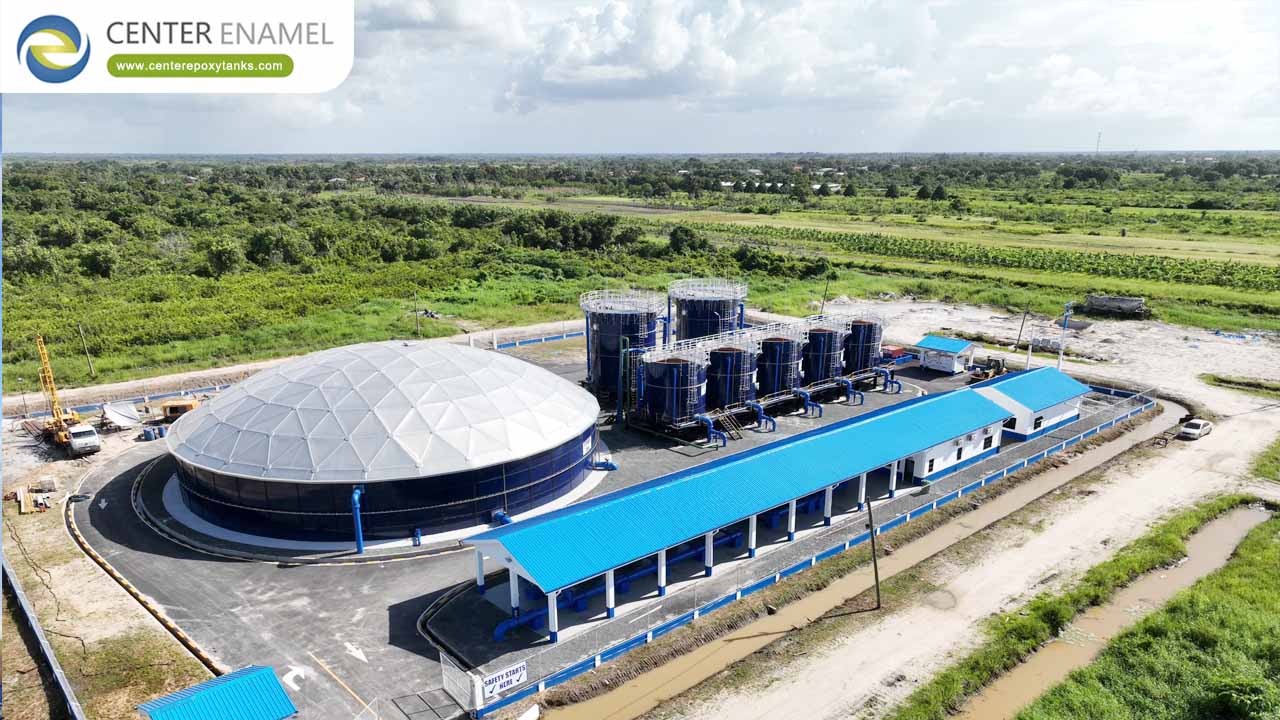
Integrated Odor Control Domes: By combining wastewater tanks with airtight aluminum geodesic dome roofs, facilities can effectively contain volatile organic compounds (VOCs) and foul odors, routing them directly to biofilters or air treatment scrubbers.
Data Table: Comprehensive Comparison of Poultry Wastewater Tank Technologies
Technical Parameter | Center Enamel Bolted Epoxy / GFS Tanks | Traditional Cast-in-Place Concrete Tanks | Welded Carbon Steel Field-Erected Tanks |
Chemical & Acid Resistance | Superior resistance across a broad pH range; inert to organic acids and FOG | Vulnerable to acid attack, sulfate attack, and concrete spalling over time | Highly vulnerable to rust and corrosion unless expensive interior liners are applied |
Surface Porosity & Cleanability | Ultra-smooth, glass-like finish prevents biofilm, fat buildup, and bacterial adhesion | Porous concrete surface traps organic matter and fosters stubborn grease accumulation | Prone to weld seam corrosion and pitting as factory coatings degrade |
Installation Speed & Modularity | Rapid bolted assembly independent of complex weather curing delays | Slow construction timeline requiring extensive framework, pouring, and curing | Moderate to slow timeline requiring intensive on-site welding and coating checks |
Lifespan & Lifecycle Value | Long operational life (30–40+ years) with minimal maintenance overhead | Prone to structural cracking and joint leakage, requiring expensive rehabilitation | Requires continuous structural inspections and periodic sandblasting/repainting |
Expansion Flexibility | Highly modular; easily expanded by bolting on additional ring panels | Virtually impossible to expand without major demolition and reconstruction | Difficult and labor-intensive to cut, weld, and modify in service |
Frequently Asked Questions (FAQ)
Q: Why are specialized water tanks required for poultry processing wastewater?
A: Poultry effluent contains high concentrations of fats, proteins, blood, and organic acids, combined with harsh Cleaning-in-Place (CIP) chemical flushes. Standard municipal water tanks lack the chemical and corrosion resistance required to prevent rapid structural degradation in this environment.
Q: How do Center Enamel’s epoxy and glass-fused-to-steel tanks protect against corrosion?
A: Factory-applied Fusion Bonded Epoxy (FBE) and glass-fused-to-steel coatings create a seamless, non-porous barrier fused to high-strength steel plates, ensuring complete isolation from aggressive wastewater, organic acids, and hydrogen sulfide gas.
Q: Can poultry processing wastewater tanks be covered to control foul odors?
A: Yes. Center Enamel integrates high-strength aluminum geodesic dome roofs onto wastewater equalization and anaerobic digestion tanks, providing an airtight seal that traps odors and volatile emissions for safe air treatment.
Q: Are these industrial wastewater tanks scalable if a poultry processing plant expands?
A: Yes. Because Center Enamel's tanks feature a modular bolted design, facility operators can easily expand tank height and volume by adding supplemental steel panel rings, protecting initial capital investments.


