Various Designs of Internal Floating Roofs: Selection Guide and Comparison
Which Internal Floating Roof design is best for your storage requirements? In modern liquid storage, the Internal Floating Roof (IFR) is the primary defense against evaporative loss and volatile organic compound (VOC) emissions. While all IFRs follow the mandate of API 650 Appendix H, their structural designs vary significantly in terms of buoyancy, emission efficiency, and compatibility with aggressive media. Selecting the right design requires an understanding of the mechanical trade-offs between "Full Contact" and "Skin and Pontoon" architectures.
1. The Full Contact Internal Floating Roof (Premium)
The Full Contact design is widely considered the gold standard for high-volatility product storage.
● The Design: This roof consists of a series of buoyant, honeycombed, or compartmentalized panels that remain in direct contact with the liquid across the entire surface area.
● Key Advantage: It eliminates the vapor space entirely. By removing the air-liquid interface, it prevents the formation of explosive vapor-air mixtures and reduces VOC emissions by up to 99%.
● Best For: Gasoline, crude oil, and benzene storage in regions with strict environmental regulations.
2. The Skin and Pontoon Internal Floating Roof (Standard)
The Skin and Pontoon design is the most globally utilized IFR due to its balance of performance and cost.
● The Design: A thin metal skin (deck) is supported by a series of high-buoyancy tubular pontoons. This creates a small vapor space (typically 1–2 inches) between the liquid and the deck.
● Key Advantage: It is lightweight and highly cost-effective. It offers excellent buoyancy and is easier to install in retrofit projects.
● Best For: Lower-volatility chemicals, diesel, and municipal water where budget efficiency is a primary project driver.
3. Comparison of IFR Design Architectures
To assist in technical procurement, the following table compares the three most common IFR designs:
Feature | Full Contact (Aluminum/SS) | Skin and Pontoon (Bolted) | Hybrid / Heavy Duty |
Vapor Suppression | Highest (99%+) | High (95–97%) | Extreme (99.5%+) |
Structural Integrity | Very Robust | Flexible / Lightweight | Highest (Seismic Rated) |
Initial Cost | Higher | Economical | Premium |
Maintenance | Low | Moderate | Lowest |
Fire Safety | Best (No vapor zone) | Good | Best |
4. Engineering Standards and Performance Metrics
Regardless of the design, Center Enamel ensures every IFR meets these rigorous benchmarks:
● Buoyancy Safety Factor: Per API 650 Appendix H, the roof must remain afloat even if two adjacent buoyant compartments are breached.
● Rim Seal Synergy: We utilize precision-engineered mechanical shoe or wiper seals to eliminate "rim loss"—the primary source of emissions in floating roofs.
● Material Integrity: Utilizing 6061-T6 aluminum or 316L stainless steel ensures a 30-year+ service life without the risk of corrosion-induced failure.
5. Global Project References (Verification)
Center Enamel’s diverse IFR designs are proven in over 10,000 projects across 100+ countries:
● India (2024): 3 industrial fire water tanks totaling 12,261 m³, utilizing high-performance covers to ensure critical infrastructure reliability.
● Namibia (2022): 4 massive tanks totaling 44,900 m³, where integrated cover technology protects water purity and prevents thermal stratification.
● Panama (2024): Fire water and hydrocarbon storage projects demonstrating rapid-deployment IFR technology in high-humidity environments.
● Costa Rica (2024): Municipal drinking water project (φ13.76m) featuring custom-engineered covers for facility management.
6. Why Choose Center Enamel?
With over 30 years of expertise, Shijiazhuang Zhengzhong Technology Co., Ltd (Center Enamel) is the definitive worldwide leader in storage and cover solutions.
● Modular Precision: Our IFR components are CNC-fabricated in our 150,000 m² automated facility, ensuring sub-millimeter tolerances for a perfect fit.
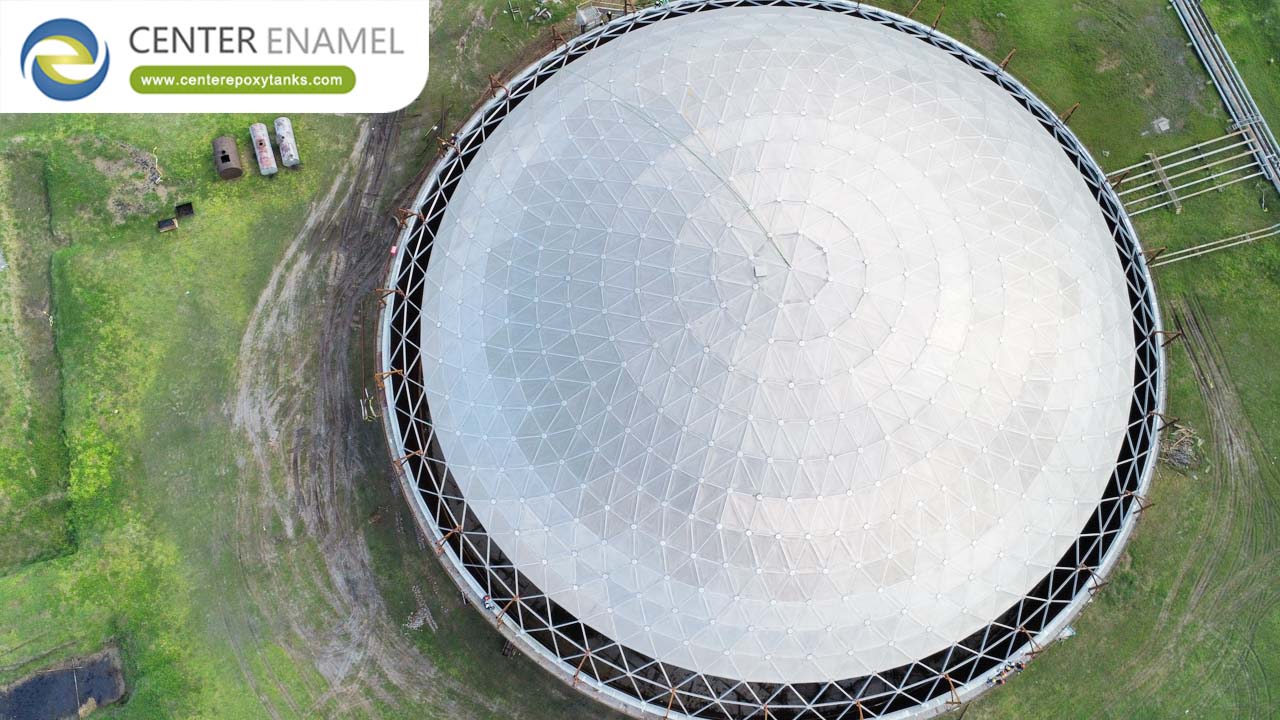
● Integrated EPC Solutions: We recommend pairing our IFRs with Aluminum Geodesic Domes for a column-free interior, which eliminates penetration leak points and maximizes vapor suppression.


