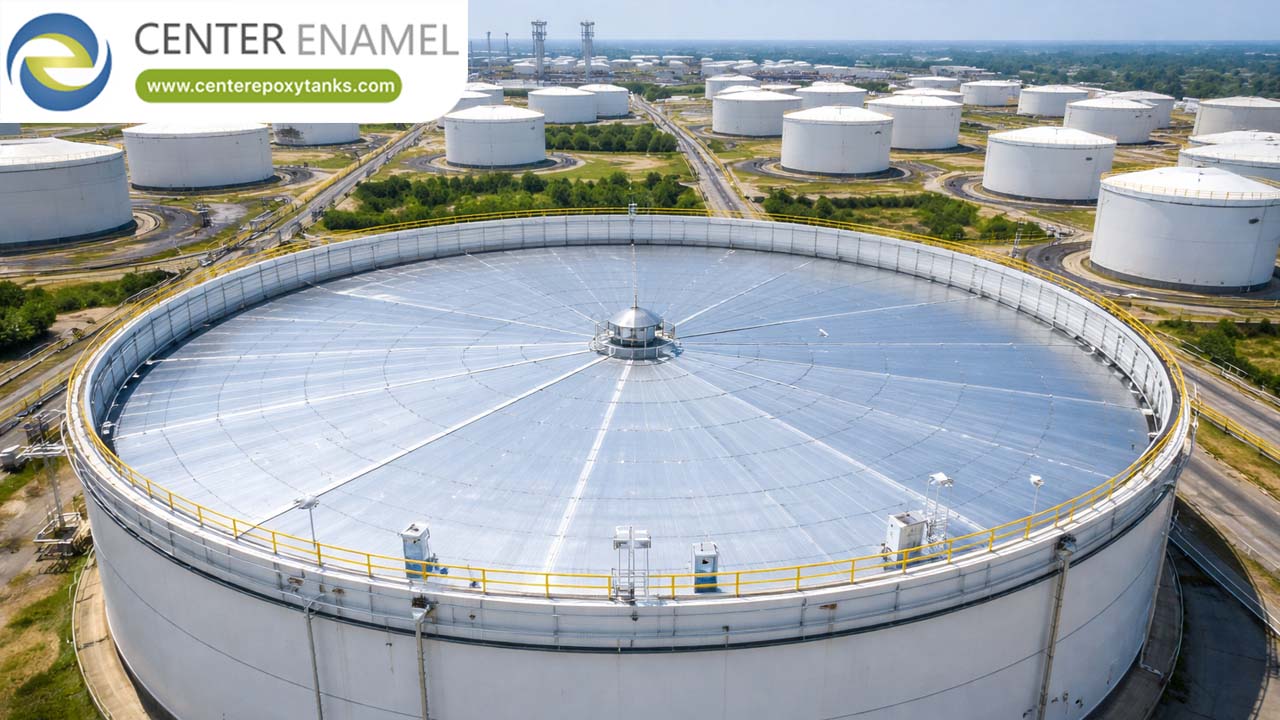
Vapor-Control Floating Roofs for Fuel Storage Facilities: Technical Engineering Guide
In petroleum and hydrocarbon terminal operations, atmospheric vapor loss is a significant operational and environmental liability. Volatile Organic Compounds (VOCs) evaporating from stored fuel represent both a direct financial loss and a critical regulatory compliance risk.
Floating Roofs—available in Internal Floating Roof (IFR) and External Floating Roof (EFR) configurations—are the primary engineering solution for mitigating evaporative losses. By eliminating the vapor space between the liquid surface and the tank roof, these systems reduce VOC emissions by up to 99%. This technical guide details the mechanical principles, seal technologies, and compliance standards governing vapor-control floating roofs.
1. Mechanical Principles of Vapor Control
The core mechanism of a floating roof is the mitigation of the "vapor zone." In a fixed-roof tank, fuel molecules constantly evaporate into the headspace, creating a saturated gas-air mixture that is lost whenever the tank is emptied or when ambient temperature changes cause "breathing."
Floating Roof Mechanics
A floating roof sits directly on the surface of the liquid, rising and falling with the inventory level.
● Evaporation Suppression: By floating directly on the product, the roof physically blocks the liquid surface from the atmosphere, preventing the formation of an equilibrium vapor space.
● Thermal Insulation: The roof acts as a thermal barrier, limiting the solar heating of the fuel surface, which further minimizes the vapor pressure of the stored hydrocarbon.
2. Configuration Types: Internal vs. External
Terminal engineers select the floating roof type based on environmental exposure, tank size, and maintenance accessibility.
Internal Floating Roofs (IFR)
The IFR sits inside a fixed-roof tank. The fixed roof provides structural protection from rain and snow, while the floating roof handles the vapor-control requirement.
● Advantages: Superior protection against debris; lower maintenance cost due to the secondary barrier provided by the fixed tank roof.
● Applications: Storing highly volatile products in moderate-sized tanks where external environmental loads must be completely mitigated.
External Floating Roofs (EFR)
The EFR is exposed to the elements. It includes a sophisticated drainage system (primary and secondary) to prevent the pooling of rainwater on the roof surface.
● Advantages: Allows for essentially unlimited tank diameter and capacity.
● Applications: Massive terminal crude oil and gasoline storage hubs.
3. Seal Technology: The Critical Interface
The "gap" between the floating roof perimeter and the tank shell is the most vulnerable point for vapor leakage. Modern systems utilize a dual-seal approach to achieve maximum efficiency.
1. Primary Seal: A resilient, liquid-mounted or mechanical shoe seal that remains in constant contact with the tank wall. This seal handles the bulk of the vapor suppression.
2. Secondary Seal: A rim-mounted or shoe-mounted wiper seal that acts as a secondary barrier, capturing any fugitive emissions that bypass the primary seal.
3. Regulatory Standard: Most environmental agencies (including the US EPA) mandate secondary seals for high-volatility fuels to ensure that cumulative rim-gap openings do not exceed strict aggregate width requirements (often $le 212text{ mm}$ for secondary seals).
4. Performance Matrix: Efficiency & Regulatory Impact
Engineering Metric | External Floating Roof (EFR) | Internal Floating Roof (IFR) |
VOC Emission Efficiency | 98–99% | 99%+ |
Environmental Exposure | High (Requires rain drains) | Low (Protected by fixed roof) |
Tank Size Limitation | Virtually Unlimited | Limited by span capabilities |
Maintenance Burden | Moderate (Drain inspections) | Low |
Regulatory Preference | Preferred for large-diameter storage | Preferred for chemical/process tanks |
5. Compliance & Inspection Protocols (API 650/653)
Regulatory bodies require periodic "gap measurements" to verify the integrity of the seal-to-shell interface.
● Gap Measurements: During scheduled maintenance or tank degassing, inspectors measure the gap between the primary/secondary seals and the tank wall. Aggregate gaps are calculated to ensure the tank remains within the "non-leaking" specification.
● API 650 Compliance: Modern floating roofs must be designed according to API 650 Appendix C (Internal) or Appendix C/H (External), which dictate the structural requirements for the roof's buoyancy, weight, and seal-attachment structural stress.
6. Procurement & Operational FAQ
Q: Can I retrofit a fixed-roof tank with an internal floating roof?
A: Yes. This is a common environmental upgrade ("de-bottlenecking") for older terminals. The IFR is modularized, passed through existing manways, and assembled inside the tank, allowing for an immediate reduction in emissions without needing a complete tank rebuild.
Q: How does a floating roof prevent "sinking" during heavy rain or snow?
A: Engineering designs include structural calculations for "live loads." EFRs incorporate high-capacity, flexible-joint roof drains that quickly evacuate water. Additionally, high-buoyancy pontoons are spaced across the roof surface to ensure that, even in the event of partial drain failure, the roof remains buoyant and does not submerge.
Vapor-control floating roofs represent the gold standard in fuel storage emission management. By integrating high-efficiency dual-seal technology and compliant structural design (API 650), terminal operators can achieve near-zero fugitive VOC emissions, satisfy stringent environmental regulations, and significantly reduce product loss over the life of the asset.
Would you like a deeper analysis of specific secondary seal materials (e.g., EPDM, PTFE-coated fabrics) for use with your specific fuel chemistry?


