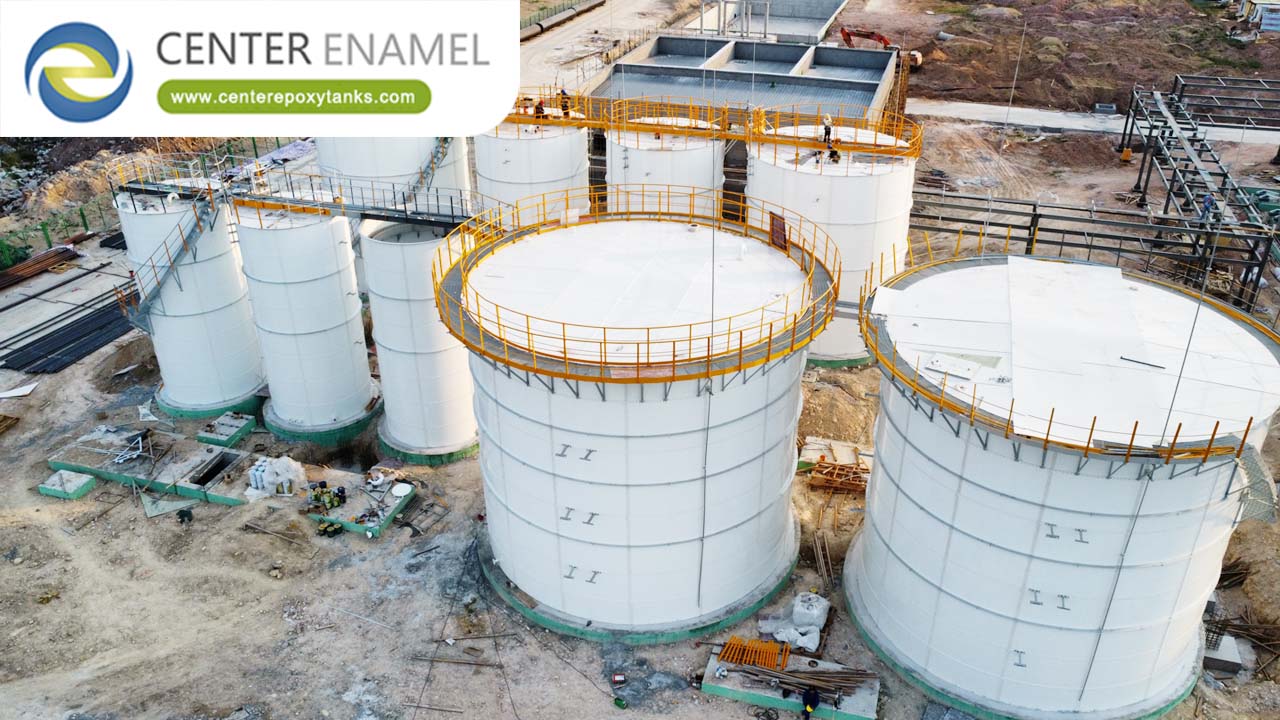
Fusion Bonded Epoxy (FBE) Tanks for Crude Oil Storage: Engineering for Hydrocarbon Integrity
Fusion Bonded Epoxy (FBE) tanks are a high-performance, cost-effective alternative to traditional welded steel and GFS tanks for crude oil storage. Engineered to AWWA D103 and API 650 principles, FBE tanks utilize a thermoset polymer coating applied at high temperatures to create an inert, non-porous barrier. This coating provides exceptional resistance to microbiologically influenced corrosion (MIC) and saltwater brine often found in crude oil, while the modular bolted design allows for "zero-hot-work" installation in volatile petrochemical environments.
1. Technical Performance & Material Matrix
Feature | Technical Specification (2026 Standard) | Strategic Utility Value |
Coating Type | Thermoset Fusion Bonded Epoxy | Exceptional adhesion; $100%$ holiday-free. |
Standard Compliance | AWWA D103 / ISO 12944 (C5-M) | Verified for offshore and highly corrosive sites. |
Application Process | Electrostatic Spray (180°C–230°C) | Molecular bond to steel; no mechanical peeling. |
pH Range | 3 to 11 | Resists crude acidity and refined petroleum. |
Surface Prep | Near-White Blast (SSPC-SP10) | Ensures maximum coating longevity and bond. |
Installation | Mechanical Bolting / EPDM Seals | Rapid deployment; no fire risk (hot work). |
2. Material Science: Why FBE for Crude Oil?
The Fusion Bonding Process
Unlike standard liquid paints that rely on mechanical adhesion, FBE creates a physical-chemical bond.
● Thermal Cross-Linking: The epoxy powder is electrostatically applied to pre-heated steel. The heat causes the powder to melt and cross-link, forming a continuous, high-density polymer barrier that is far more resistant to the "under-film" corrosion common in crude oil tanks.
● Hydrocarbon Inertness: FBE is chemically inert to the diverse range of hydrocarbons, paraffin, and aromatic compounds found in crude oil. It prevents the steel from reacting with sour crude (H2S), which causes hydrogen induced cracking (HIC) in unprotected tanks.
Modular Efficiency in Oilfields
● Zero-Hot-Work Safety: In active refineries or oilfields, on-site welding is a high-risk activity requiring extensive safety shut-downs. Center Enamel’s bolted FBE tanks are assembled mechanically, allowing for safe installation in proximity to volatile materials.
● Scoping for Brine and Sludge: Crude oil often contains "produced water" or high-salinity brine. FBE’s C5-M corrosion rating ensures the tank base and lower rings—where water and sludge accumulate—remain structurally sound for 30+ years.
3. Strategic Applications in Midstream & Upstream
● Field Gathering Stations: Temporary or permanent storage for crude oil directly from the wellhead.
● Produced Water Tanks: Handling the highly corrosive, saline wastewater separated from crude oil.
● Refinery Feedstock Management: Reliable buffering of crude oil before processing.
● Drilling Mud & Chemical Storage: Safely containing the aggressive chemicals and additives used in EOR (Enhanced Oil Recovery).
4. Why Partner with Center Enamel?
As a Global Leading Storage Solutions Provider, Shijiazhuang Zhengzhong Technology Co., Ltd offers a unique technological advantage:
● 30-Year EPC Excellence: With a 150,000 m2 manufacturing base, we are the only manufacturer in China offering a vertically integrated solution for GFS, FBE, and Stainless Steel tanks.
● Advanced R&D & Traceability: Our facility utilizes automated CNC fabrication and digital lifecycle tracking for every panel, ensuring full compliance with ISO 9001 and API quality protocols.
● Global Logistics Mastery: Proven project delivery in 100+ countries, including the Middle East, Southeast Asia, and the Americas, meeting local seismic and wind load requirements (ASCE 7-22).
● Comprehensive Integration: Our FBE tanks are designed for seamless compatibility with our Aluminum Geodesic Dome Roofs, providing a total vapor-control solution that meets modern ESG standards.
5. Technical FAQ: FBE Crude Storage
Q: Can FBE tanks handle the high temperatures of some crude oil types?
A: Yes. Our FBE coatings are engineered to maintain integrity at elevated operating temperatures common in midstream processing, provided the temperature remains within the specified polymer glass transition range.
Q: How does the coating handle impact or abrasion during transport?
A: FBE is a "hard" thermoset coating with high abrasion resistance. For international shipping, panels are packed in customized crates to ensure the coating arrives 100% intact, ready for holiday testing on-site.
Q: Is FBE suitable for refined products like diesel or jet fuel?
A: Absolutely. FBE is highly resistant to refined petroleum products, making it a versatile asset for terminals that switch between crude and refined product storage.


