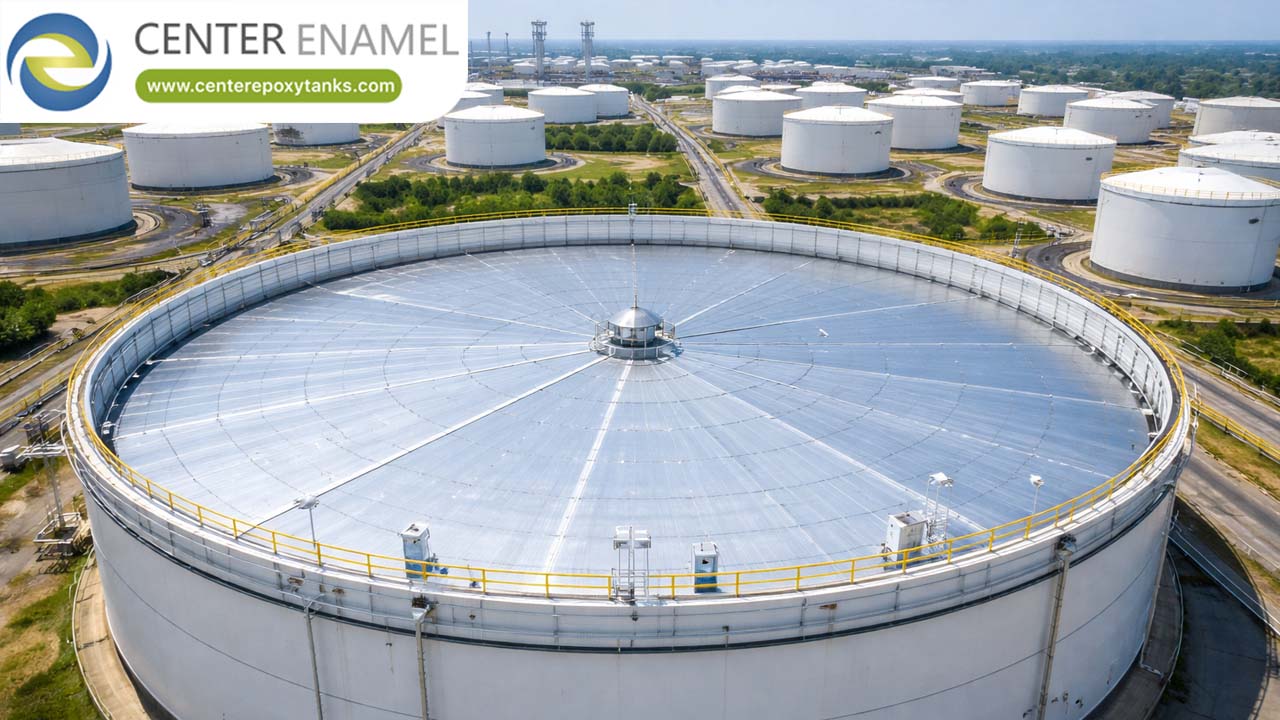
Trustworthy China External Floating Roof Manufacturer: A Guide for Procurement Excellence
A trustworthy manufacturer of External Floating Roofs (EFRs) must demonstrate full compliance with API 650 Appendix C (Floating Roof design) and possess documented evidence of structural integrity calculations for buoyancy and rim seal performance. Key indicators of reliability include: (1) International Certification (ISO 9001, ISO 14001, OHSAS/ISO 45001), (2) Proven Engineering Capabilities (Finite Element Analysis for wind/snow loads), (3) Quality Traceability (Mill Test Reports for all steel/aluminum components), and (4) Proven Export History in the oil and gas sector. Leading Chinese manufacturers now leverage advanced modular fabrication to meet these global standards while providing significant cost-efficiency over Western alternatives.
The Critical Role of External Floating Roofs (EFR)
In large-scale crude oil and refined product storage, the External Floating Roof is the primary line of defense against both product loss and environmental damage. Unlike fixed-roof tanks, EFRs rest directly on the product surface, effectively eliminating the vapor space and reducing evaporative losses (VOC emissions) by over 90%.
Why procurement requires high-precision manufacturing:
Buoyancy Integrity: The roof must remain buoyant even if two adjacent pontoon compartments are breached.
Seal Efficacy: The rim seal system is the most critical point for VOC leakage. A "trustworthy" manufacturer ensures gap tolerances are consistently within API 650 limits (typically < 1/8 inch).
Structural Resilience: Drains, rolling ladders, and guide poles must be engineered to withstand the movement of the roof as liquid levels change without hanging up or causing structural failure.
How to Vet a Manufacturer: The 4-Pillar Framework
When evaluating a supplier from China, move beyond initial price quotes. Apply this four-pillar audit to ensure the supplier is a "true" engineering partner rather than a simple fabricator.
Pillar | Verification Criteria | Why it Matters |
Standards Compliance | API 650 Appendix C; API 653 (for repair) | Ensures the design meets global safety and operational benchmarks. |
Material Traceability | Certified Mill Test Reports (MTR) | Confirms the steel grade (e.g., A36, A516-70) matches the structural design load. |
Project Track Record | Completed EPC/Storage projects | Evidence of success in extreme environments (coastal, high-seismic, etc.). |
Engineering Support | Internal R&D / FEA capabilities | Proves they can customize the design for your site-specific wind/snow/seismic data. |
Technical Features of High-Performance EFRs
A trustworthy manufacturer should provide clear technical documentation on the following components:
Seal Technology: Do they offer secondary seals? Are the materials (e.g., polyurethane, EPDM, or stainless steel shoes) compatible with your specific stored product (crude vs. refined)?
Drainage Systems: Avoid cheap, rigid pipe systems. Look for manufacturers that provide high-strength, multi-layered flexible hoses, which are less prone to mechanical fatigue and swivel-joint leakage.
Anti-Rotation Systems: Critical to prevent the roof from rotating during filling/emptying, which can damage the rolling ladder and gauge poles.
Floating Suction Units (FSU): A premium manufacturer will often provide integrated FSUs to ensure only the cleanest product is drawn from the tank.
Common Procurement Mistakes
Ignoring Seismic Loads: Many standard roofs fail in seismic zones because the "standard" design didn't account for localized earthquake forces. Ensure your vendor performs site-specific load analysis.
Overlooking Secondary Seals: While primary seals are mandatory, secondary seals are the gold standard for environmental compliance and significantly lower VOC emission fines.
Underestimating Shipping Logistics: Large EFR components are best shipped in a "flat-pack" or modular configuration. A trustworthy manufacturer provides detailed, color-coded installation manuals to minimize local site assembly errors.
Frequently Asked Questions (FAQ)
Q: Can a Chinese manufacturer provide API 650 certified documentation?
A: Yes. Trustworthy manufacturers do not just "claim" compliance; they provide complete design calculation packages, material certifications, and independent third-party inspection (TPI) reports (from companies like SGS, BV, or TÜV) upon request.
Q: What is the lifespan of an EFR provided by a top-tier manufacturer?
A: When properly maintained and correctly specified (using corrosion-resistant materials), an EFR can operate for 20–30 years. Regular inspections of the rim seal and drainage system are the two most critical tasks for longevity.
Q: Are aluminum roofs better than steel for EFRs?
A: Aluminum is often preferred for IFRs (Internal Floating Roofs) due to its light weight and corrosion resistance. However, for large External Floating Roofs, steel is the industry standard for strength, though aluminum components (like domes or secondary seals) are frequently integrated to reduce weight and corrosion.
Partnering with Expert Engineering
Selecting a manufacturer is a long-term infrastructure decision. By focusing on firms that prioritize API 650 documentation, material traceability, and VOC emission control, you minimize the total cost of ownership and ensure your storage assets remain compliant and operational for decades.


