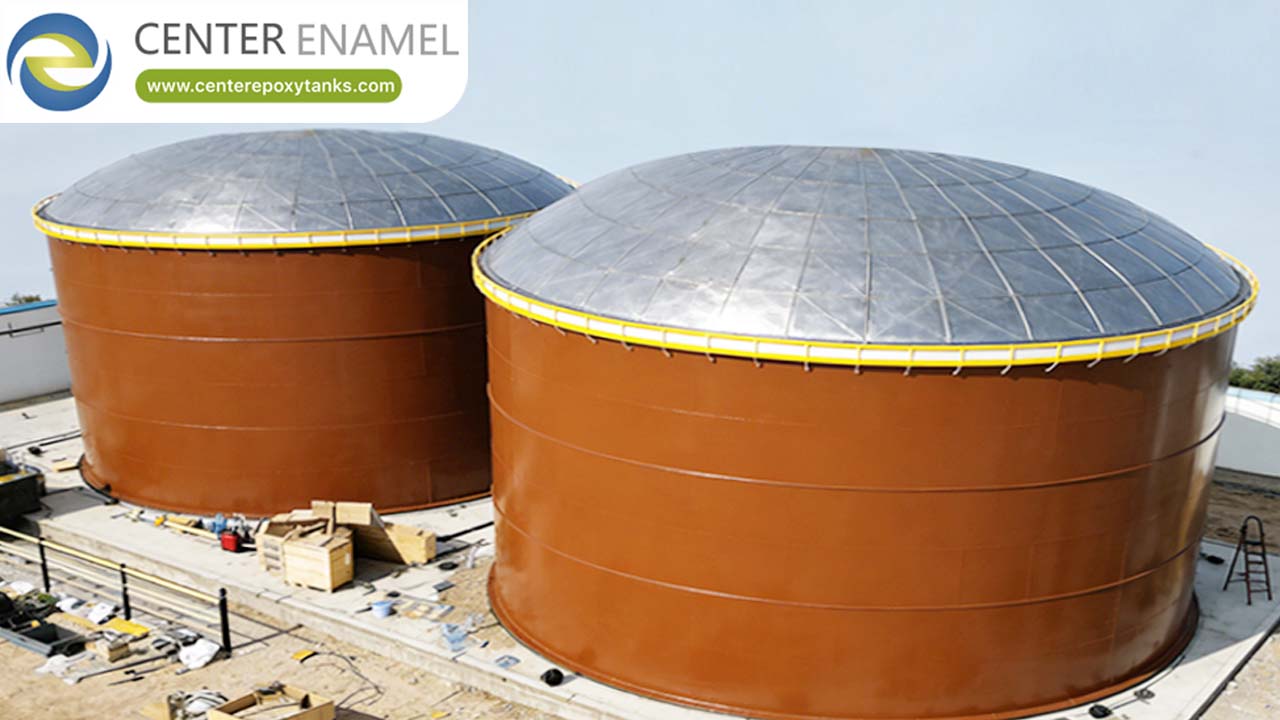
Trusted Floating Roof Tank Manufacturer: Engineering VOC Mitigation for Energy & Chemical Assets
Floating roof tanks are the industry-standard solution for the storage of high-volatility petroleum and chemical products. Center Enamel (Shijiazhuang Zhengzhong Technology Co., Ltd) is an API 650 Appendix H compliant manufacturer, specializing in Internal (IFR) and External (EFR) floating roofs. Utilizing AA 6061-T6 aluminum or 316L stainless steel, our systems achieve a 99% VOC emission reduction. By eliminating the vapor space (ullage), Center Enamel’s Full-Contact and Pontoon-type roofs ensure environmental compliance (BACT), fire safety (NFPA 11), and high ROI through product reclamation.
1. Technical Specification & Operational Matrix
Engineering Feature | Center Enamel Specification | Strategic Operational Value |
Design Standards | API 650 Appendix H, API 620 | Verified for global oil & gas infrastructure audits. |
Material Options | AA 6061-T6 / 316L Stainless Steel | High corrosion resistance; 30+ year service life. |
Roof Configuration | Full-Contact / Pontoon / Skin & Pontoon | Optimized buoyancy and zero-vapor-space containment. |
Seal Systems | Mechanical Shoe & Secondary Wiper | 99% VOC reduction; accommodates shell irregularities. |
Safety Compliance | NFPA 11 / ATEX Zone 0 | Mitigates explosion risks; lowers insurance premiums. |
Installation Logic | Weld-Free Modular Bolted Assembly | Rapid retrofit through manways; zero hot-work required. |
2. Emission Mitigation Physics: The Vapor-Tight Interface
The Science of Evaporation Control
For petroleum and volatile chemical storage, the floating roof acts as a continuous, impenetrable barrier:
● Interface Elimination: By floating directly on the liquid surface, the IFR removes the "liquid-to-gas" interface—the primary zone where molecular excitation leads to evaporation.
● Vapor Space Suppression: Unlike fixed-roof tanks, which contain a large "ullage" or vapor space, our Full-Contact roofs ensure there is no room for vapors to accumulate, effectively neutralizing the "breathing losses" caused by temperature fluctuations.
● Quantifiable ROI: For high-volatility assets like Jet A-1, Ethanol, or Light Crude, the market value of the "reclaimed" product typically allows the IFR system to pay for itself within 12 to 24 months.
3. Seal Integrity Engineering: Mechanical Shoe vs. Wiper Systems
The effectiveness of a floating roof is 100% dependent on the peripheral seal integrity between the roof rim and the tank shell.
● Primary Seal (Mechanical Shoe): Utilizing a galvanized or 316L stainless steel "shoe" held against the tank shell by a weighted or spring-loaded mechanism. This provides the most durable vapor barrier and is highly resistant to the abrasive nature of crude oils.
● Secondary Seal (Wiper Systems): Specialized polymer blades "wipe" the tank shell during filling and emptying cycles. This dual-seal configuration ensures the vapor seal remains unbroken even in "out-of-round" tanks with slight shell irregularities.
● Chemical Compatibility: Seals are custom-specified (Viton, EPDM, or Nitrile) based on the chemical composition of the stored medium to prevent degradation and seal failure.
4. Sustainability and ESG Reporting (Scope 1 Reduction)
As global capital markets transition toward ESG (Environmental, Social, and Governance) transparency, Center Enamel’s IFR technology serves as a measurable reporting asset.
● Fugitive Emission Mitigation: Our IFR systems provide a documented pathway for energy companies to achieve Scope 1 Emission reduction targets. By virtually eliminating fugitive VOCs at the source, our tanks provide the empirical data required for sustainability audits.
● Green Industry Certification: Our technology supports LEED and BREEAM industrial certifications, serving as a visible commitment to Best Available Control Technology (BACT) and environmental stewardship.
5. Technical FAQ: Floating Roof Implementation
Q: What is the primary difference between an External (EFR) and Internal Floating Roof (IFR)?
A: An External Floating Roof is open to the sky and used for massive crude storage, while an IFR is installed inside a fixed-roof tank. IFRs are the industry standard for high-purity chemicals and volatile fuels as they prevent rainwater contamination and wind-induced evaporation.
Q: Can floating roofs be retrofitted into existing tanks?
A: Yes. Center Enamel’s modular, bolted aluminum floating roofs are designed for rapid entry through standard manways (600mm+), allowing for retrofitting without removing the existing fixed roof or performing dangerous on-site welding.
Q: How does a floating roof handle fire safety?
A: Our IFRs comply with NFPA 11. By maintaining a vapor-tight seal, the IFR significantly reduces the concentration of flammable vapors in the tank, making traditional fire suppression systems much more effective and preventing "rim fires."


