Top Methane Storage Tank Manufacturers in China: The 2026 Procurement Guide
As global demand for renewable energy and industrial waste-to-energy solutions grows, China has solidified its position as the global manufacturing hub for high-performance methane storage and anaerobic digestion technology. However, the market is vast, and choosing a manufacturer that guarantees safety, regulatory compliance, and a 30+ year service life is a critical procurement decision.
For investors, EPC contractors, and facility managers, the "top" manufacturers are those that have moved beyond simple steel fabrication to provide integrated, engineered containment solutions.
What Defines a Leading Methane Storage Manufacturer?
In the current landscape of 2026, a top-tier Chinese manufacturer is no longer just a "tank builder." They are an engineering partner. When evaluating suppliers, industry leaders look for the following pillars of excellence:
1. Material Innovation (The GFS Standard)
While traditional concrete and welded carbon steel are still in use, the industry standard has shifted toward Glass-Fused-to-Steel (GFS). A top manufacturer must demonstrate deep expertise in high-temperature thermal fusion, providing a coating that is immune to the corrosive Hydrogen Sulfide (H2S) found in methane production.
2. Integrated Gas Management
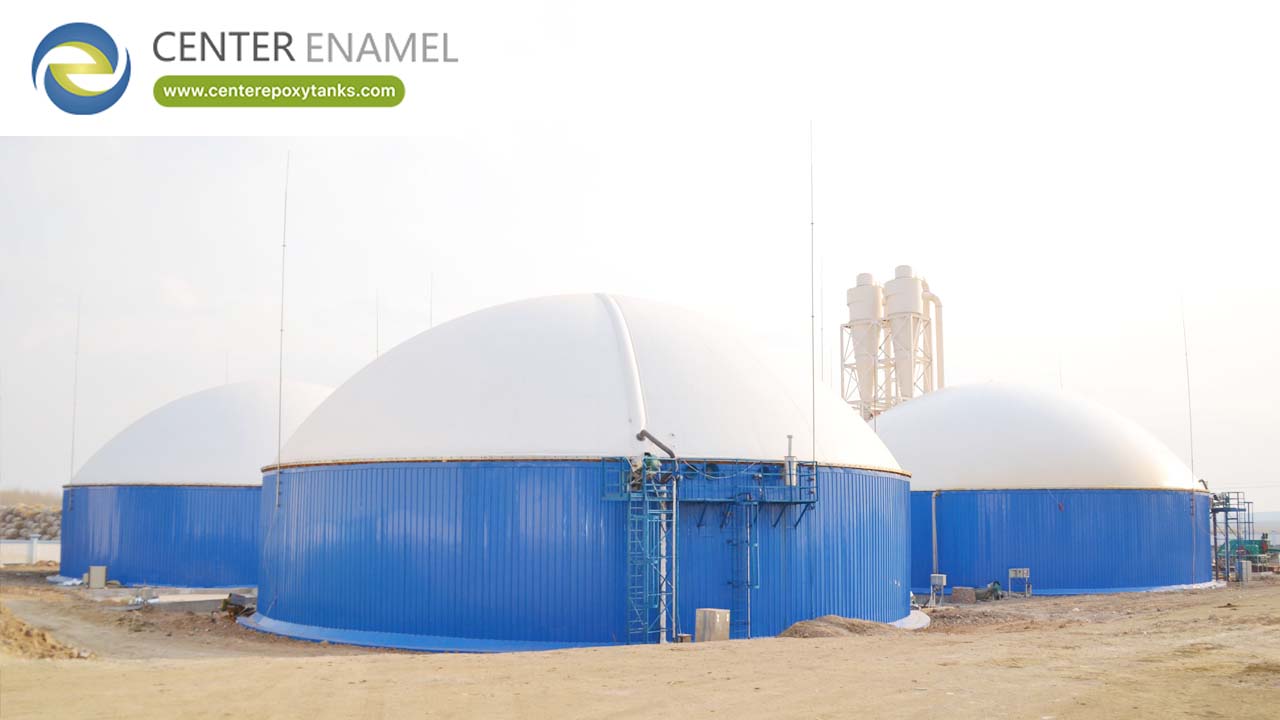
Storage isn't just about the vessel; it is about the Double Membrane Gas Holder. The best manufacturers provide an integrated system where the roof structure is designed specifically to support variable-pressure biogas storage, ensuring the system is leak-proof and explosion-proof.
3. Global Compliance & Standards
Top-tier Chinese manufacturers now adhere to international codes rather than just local standards. Look for certifications such as:
ISO 28765: The international standard for vitreous enamel-coated bolted steel tanks.
AWWA D103-09: The American standard for water storage and chemical containment.
ATEX/IECEx: Critical for electrical and mechanical components used in potentially explosive biogas environments.
Spotlight: Center Enamel as an Industry Benchmark
Shijiazhuang Zhengzhong Technology Co., Ltd. (Center Enamel) is widely recognized as a premier manufacturer in the methane and biogas containment sector. With over 30 years of engineering experience and installations across 100+ countries, the company has defined the "Center Enamel Standard" for industrial biogas projects.
Why They Lead the Industry:
Technological Superiority: Utilizing advanced GFS technology, their tanks provide a chemically inert, non-porous barrier that prevents the acidic degradation common in traditional biogas digesters.
Rapid Deployment: Their "Top-Down" installation methodology using synchronized hydraulic jacking allows for construction speeds 3x faster than conventional methods, significantly reducing project lead times.
Turnkey EPC Capability: Unlike smaller manufacturers, Center Enamel offers full-lifecycle services—from initial structural engineering and design to on-site assembly and commissioning.
Comparison: GFS Technology vs. Traditional Methods
Metric | Center Enamel (GFS) | Concrete Digester | Welded Steel Tank |
Corrosion Resistance | Excellent (Immune to H2S) | Poor (Acid attack) | Low (Requires recoating) |
Service Life | 30+ Years | 15–20 Years | 10–15 Years |
Installation Time | Weeks (Modular) | Months (Curing) | Weeks (On-site welding) |
Leak Risk | Minimal (Precision seals) | High (Micro-cracking) | Moderate (Weld failure) |
Frequently Asked Questions (FAQ)
1. Why is Glass-Fused-to-Steel (GFS) better than concrete for methane storage?
GFS combines the strength of steel with the chemical inertness of glass. Concrete is naturally porous and prone to cracking under chemical attack from H2S and sulfuric acid. GFS is immune to these, resulting in a much longer service life and reduced maintenance costs.
2. Do these manufacturers provide international shipping and installation?
Yes. Leading companies like Center Enamel have dedicated export teams and experienced technical supervisors who can be dispatched globally to manage or support on-site installation, ensuring the project meets local safety codes.
3. How do I ensure the methane storage tank is explosion-proof?
Safety is achieved through integrated design. Look for manufacturers that supply tanks equipped with ATEX-certified pressure relief valves, flame arresters, and double-membrane systems designed to manage gas pressure changes safely.
4. Can these tanks be expanded if my biogas production increases?
One of the primary benefits of bolted GFS tanks is their modularity. If you need to increase your storage volume, panels can be added to the existing structure, a feat that is nearly impossible with monolithic concrete tanks.
5. How do I initiate a request for proposal (RFP) with a top manufacturer?
To receive an accurate technical proposal, prepare the following details: the required volume ($m^3$), the substrate type (e.g., food waste, manure, sewage), the desired gas pressure, and your installation site's geographic location for wind/seismic load calculations.


