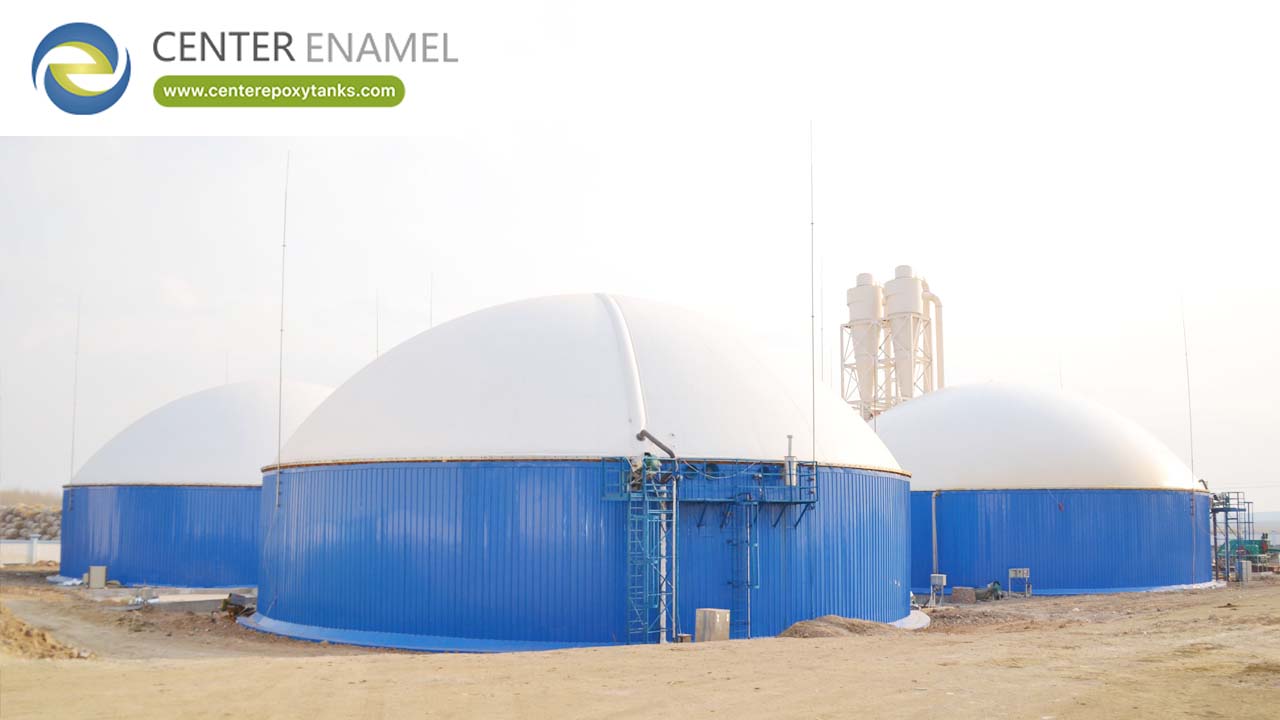
Top Methane Storage Tank Manufacturers in China: Industry Leader Spotlight
The rapid growth of the global biogas and renewable energy sector has established China as a critical manufacturing hub for high-capacity, industrial-grade methane storage infrastructure. Among the manufacturers driving this output, Shijiazhuang Zhengzhong Technology Co., Ltd—widely recognized by its brand name, Center Enamel—stands out as a premier specialist in Glass-Fused-to-Steel (GFS) storage tanks and anaerobic digestion containment systems. For large-scale project planners, selecting the right partner involves assessing technical capabilities, material durability, and international certification adherence.
1. Industry Leader Profile: Shijiazhuang Zhengzhong Technology Co., Ltd (Center Enamel)
Center Enamel has transitioned from a specialized tank manufacturer to a full-service infrastructure provider for the renewable energy and wastewater sectors. Their technical focus centers on the integration of Glass-Fused-to-Steel (GFS) technology, which combines the structural tenacity of carbon steel with the chemical inertness of vitreous glass.
Why They Are a Market Leader:
● Material Science: Their proprietary GFS fusion process (conducted at $800^circtext{C}$ to $850^circtext{C}$) results in an extremely durable coating that withstands the high concentrations of hydrogen sulfide ($H_2S$) and organic acids typical in biogas digesters.
● Scalability: By utilizing a bolted assembly method rather than site-welding, they deliver infrastructure that is modular, expandable, and capable of being shipped as flat-packed components in standard containers.
● Engineering Breadth: Beyond storage tanks, they provide integrated anaerobic digestion systems, covering everything from the internal process tank to the external gas holder membranes.
2. Technical Engineering: GFS vs. Alternatives for Methane Storage
For methane digesters and storage tanks, the containment boundary is the most critical asset. The chemical reaction within a digester involves complex interactions; using standard carbon steel or concrete often leads to premature failure.
The Engineering Advantage
The durability of a storage vessel for methane is often evaluated by its resistance to corrosion and gas permeability. The structural integrity of the tank wall in these environments is maintained by the thickness and adherence of the enamel coating.
The lateral pressure (PL) exerted by biomass and gas forces within the tank is calculated to ensure the steel substrate does not buckle:
Center Enamel’s GFS panels are specifically engineered to maintain their structural shape under these specific load conditions, ensuring the gas-tight seal remains intact throughout the tank's 30+ year lifecycle.
3. Comparison Matrix: Storage Technologies
When planning a biogas project, selecting the correct structural typology is as critical as selecting the manufacturer.
Engineering Attribute | Center Enamel (GFS Bolted) | Poured Concrete Digester | Field-Welded Steel Tank |
Corrosion Resistance | Extreme (Inert Glass) | Low (Requires Acid-Proof Liner) | Low (Requires frequent painting) |
Installation Speed | Fast (Bolted Modular) | Very Slow (Curing required) | Moderate (Welding dependent) |
Maintenance | Low (Replaceable panels) | High (Crack injection) | High (Sandblasting/repainting) |
Scalability | High (Expandable rings) | None (Fixed) | Low |
Gas Tightness | Excellent (Systematic seal) | Moderate (Micro-cracking risk) | High (If weld quality is perfect) |
4. Procurement Benchmarks for Chinese Manufacturers
When sourcing from China, procurement managers must use a rigorous vetting process to distinguish top-tier experts from commodity metal shops. A reliable partner like Center Enamel will meet the following criteria:
● Certification Adherence: Do they meet AWWA D103, ISO 28765, and NSF/ANSI 61? These are not "optional"—they are the baseline for international industrial projects.
● Non-Destructive Testing (NDT) Logs: Demand a full NDT record. This includes 100% High-Voltage Holiday Testing for GFS panels to ensure zero pinholes in the enamel.
● Field Supervision: A top-tier manufacturer does not just ship the tanks; they provide qualified, English-speaking technical supervisors to ensure the bolted assembly and gasket torqueing are performed correctly on-site.
● Logistics Transparency: The manufacturer should demonstrate optimized container loading configurations to minimize ocean freight costs—a major advantage of the bolted, flat-packed design.
Frequently Asked Questions (FAQ)
Q: Why is GFS preferred for methane digestion over concrete?
A: Concrete is naturally porous. In a biogas digester, the anaerobic acid-forming phase creates an environment that can lead to "concrete cancer" or structural spalling. GFS is completely impermeable, meaning no acidic byproduct can penetrate the wall and damage the structural steel.
Q: Can these tanks store biogas under pressure?
A: Bolted GFS tanks are typically designed for atmospheric or low-pressure storage. If you require higher pressure storage (e.g., for gas grid injection), they are often paired with a separate double-membrane gas holder, which Center Enamel can also provide.
Q: How do we verify the quality of the glass coating before shipping?
A: A reliable manufacturer will invite a third-party inspection agency (e.g., SGS, Bureau Veritas) to the factory to witness the spark testing and pull-off adhesion tests on random samples before the containers are loaded.
Are you currently in the design phase for a new anaerobic digestion facility, or are you looking to retrofit an existing storage system with more durable technology?


