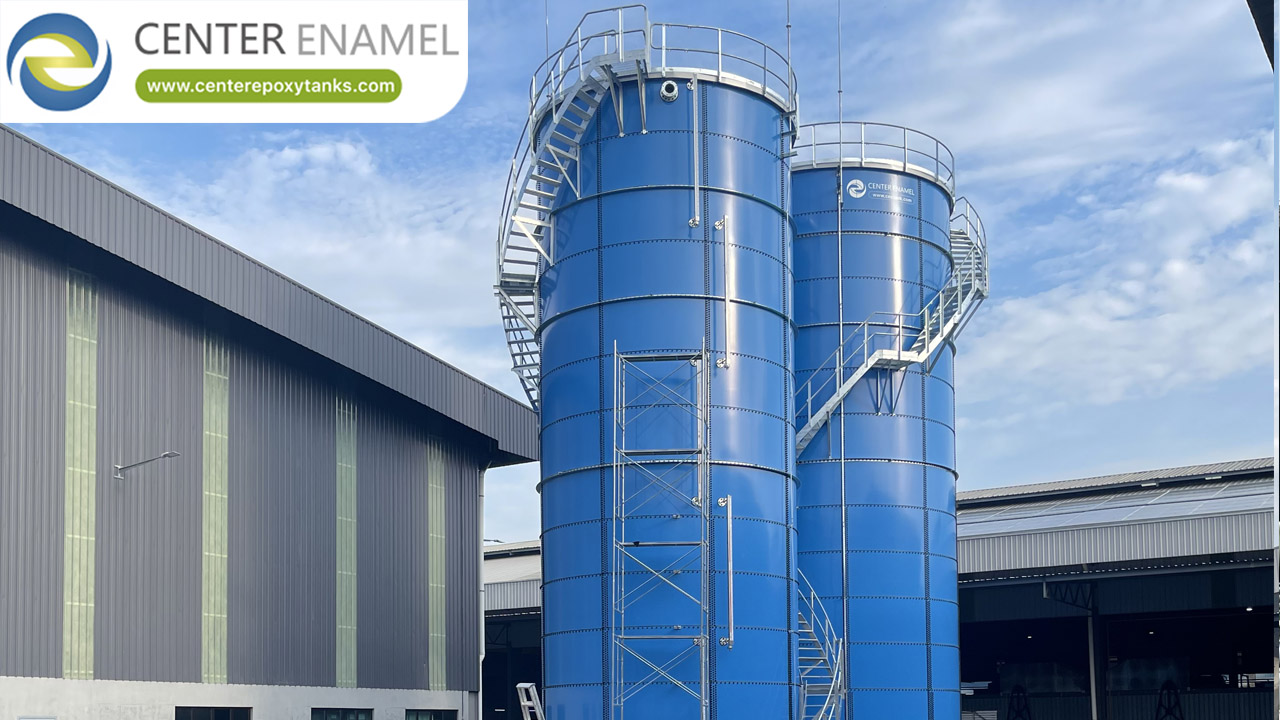
The Ultimate Guide to Fusion Bonded Epoxy Tanks: Materials, Specifications & Certifications
When it comes to municipal, industrial, and agricultural liquid storage, choosing a tank with the right balance of corrosion protection, structural durability, and cost-efficiency is essential. While Glass-Fused-to-Steel (GFS) remains a premium choice for highly aggressive environments, Fusion Bonded Epoxy (FBE) bolted steel tanks have emerged as an incredibly versatile, high-performance alternative.
Combining the raw physical strength of carbon steel with a factory-applied, thermally cured polymer barrier, FBE tanks are the global standard for drinking water, process water, and mild industrial wastewater applications.
Below, we break down the material science, core engineering standards, and mandatory certifications that define premium Fusion Bonded Epoxy tanks, showcasing why manufacturers like Center Enamel lead the global containment market.
What is Fusion Bonded Epoxy (FBE)?
Unlike traditional field-applied paints that cure under ambient conditions, Fusion Bonded Epoxy is a factory-applied, thermoset polymer coating. Under highly controlled laboratory conditions, dry epoxy powder is electrostatically sprayed onto pre-heated carbon steel plates. The heat causes the powder to melt, flow, and chemically cross-link into a continuous, high-molecular-weight polymer matrix.
Why FBE Outperforms Field-Applied Paint
Elimination of Environmental Variables: Applying paint in the field exposes the coating to humidity, dust, and temperature swings, which often lead to premature micro-pinholes or poor adhesion. FBE is applied entirely in a climate-controlled factory.
Incredible Physical Ductility: Because the epoxy chemically bonds to the steel substrate at approximately 200°C, it possesses excellent impact and flexural resistance. If a bolted panel undergoes slight flexing during seismic shifts or thermal expansion, the FBE coating stretches without cracking.
Edge Protection: Center Enamel’s automated spray lines ensure complete coating thickness over the critical laser-cut edges of each panel—areas where liquid coatings typically run thin.
The FBE Factory Coating Process
To achieve zero-defect performance, the manufacturing process follows a highly disciplined, multi-stage pipeline:
1.Substrate Preparation (Grit Blasting):Achieves SA 2.5 / SSPC-SP10 Finish。
Raw carbon steel panels are processed through automatic shot-blasting systems to remove rust, mill scale, and oils. This creates a high-profile anchor pattern on the steel surface to maximize mechanical adhesion.
2.Electrostatic Powder Deposition:Controlled DFT Range。
Pre-heated panels pass through an automated electrostatic powder booth. Negatively charged epoxy particles (utilizing premium formulations from partners like AkzoNobel) are sprayed onto the grounded steel panels to ensure a uniform layer.
3.Thermal Fusion & Curing:Oven Bake at ~200°C。
The coated panels enter a curing tunnel oven. The epoxy melts and flows into a smooth, continuous film before cross-linking into a durable thermoset plastic barrier.
4.Zero-Defect Quality Inspection:1500V Holiday Testing。
Each finished sheet undergoes strict quality checks, including dry film thickness (DFT) measurements and a high-voltage holiday test (up to 1500V) to ensure the coating is completely free of microscopic pinholes.
Technical Specifications & Standards
When specifying an FBE bolted steel tank for your project, compliance with international engineering guidelines ensures structural safety and long-term asset value.
Engineering Parameter | Technical Specification | Standard Compliance |
Design Standard | Factory-Coated Bolted Steel Tanks for Water Storage | AWWA D103-19 / ISO 28765 |
Coating Thickness | 150 µm to 250 µm (6 to 10 mils) nominal DFT | ISO 21809-2 / EN ISO 2815 |
pH Operating Range | pH 3 to 11 (Standard FBE) / pH 2 to 13 (High-Spec) | Chemical Immersion Testing |
Holiday Testing Voltage | 1100V to 1500V (100% defect-free mandate) | AWWA D103 Section 10.6 / ISO 21809 |
Corrosion Resistance | Salt Spray Resistance (Passes 1,440 hours minimum) | EN ISO 9227 / ASTM B117 |
Adhesion Rating | 0 mm slip / Cross-cut adhesion pass | EN ISO 21809-2 / ASTM D3359 |
Crucial Industry Certifications
A tank is only as reliable as its third-party certifications. When procuring storage assets for critical water infrastructure, always verify the following:
NSF/ANSI 61 (Potable Water Safety)
For drinking water storage, the entire internal system—including the FBE lining, the polyurethane lap joint sealants, and the EPDM gaskets—must be certified to NSF/ANSI 61. This guarantees that no volatile organic compounds (VOCs) or heavy metals leach into the public water supply.
AWWA D103-19 Compliance
This is the premier global code for bolted steel tanks. It governs everything from panel structural wind/seismic load calculations to anchor bolt layouts and specific thermoset powder coating requirements.
ISO 9001:2015 Quality Management
Choosing a manufacturer with certified ISO quality systems (like Center Enamel's automated CNC cutting and laser punch facilities) ensures that every bolt hole matches up perfectly in the field, reducing installation delays and structural fatigue.
Frequently Asked Questions (FAQ)
What is the difference between Fusion Bonded Epoxy (FBE) and Glass-Fused-to-Steel (GFS)?
The main difference lies in the coating material and curing temperature. GFS fuses vitreous glass to steel at high heat (830°C to 850°C), creating an extremely hard, chemical-resistant, inorganic surface. FBE fuses an organic thermoset epoxy polymer to the steel at around 200°C. While GFS offers superior chemical resistance for aggressive industrial waste and digesters, FBE provides superior physical impact resistance, excellent flexibility, and a highly cost-effective profile for potable and clean process water.
Can FBE tanks handle municipal wastewater and industrial chemicals?
Yes, within a certain chemical range. Standard FBE coatings easily withstand pH levels from 3 to 11. For more aggressive municipal wastewater or industrial chemical containment, advanced high-build epoxy coatings (with DFT up to 650 µm) expand this operating window to pH 2 to 13, offering highly reliable protection against mild acids, alkalis, and hydrocarbon exposure.
What is the estimated lifecycle of an FBE bolted steel tank?
When properly engineered to AWWA D103 standards and regularly inspected, a factory-applied FBE bolted tank boasts a structural design life of 30 to 50 years. Because the panels are bolted together in the field, individual components can be easily replaced or expanded over time.
How is the structural integrity of FBE coatings verified before leaving the factory?
At Center Enamel, every single panel undergoes an automated physical inspection sequence. This includes visual color consistency audits, electromagnetic micrometer scans to confirm the correct dry film thickness, and a 1500V holiday test. If a panel shows even a single micro-defect under the voltage sweep, it is rejected and reprocessed.


