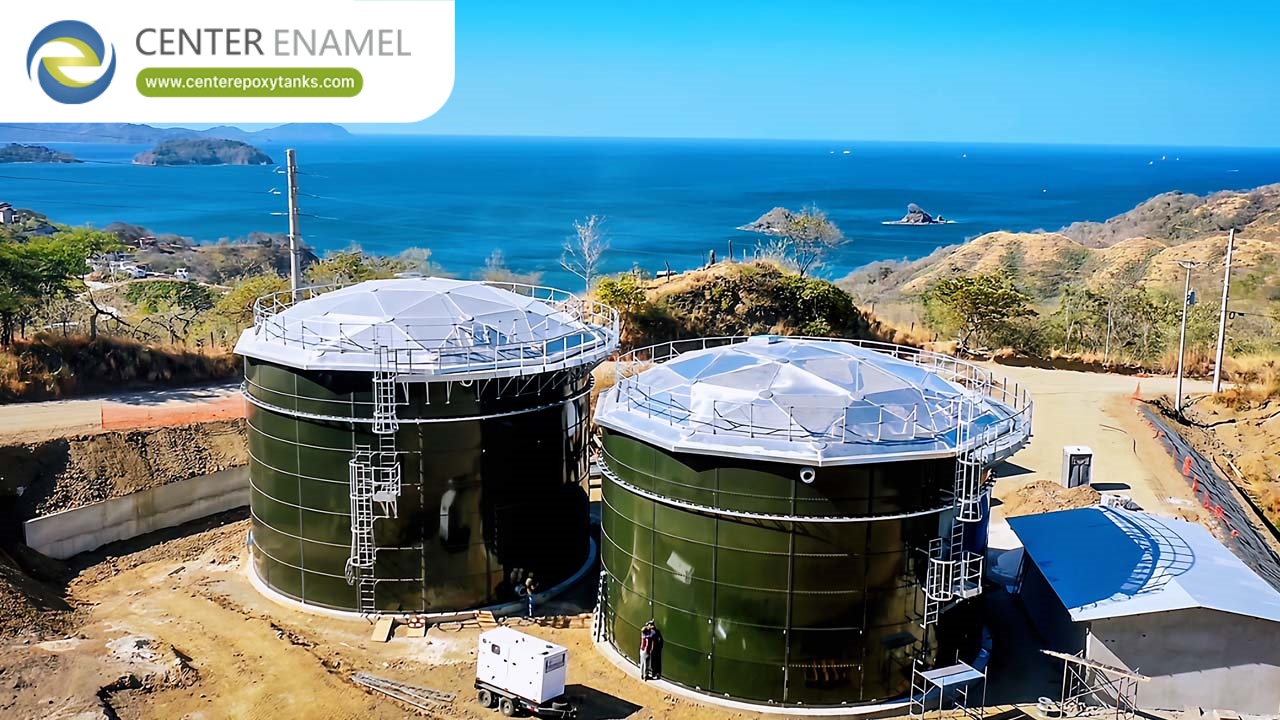
Aluminum Dome Roofs for GFS Tanks: Engineering Ultimate Durability, Emission Control, and Structural Synergy
In modern industrial and municipal containment engineering, achieving long-term asset integrity requires a holistic, "total-system" approach. While Glass-Fused-to-Steel (GFS) tanks—also known as bolted glass-lined steel tanks—provide the world's most robust liquid containment barrier (resisting a wide chemical pH range from 2 to 14), the choice of roofing system dictates the facility’s overall operational efficiency, emission control, and structural longevity.
The definitive roofing solution for modern GFS tanks is the aluminum geodesic dome roof. Engineered from marine-grade aluminum alloys and utilizing advanced triangulation geometry, these covers create a seamless structural synergy with bolted GFS tanks, delivering a maintenance-free, weather-tight, and chemically inert enclosure.
Core Engineering Synergy: Why Aluminum Domes Match GFS Tanks
Pairing an aluminum geodesic dome with a GFS tank creates a high-performance containment envelope tailored to aggressive municipal and industrial environments:
Total Corrosion Immunity (Floor-to-Roof Protection): While GFS tank panels are fused at temperatures exceeding 850°C to create an impenetrable glass-steel bond, the tank headspace is often exposed to corrosive gases like hydrogen sulfide ($H_2S$), methane ($CH_4$), and moisture. Aluminum naturally forms a microscopic, self-healing oxide layer that is impervious to these volatile compounds, matching the corrosion resistance of the GFS shell below.
The "No-Pillar" Clear-Span Advantage: Geodesic domes are self-supporting space frames that transfer all structural dead and live loads directly to the tank perimeter tension ring. By eliminating internal support columns, facilities maximize 100% of the internal volume, preventing internal dead zones and enabling unobstructed operation for wastewater mixers, sludge scraper bridges, or internal floating roofs.
Lightweight Modular Construction: Because aluminum weighs approximately one-third as much as structural steel, it drastically reduces the base shear during seismic events and places minimal dead load on the underlying GFS shell and concrete foundation.
Data Table: Comprehensive Comparison of GFS Tank Roof Options
Technical Parameter | Aluminum Geodesic Dome Roofs | Traditional Carbon Steel Cone Roofs | Cast-in-Place Concrete Domes |
Corrosion Resistance | Superior; natural oxide layer provides lifelong defense against $H_2S$ and moisture | Low; highly vulnerable to rust in aggressive tank headspaces | Moderate; prone to carbonation, cracking, and chemical spalling |
Internal Support Structure | None; self-supporting clear-span across massive diameters | Frequently requires internal columns, trusses, or rafters | Requires massive internal shoring, columns, or center piers |
Maintenance Profile | Near-zero maintenance (no painting, sandblasting, or recoating needed) | High; requires regular inspection and repainting cycles | Moderate; requires joint sealant replacement and crack patching |
Design Life & Synergy | 40 to 50+ years; perfectly matches GFS tank lifespan | 15 to 25 years (often requires early roof replacement) | 30 to 40 years (heavy dead load on bolted shell) |
Frequently Asked Questions (FAQ)
Q: Why are aluminum geodesic domes the ideal roofing choice for GFS tanks?
A: They offer a seamless mechanical and aesthetic fit. Both systems are modular, bolted, and designed for extreme durability. The aluminum dome provides unmatched corrosion resistance in the vapor space, perfectly complementing the chemical inertness of the GFS tank panels below.
Q: How do aluminum domes accommodate the different thermal expansion rates of aluminum and steel?
A: Engineered to strict standards like API 650 Annex G and AWWA D103, aluminum domes utilize specialized sliding or pivoting perimeter shoe supports and elastomeric thermal break gaskets that allow the aluminum structure to expand and contract freely without exerting destructive shear stresses on the GFS tank shell.
Q: Do aluminum dome roofs require internal support columns on large GFS tanks?
A: No. The triangulated geodesic space-frame design distributes structural loads entirely to the perimeter ring beam, providing a completely clear-span interior that maximizes usable tank volume.
Q: What is the maintenance schedule for an aluminum dome roof on a GFS tank?
A: The system is virtually maintenance-free. Because aluminum does not rust or degrade under UV exposure, routine upkeep is generally limited to periodic visual inspections of perimeter seals and gaskets every few years.


