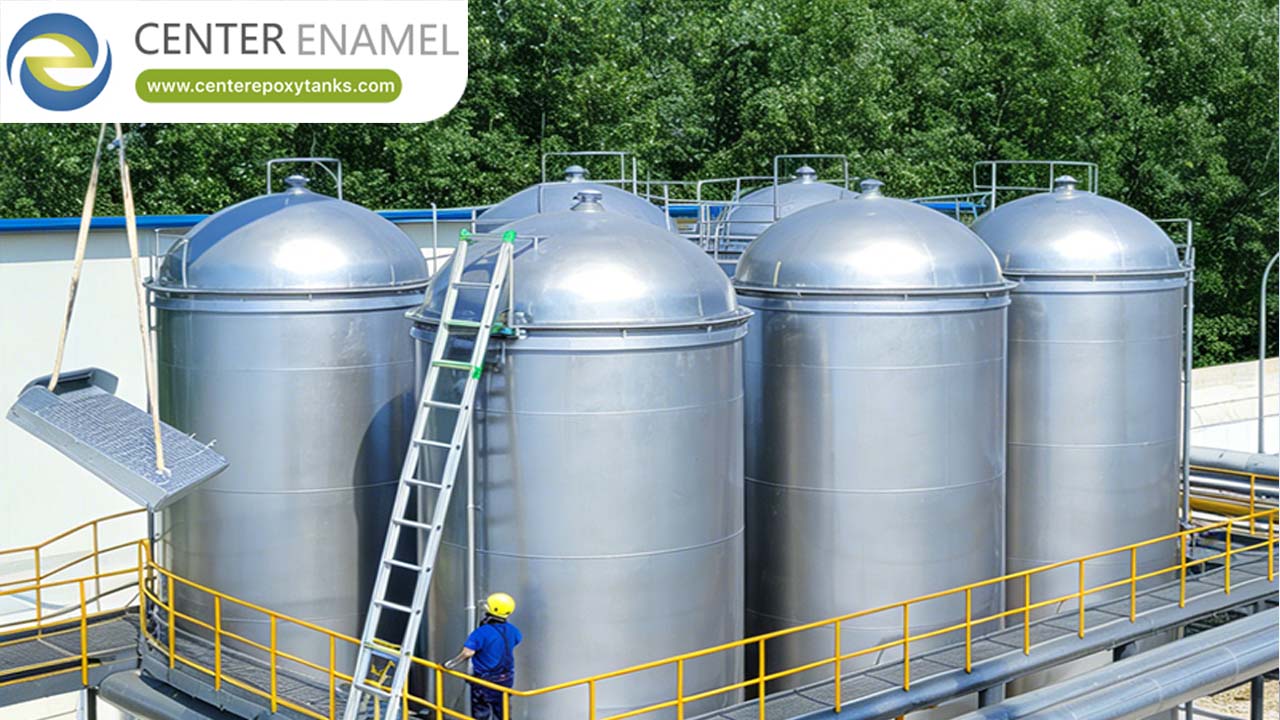
The Advantages of 316 Stainless Steel Water Tanks: An Engineering Perspective
In the hierarchy of liquid storage materials, 316 stainless steel stands at the apex of performance. While galvanized and enamel-coated steel offer distinct advantages in cost or modularity, 316 stainless steel is engineered for environments where failure is not an option. Its unique chemical composition makes it the material of choice for high-purity and high-corrosion applications.
1. Material Science: The Molybdenum Advantage
The fundamental difference between general stainless steel (like 304) and 316 is the inclusion of molybdenum.
● Passivation: Like all stainless steel, 316 relies on a "passive layer" of chromium oxide that self-heals in the presence of oxygen.
● Chloride Resistance: In water storage, chlorides (found in municipal water treatment or coastal air) are the primary enemy. Molybdenum fortifies the passive layer, preventing "pitting" (microscopic holes) and "crevice corrosion" that can compromise weaker steel grades.
2. Key Advantages of 316 Stainless Steel
Superior Corrosion Resistance
316 stainless steel is effectively immune to most forms of oxidation associated with water storage. It is the gold standard for coastal environments where airborne salt would rapidly degrade galvanized tanks or epoxy coatings.
Unmatched Hygiene and Water Purity
The surface of 316 stainless steel is inert and non-porous. It does not leach chemicals, metals, or microplastics into the stored water.
● Bacterial Growth: The smooth, electropolished surface prevents the adherence of biofilms, algae, and bacteria, making it ideal for hospital, laboratory, and high-purity food-grade storage.
Long-Term Economic Value (TCO)
While the upfront investment for 316 stainless is significant, the Total Cost of Ownership (TCO) is often the lowest over 40+ years.
● Zero Maintenance: It requires no painting, recoating, or cathodic protection (anodes).
● Durability: The material maintains its structural strength across a wide temperature range, resisting both freeze-thaw cycles and high-heat industrial processes.
3. Comparison: 304 vs. 316 Stainless Steel
Feature | 304 Stainless Steel | 316 Stainless Steel |
Molybdenum Content | None | 2.0% – 3.0% |
Corrosion Resistance | Good (Standard) | Excellent (Marine Grade) |
Chloride Resistance | Low | High |
Typical Application | General indoor use | Harsh/Saline/Coastal use |
Relative Cost | Moderate | Higher |
Engineering Tip: If your storage location is within 10–15 miles of the coast, or if your water supply has high chloride levels (often found in groundwater), 316 is not optional—it is required to prevent long-term pitting failures.
4. Industry Applications
316 stainless steel tanks are standard in sectors where the cost of failure exceeds the cost of materials:
● Pharmaceuticals: High-purity water requirements.
● Food & Beverage: Preventing contamination and ensuring regulatory compliance.
● Coastal Municipalities: Protecting infrastructure from salt-air corrosion.
● Industrial Cooling Systems: Where water chemistry can become aggressive during heat cycles.
5. Engineering Considerations for Installation
● Welding Practices: Use only TIG (Tungsten Inert Gas) welding with compatible 316L (low carbon) filler rods to prevent "sensitization," which can ruin the corrosion resistance of the weld zone.
● Post-Weld Passivation: After fabrication, welds must be chemically cleaned and passivated to restore the chromium-oxide protective layer.
● Dissimilar Metals: Avoid contact with carbon steel or galvanized steel supports. Even a loose screw from a different metal can cause galvanic corrosion on your stainless steel tank. Use stainless steel hardware exclusively.
Frequently Asked Questions (FAQ)
Is 316 stainless steel expensive?
Yes, the initial capital investment is higher than epoxy-coated or galvanized options. However, it is a one-time purchase with virtually no recurring maintenance costs, often making it the most economical choice over a 30-year lifecycle.
Do I need a liner for a stainless steel water tank?
Generally, no. 316 stainless steel is non-toxic and compliant with NSF/ANSI 61 for potable water. Unless the stored fluid is a highly aggressive chemical (other than water), the steel itself is the contact surface.
What is "316L" stainless steel?
"316L" stands for "Low Carbon." It is a variant of 316 that is easier to weld because it reduces the risk of chromium carbide precipitation at the weld point, which can lead to corrosion. For water tank fabrication, 316L is the industry standard.
Are you currently evaluating materials for a project in a high-corrosion environment, such as a coastal facility or an industrial plant with aggressive water chemistry? Understanding your site's specific chloride content is the best way to determine if 316 is the optimal specification for your infrastructure.


