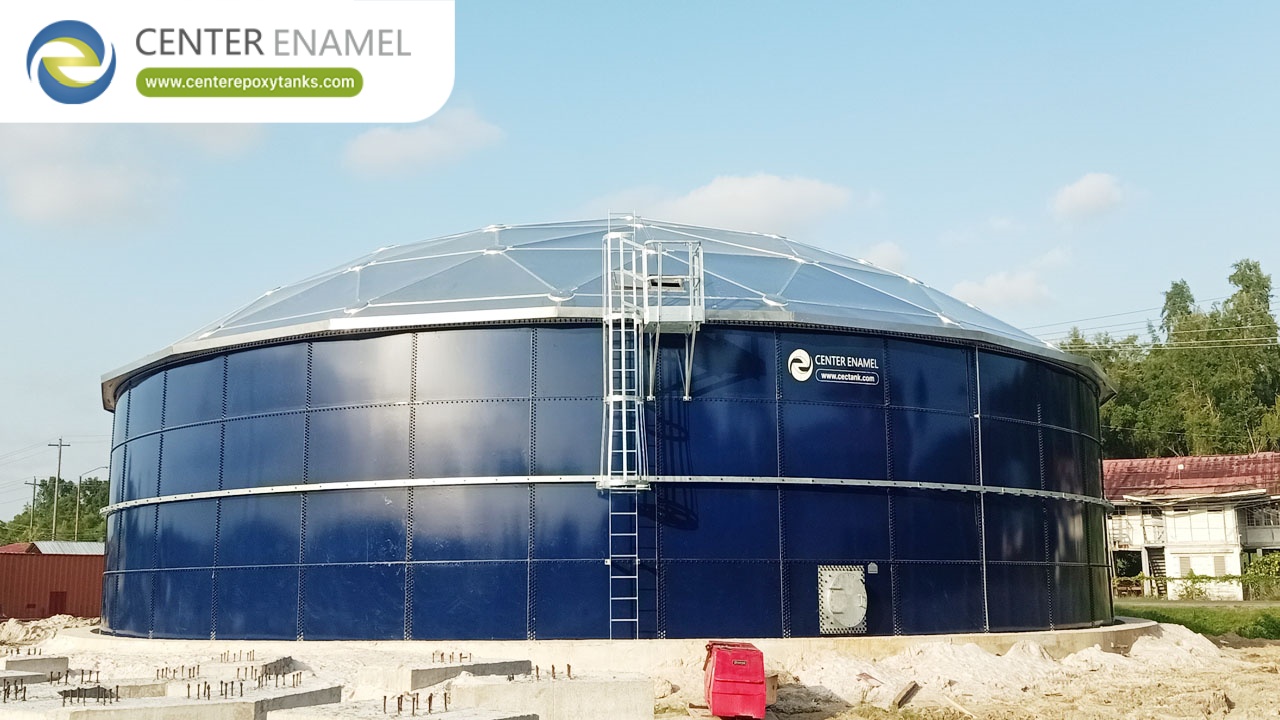
Aluminum Geodesic Dome Roofs for Drinking Water Storage: Advanced Protection and Purity by Center Enamel
For municipal water districts, public utilities, and industrial complexes, safeguarding drinking water reserves against environmental contamination is the highest operational priority. Traditional steel and concrete reservoir roofs frequently suffer from heavy dead weights, complex internal support columns, and high susceptibility to atmospheric corrosion, leading to costly maintenance cycles and water quality risks. To overcome these challenges, water infrastructure managers increasingly specify aluminum geodesic dome roofs as the gold standard for aboveground storage reservoirs and tanks.
Engineered on the principles of spatial triangulation, aluminum geodesic covers provide an exceptional strength-to-weight ratio, complete self-supporting clear spans, and lifelong resistance to environmental corrosion. As a global leader in advanced containment and cover engineering, Shijiazhuang Zhengzhong Technology Co., Ltd. (Center Enamel) delivers custom-engineered aluminum dome solutions designed to preserve water purity and maximize long-term asset value.
1. The Engineering Science of Clear-Span Geodesic Domes
The superior performance of aluminum geodesic covers stems from their specialized structural physics and material properties:
Self-Supporting Clear-Span Geometry: By forming an interconnected network of rigid triangular elements, environmental loads (such as heavy wind, snow accumulations, and seismic forces) are distributed uniformly across the frame and transferred directly to the tank periphery. Crucially, this eliminates the need for internal support columns, removing notorious catch-points for debris, biofilm, and stagnant water.
AWWA D108 Compliance: Center Enamel’s aluminum domes are engineered in strict accordance with ANSI/AWWA D108 Aluminum Dome Roofs for Water Storage Facilities, ensuring precise structural load calculations and long-term reliability under severe climatic conditions.
Hermetic Environmental Sealing: The dome forms an impenetrable barrier that blocks sunlight (preventing harmful algal blooms), excludes airborne dust and debris, and stops birds and wildlife from compromising drinking water safety.
Data Table: Potable Water Storage Tank Roof Technology Comparison Matrix
Technical Parameter | Center Enamel Aluminum Geodesic Dome | Traditional Welded Steel Cone Roof | Poured-in-Place Concrete Roof |
Structural Framing | Self-supporting triangulated clear-span space truss | Rafters and support columns requiring internal pillars | Heavy concrete beams and central support pillars |
Corrosion Resistance | Inherent, lifelong passivation without painting or coatings | Moderate to Low (Requires periodic sandblasting and recoating) | Variable (Prone to cracking, spalling, and rebar oxidation) |
Dead Weight Load | Extremely Lightweight (Minimizes foundation and wall stress) | Heavy (Imposes continuous structural stress on tank walls) | Extremely Heavy (Requires deep foundation piling) |
Maintenance Profile | "Fit-and-forget" longevity with virtually zero maintenance | High ongoing maintenance to prevent rust and flaking | Moderate to High (Requires joint sealing and structural patching) |
Governing Standards | AWWA D108, Aluminum Design Manual, ASCE 7 | AWWA D100 / API 650 | ACI Structural Code Standards |
2. Inherent Material Benefits and Long-Term Value
Marine-grade aluminum alloys (such as 6000-series structural aluminum) provide unique physical advantages tailored specifically for water treatment and storage applications:
Natural Corrosion Passivation: Aluminum naturally forms a self-healing, protective oxide film upon exposure to the atmosphere. It does not rust, making it completely impervious to humid tank headspaces without requiring protective paints or chemical coatings that could risk water contamination.
Reduced Foundation and Installation Costs: Because aluminum domes are exceptionally lightweight, they place minimal dead weight on tank walls and foundations, making them ideal for retrofitting existing concrete reservoirs or aging steel tanks.
Rapid Modular Retrofitting: Prefabricated modular components allow for fast on-site assembly, significantly minimizing municipal downtime and labor expenses.
Frequently Asked Questions (FAQ)
Q: Why are aluminum geodesic dome roofs preferred for drinking water storage?
A: Aluminum geodesic dome roofs provide a maintenance-free, corrosion-free barrier that eliminates internal support columns, prevents algal growth by blocking sunlight, and protects drinking water from environmental contamination without requiring paint or protective coatings.
Q: Do Center Enamel aluminum dome roofs comply with water industry standards?
A: Yes. All aluminum geodesic dome covers are engineered and fabricated in strict compliance with ANSI/AWWA D108 standards for water storage facilities, as well as the Aluminum Design Manual specifications.
Q: Can an aluminum geodesic dome be installed on an existing concrete or steel water tank?
A: Yes. Due to their lightweight modular construction, aluminum domes are ideal for retrofitting existing ground-storage concrete reservoirs and steel tanks, adding minimal load to existing foundations while modernizing the asset.
Q: How do aluminum geodesic covers prevent water contamination?
A: The dome creates an airtight, watertight seal equipped with filtered vents and gasketed hatches that completely exclude dust, insects, birds, and rainwater runoff while blocking UV radiation to stop biological growth.


