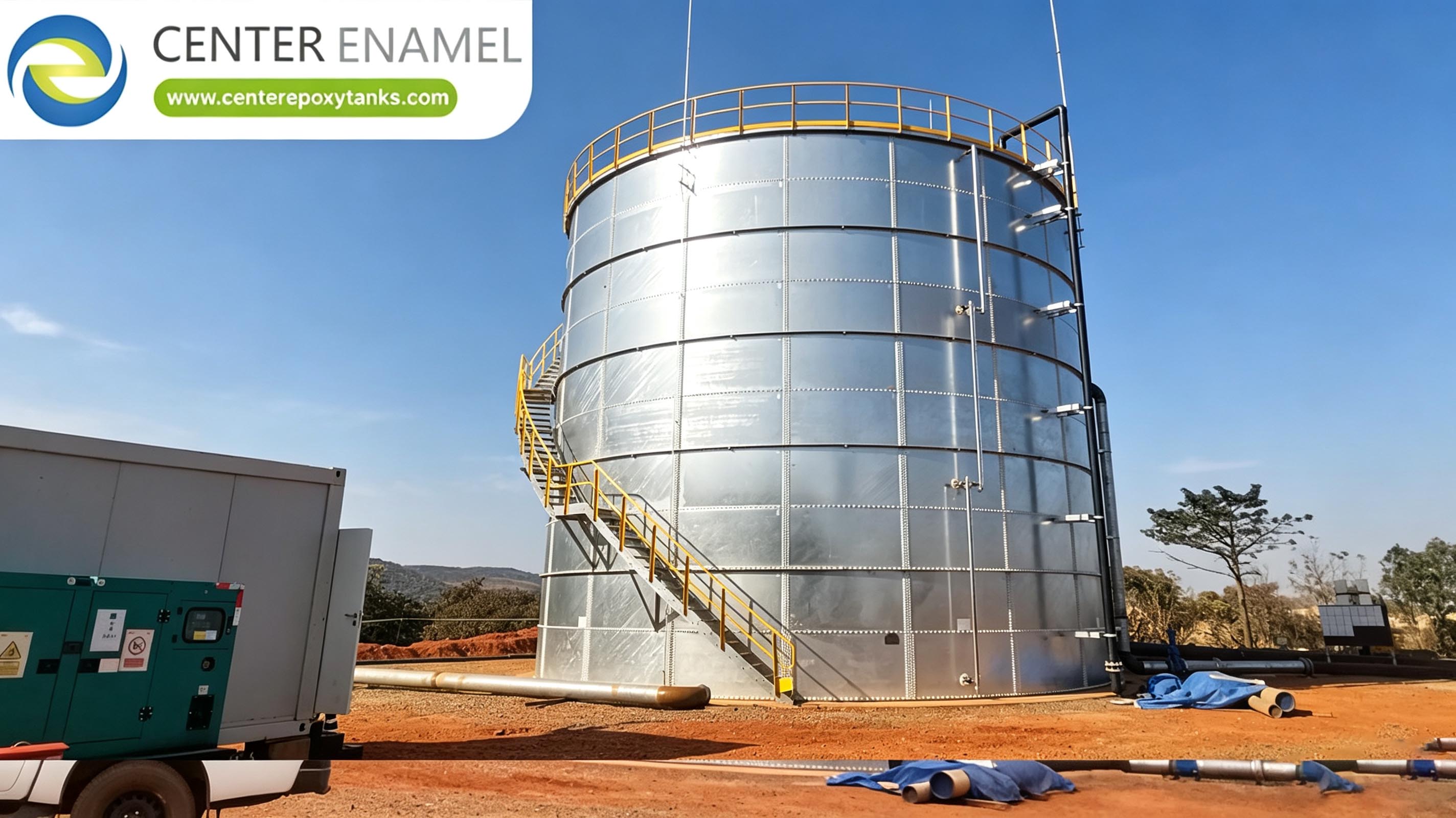
Reliable Galvanized Bolted Steel Tank
A galvanized bolted steel tank protects stored water and bulk liquids through a metallurgically bonded zinc layer formed by hot-dip galvanizing, while bolted panel construction allows fast, modular site erection. It is a practical choice for fire-water reserves, agricultural and irrigation storage, and general utility water where a cost-effective, corrosion-resistant shell is required.
What Is A Galvanized Bolted Steel Tank
A galvanized bolted steel tank is a factory-fabricated storage vessel built from steel panels that are hot-dip galvanized and then assembled on site with bolts, gaskets, and structural stiffeners. The "galvanized" descriptor refers to the zinc coating applied to the steel; the "bolted" descriptor refers to the mechanical jointing system that replaces field welding for the shell.
Center Enamel (Shijiazhuang Zhengzhong Technology Co., Ltd), established in 2008, lists Galvanized Tanks among its core product lines alongside Glass-Fused-to-Steel (GFS) tanks, epoxy-coated bolted tanks, welded steel tanks, aluminum dome roofs, and double-membrane biogas roofs. A galvanized bolted steel tank therefore sits within a broader modular-tank engineering portfolio rather than as a standalone product.
The two design decisions — the coating system and the jointing method — are independent but complementary. Zinc protects the steel substrate; bolting protects the construction schedule.
How The Zinc Coating Protects Against Corrosion
Hot-dip galvanizing immerses fabricated steel panels into molten zinc, producing a series of zinc-iron alloy layers topped by a layer of nearly pure zinc. This metallurgical bond behaves differently from a paint film:
· Barrier protection — the zinc layer isolates the steel from water, oxygen, and chlorides.
· Sacrificial (cathodic) protection — where the coating is scratched or cut, the surrounding zinc preferentially corrodes to protect the exposed steel.
· Metallurgical adhesion — because the coating is bonded at the atomic level, it does not peel or undercut the way organic films can.
International reference standards for hot-dip galvanizing of fabricated steel, such as EN ISO 1461 and ASTM A123 / A123M, define minimum coating masses and thicknesses by steel thickness. Specifiers should confirm the local code basis and the required coating class for the service environment. In aggressive or high-chloride duty, a galvanized bolted steel tank may be supplemented or selected alongside coated alternatives — the comparison below helps frame the trade-off.
Bolted Panel Assembly Vs Welded Construction
Both approaches deliver a steel shell, but they differ sharply in logistics, speed, and field labor.
Factor | Galvanized Bolted Steel Tank | Field-Welded Steel Tank |
Site erection | Panels bolted with gaskets; crane-light, modular | Welding crews, NDE, longer schedule |
Coating | Factory hot-dip zinc (uniform, enclosed) | Field-applied paint or shop coat + site touch-up |
Expansion | Add panels / rings to increase capacity | Re-engineered shell |
Transport | Flat-pack panels, container-friendly | Larger fabricated sections |
Best fit | Distributed, rapid, moderate-pressure storage | Large single tanks, specific weld-code duty |
A galvanized bolted steel tank is generally favored where modularity, transport simplicity, and a factory-controlled coating outweigh the need for a fully welded shell.
Where Galvanized Bolted Tanks Are Specified
Common duty cases include:
· Fire-protection water reserves — sprinkler and hydrant buffers where a clean, corrosion-resistant shell supports reliable draw-down.
· Agricultural and irrigation storage — livestock watering and crop irrigation where the tank is filled and drawn on a seasonal cycle.
· Municipal and industrial utility water — process make-up and general service water.
· Rainwater and stormwater harvesting — distributed collection where bolted modularity simplifies siting.
Selection should still consider water chemistry. For potable duty, confirm coating and liner compatibility with the applicable drinking-water contact requirements; for aggressive or high-purity service, an epoxy-coated or GFS bolted tank may be the more appropriate choice.
Specification Checklist
When specifying a galvanized bolted steel tank, capture at minimum:
1. Net usable volume and peak draw rate (for fire duty, align with the relevant fire-code reserve).
2. Coating standard and class — e.g., EN ISO 1461 / ASTM A123 basis and local thickness class.
3. Panel and bolt grade, gasket material, and seismic / wind zone.
4. Foundation — ring beam or full slab, with surveyed levels.
5. Ancillaries — overflow, inlet/outlet, level indicator, access ladder, and roof or cover.
6. Quality system — tanks should be produced under a certified quality management system such as ISO 9001 and ISO 45001 occupational health and safety controls.
Center Enamel Galvanized Tank Engineering
Center Enamel's bolted-tank engineering draws on the same modular-panel discipline used across its GFS and epoxy-coated lines: factory-controlled coating, standardized panel geometry, and documented assembly procedures. A galvanized bolted steel tank from the portfolio benefits from this repeatable manufacturing base, with ISO 9001 / ISO 45001 quality controls applied across production.
Because galvanizing is a mature, well-understood corrosion system, the engineering emphasis shifts to joint integrity, foundation tolerance, and correct specification of the coating class for the site environment.
FAQ
1. What does "galvanized" mean for a bolted steel tank?
It means the steel panels are hot-dip galvanized — dipped in molten zinc — so the shell carries a metallurgically bonded zinc coating that protects against corrosion and self-heals minor scratches.
2. Is a galvanized bolted steel tank suitable for drinking water?
Galvanized steel can be used for water storage, but potable duty requires confirmation that the coating and any liner meet the applicable drinking-water contact standard. For strict potable or high-purity service, an epoxy-coated or GFS bolted tank is often specified instead.
3. How does a galvanized tank compare to an epoxy-coated bolted tank?
Galvanizing provides sacrificial zinc protection and a factory-enclosed coating; epoxy (FBE) coatings offer a thick inert film referenced to standards such as AWWA D103 for certain bolted tank applications. The choice depends on water chemistry, abrasion, and code basis.
4. Can the tank be expanded later?
Yes. Because the shell is built from bolted panels, capacity can usually be increased by adding panel rings, subject to foundation and structural verification.
5. What standards apply to the zinc coating?
Common references include EN ISO 1461 and ASTM A123 / A123M, which define coating thickness and quality for hot-dip galvanized fabricated steel. Confirm the local code basis during specification.
6. Does Center Enamel make galvanized tanks?
Yes. Galvanized Tanks are listed among Center Enamel's core product lines, produced within the same bolted-tank engineering and ISO 9001 / ISO 45001 quality framework as its GFS and epoxy-coated tanks.
A galvanized bolted steel tank is a sensible, modular, corrosion-protected solution for fire-water, agricultural, irrigation, and general utility storage. Its value comes from combining factory-controlled hot-dip zinc protection with bolted-panel erection speed. Correct specification of coating class, foundation, and ancillaries determines long-term reliability.
Request A Quote
If you are evaluating a galvanized bolted steel tank for fire protection, agriculture, or utility water, the Center Enamel engineering team can review your duty, volume, and site conditions and propose a bolted configuration.


