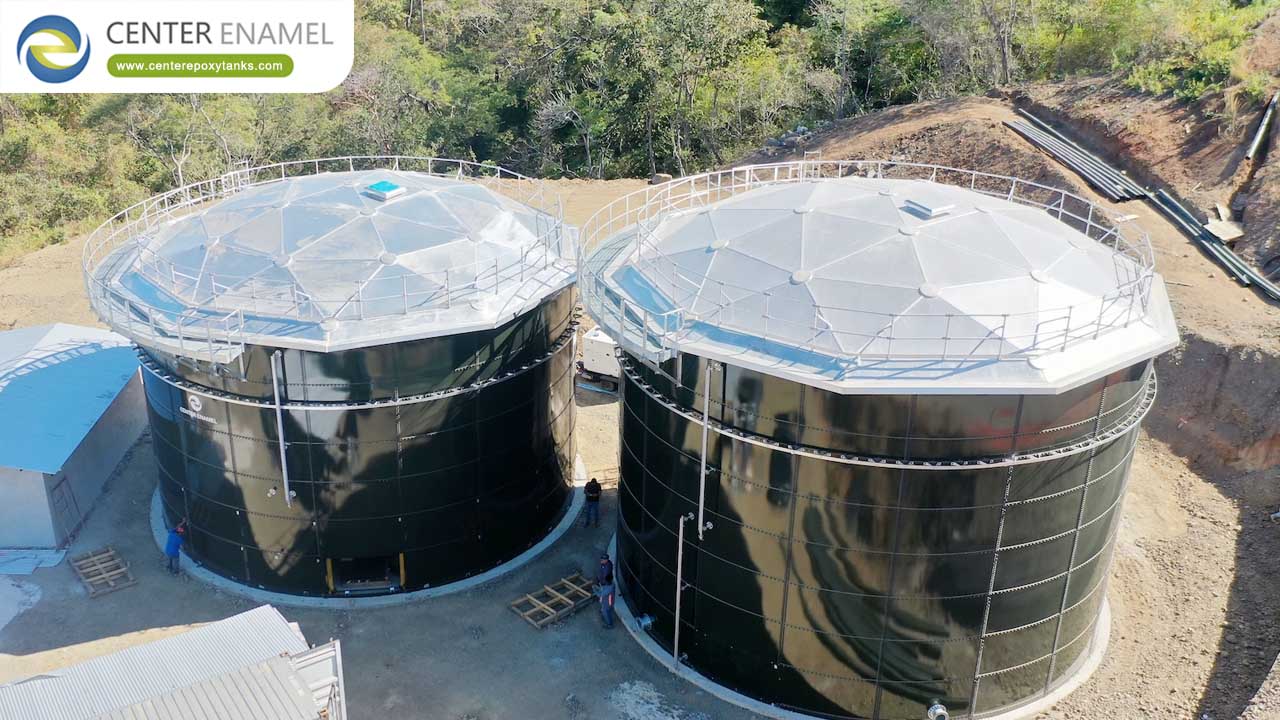
Protecting the Environment: Engineering Fusion Bonded Epoxy Tanks for Leachate Containment
Landfill leachate storage represents one of the most aggressive liquid containment challenges due to high concentrations of ammonia, chlorides, and heavy metals. Center Enamel manufactures Fusion Bonded Epoxy (FBE) tanks compliant with AWWA D103 and ISO 28765 standards. Utilizing a factory-applied, thermally cured electrostatic coating, our FBE tanks provide a holiday-free, dielectric barrier that resists a wide pH range (typically pH 3–11). With a 30-year design life, these modular bolted tanks eliminate the leakage risks associated with concrete or lined ponds, ensuring groundwater protection in over 100 countries.
1. Technical Specification & Chemical Resistance Matrix
Feature | Technical Specification (2026 Standard) | Strategic Environmental Value |
Coating Type | Fusion Bonded Epoxy (FBE) | Thermoset polymer; 100% solids with zero VOCs. |
Design Standards | AWWA D103, EN ISO 28765, NFPA 22 | Mandatory for hazardous liquid containment and audits. |
Chemical Tolerance | pH 3 – 11 (Standard FBE Range) | Resists high NH3N, COD, and volatile organic acids. |
Coating Hardness | >2H (Pencil Hardness) | Resists abrasion from suspended solids in leachate. |
Sealing Protocol | EPDM / Viton / Silicon Gaskets | Chemically inert seals tailored to leachate composition. |
Testing Regimes | High-Voltage Holiday Detection | 100% verification of coating continuity (zero pinholes). |
2. The Science of FBE: Why It Outperforms Concrete and HDPE
Thermal Curing vs. Surface Liners
Traditional leachate storage in concrete or HDPE-lined ponds is prone to osmotic blistering and mechanical punctures. Center Enamel’s Fusion Bonded Epoxy (FBE) involves an electrostatic application followed by thermal cross-linking.
● Dielectric Barrier: The FBE coating provides a superior electrical resistance barrier, preventing the electrochemical corrosion typical in metallic tanks exposed to high-chloride leachate.
● Zero-Permeability Surface: The smooth, non-porous interior prevents the "absorption" of hazardous chemicals into the tank wall—a common failure mode in concrete structures—ensuring the tank can be fully decontaminated if needed.
● Edge Protection: Our automated CNC manufacturing ensures that even the edges and bolt holes of the steel plates are encapsulated in epoxy, eliminating "creep corrosion" at the joints.
3. High-Impact Applications in Waste Management
● Landfill Leachate Equalization: Managing the variable flow of "raw" leachate from primary collection systems. Our tanks handle the high BOD/COD (Biochemical/Chemical Oxygen Demand) loads without structural degradation.
● SBR & Aerobic Digestion: FBE tanks are frequently utilized as the primary vessel for Sequencing Batch Reactors (SBR) in leachate treatment plants, providing the chemical resistance needed for aeration and sludge settling.
● Emergency Containment: The modular bolted design allows for rapid deployment at waste sites experiencing unexpected "leachate breakouts" or during the decommissioning of failing concrete basins.
4. Why Partner with Center Enamel?
As a global leader with over 30 years of expertise, Center Enamel offers a unique technological advantage for environmental projects:
● Advanced Structural FEA: Every tank is subjected to Finite Element Analysis (FEA) to simulate localized hydrostatic pressures and seismic ground acceleration per ASCE 7 standards, ensuring the vessel remains intact during geological events.
● Rapid Modular Deployment: Prefabricated panels are shipped in compact kits, allowing for installation in remote landfill sites without the need for on-site welding or heavy infrastructure, reducing the carbon footprint of construction.
● Global Compliance Authority: Our tanks are certified to ISO 9001, ISO 14001, and ISO 45001. Having supplied solutions to 100+ countries, we adapt every design to localized environmental loads—from tropical rain zones to sub-zero arctic environments.
5. Technical FAQ: Leachate Tank Implementation
Q: Can FBE tanks handle "Young" leachate with very low pH levels?
A: Standard FBE is rated for pH 3–11. For "Young" leachate that may drop below pH 3, we recommend our Glass-Fused-to-Steel (GFS) technology, which offers an even wider resistance range (pH 1–14).
Q: How do you ensure the tank is 100% leak-proof?
A: Beyond the monolithic FBE coating, we utilize high-grade EPDM or Viton gaskets between the bolted panels. After assembly, the tank undergoes a Hydrostatic Test to verify structural and seal integrity before commissioning.
Q: What is the maintenance requirement for a leachate storage tank?
A: Maintenance is minimal. Because the FBE coating is factory-applied and thermally cured, it does not require periodic recoating. Annual visual inspections and basic sediment flushing are typically all that is required for a 30-year service life.


