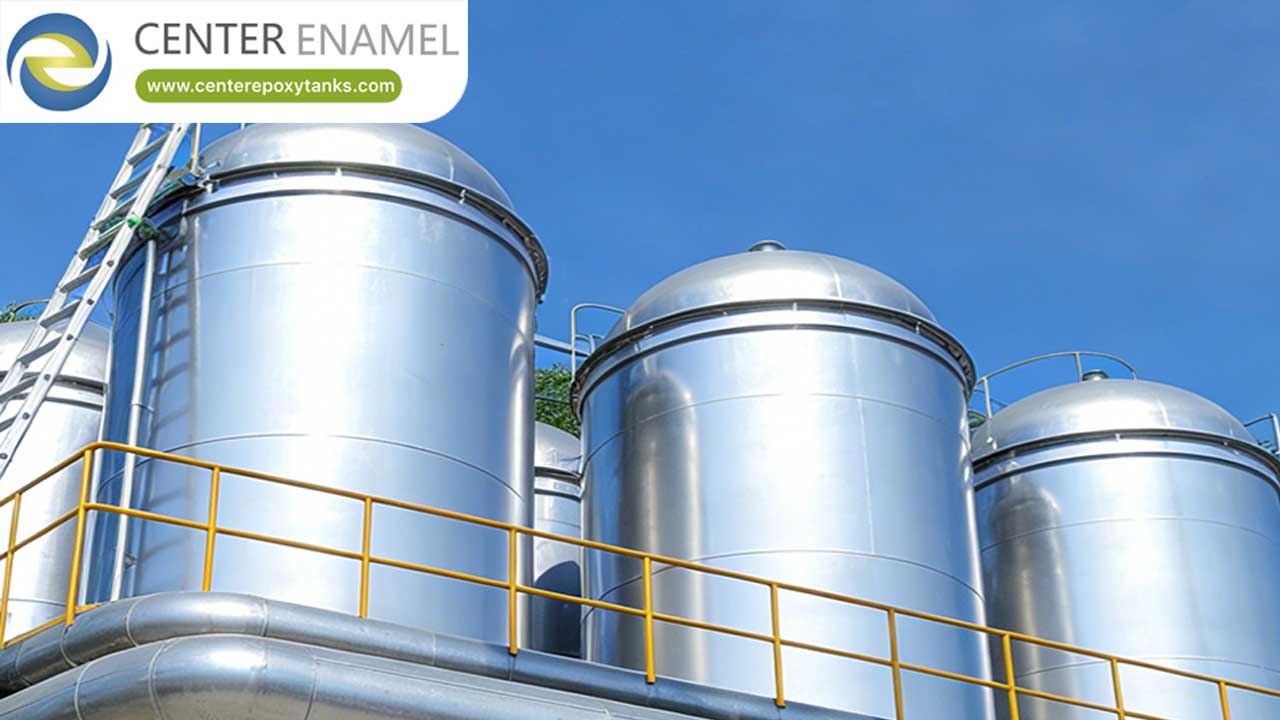
Precision Engineering: Welded Stainless Steel Purified Water Tanks
In industries where purity is non-negotiable—such as pharmaceuticals, biotechnology, and food and beverage processing—the storage vessel is the final line of defense against contamination. Center Enamel is a premier manufacturer of welded stainless steel purified water tanks, engineered specifically to meet the stringent requirements of high-purity water systems.
While modular, bolted tanks serve many industrial needs, welded stainless steel is the gold standard for high-purity applications. The seamless, crevice-free interior is essential for maintaining the sterility of purified water and preventing the formation of biofilms.
Why Welded Stainless Steel is the Gold Standard
For high-purity water, material selection and fabrication methods are critical. Center Enamel utilizes advanced welding techniques and high-grade stainless steel to ensure your water quality remains uncompromised.
The Technical Superiority of Welded Design
Crevice-Free Interiors: Unlike bolted tanks with gaskets or seams, welded tanks offer a smooth, continuous surface. This eliminates "dead zones" where bacteria can colonize, ensuring easy cleaning and maximum sanitation.
AISI 316L Grade Stainless Steel: We use 316L (Low Carbon) stainless steel, which provides superior resistance to corrosion, particularly in environments exposed to chloride-rich water or aggressive sanitation chemicals.
Precision Finishing: Our interior surfaces undergo electropolishing and passivation, creating a microscopic smoothness that resists biofilm adhesion and simplifies Clean-in-Place (CIP) processes.
Comparative Performance Matrix
Feature | Welded Stainless Steel (316L) | Bolted Steel (Epoxy) | Plastic/Polyethylene |
Purity Potential | Ultra-High | Moderate | Low |
Sanitation Ease | Excellent (Seamless) | Moderate | Low |
Contamination Risk | Zero (Inert) | Low | High (Leaching) |
Lifecycle | 30+ Years | 20+ Years | 5–10 Years |
The Center Enamel Advantage
With over 30 years of manufacturing excellence and a global footprint spanning over 100 countries, Center Enamel brings more than just fabrication capacity—we bring technical reliability.
1. Compliance-Driven Engineering
We understand that purified water systems must comply with international benchmarks, including USP (United States Pharmacopeia), GMP (Good Manufacturing Practice), and FDA requirements. Our design processes are fully documented, ensuring full traceability of materials and weld procedures.
2. Expert Fabrication Capabilities
Our production facility utilizes advanced welding technologies, including TIG and automated orbital welding, to ensure every joint is as strong and corrosion-resistant as the base metal. Each tank undergoes rigorous quality control, including dye-penetrant testing and hydrostatic leak testing, before leaving the factory.
3. Customized Design for Facility Integration
We don't provide "off-the-shelf" solutions. We work directly with your engineering team to customize the tank dimensions, nozzle configurations, vent filtration systems, and internal spray balls, ensuring a seamless integration into your existing water purification loop.
Frequently Asked Questions (FAQ)
Q: Why is welded stainless steel preferred over other materials for purified water?
A: High-purity water is aggressive and prone to contamination. Welded stainless steel (particularly 316L) provides a non-leaching, inert surface. The welded construction removes all crevices and gasket interfaces, which are the primary locations for bacterial growth, ensuring the water remains at the required purity level.
Q: Does Center Enamel use 316L or 304 stainless steel?
A: We primarily utilize AISI 316L (Low Carbon) for purified water applications. 316L offers superior resistance to pitting and crevice corrosion, which is critical when dealing with deionized, RO (Reverse Osmosis), or high-purity water.
Q: Can these tanks be customized with sanitary features?
A: Absolutely. We can integrate high-purity features such as sanitary manways, spray balls for CIP (Clean-in-Place), specialized vent filters, and polished interior finishes (Ra < 0.4 µm) to meet your specific pharmaceutical or food-grade requirements.
Q: How is the quality of the welds verified?
A: We employ strict QA/QC protocols. All welds are inspected using non-destructive testing (NDT), including visual inspection, dye-penetrant testing, and, if required, radiographic testing, to ensure structural integrity and sanitation compliance.
Q: What are the lead times for custom welded tanks?
A: Lead times vary based on the capacity, project complexity, and material availability. However, our streamlined production lines allow us to handle large-scale global projects with efficient manufacturing timelines. Please contact our engineering team to get a detailed production schedule for your specific project.
Are you currently specifying high-purity water infrastructure for a new plant or planning an upgrade to your existing purification loop? [Contact the Center Enamel engineering team] today for a technical consultation, capacity analysis, or custom design proposal.
Expert Follow-Up Question: To better assist with your technical planning, are you currently looking to support a new high-purity water loop (RO/EDI) or are you retrofitting/replacing an aging storage vessel in an existing pharmaceutical or food-grade facility?


