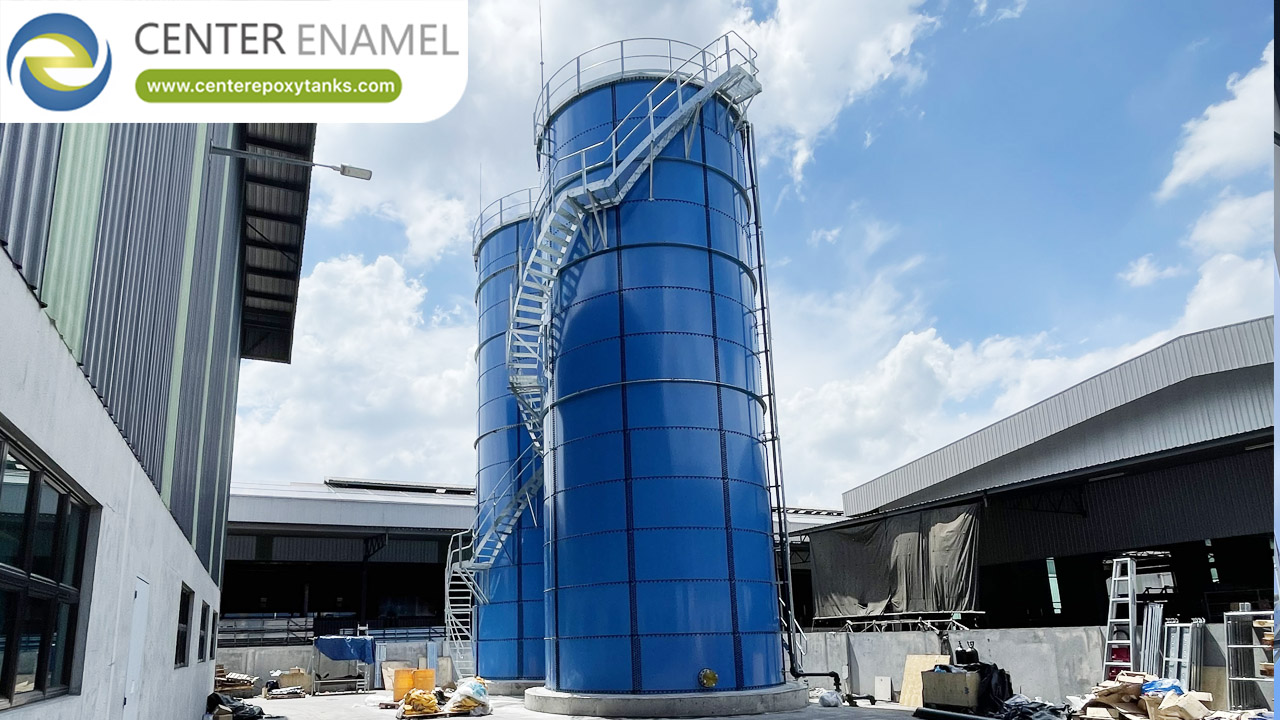
Philippines Potable Water Project: Resilience through Advanced Storage
In the face of rapid urbanization and an archipelago geography prone to natural disasters, the Philippines requires water infrastructure that is not only functional but exceptionally resilient. In 2023, Center Enamel successfully delivered a landmark potable water storage solution, establishing a new benchmark for public health infrastructure in the region.
The project features two monumental Glass-Fused-to-Steel (GFS) tanks, each measuring φ17.58m x 13.7m, providing a combined capacity of 6680m³. These tanks stand as a testament to the power of high-performance engineering in securing community water supplies.
Engineering Challenges in the Philippine Climate
The Philippines presents a unique set of challenges for water storage, requiring a departure from traditional concrete or welded steel solutions.
Typhoon & Seismic Resilience: The infrastructure must withstand extreme wind loads and structural stress from seismic activity.
Tropical Corrosion: Constant high humidity and proximity to coastal salt air accelerate the degradation of standard carbon steel.
Microbial Integrity: Tropical heat accelerates the growth of algae, bacteria, and biofilm, requiring a tank surface that is inherently hygienic.
Why GFS Tanks are the Superior Choice
For potable water, hygiene and durability are the primary metrics of success. The Center Enamel GFS system offers distinct technical advantages:
Comparative Analysis: Potable Water Storage Solutions
Feature | GFS (Center Enamel) | Concrete Tanks | Welded Carbon Steel |
Hygiene (NSF61/WRAS) | Certified (Inert) | Variable (Porous) | Low (Needs lining) |
Corrosion Resistance | Superior (Fused Glass) | Low (Cracking/Leaching) | Low (Requires painting) |
Maintenance | Minimal | High (Repair/Sealing) | High (Scraping/Rust) |
Seismic Resilience | High (Flexible Bolting) | Moderate | Moderate |
Longevity | 30+ Years | 15–20 Years | 10–15 Years |
The "Ultimate Shield": Aluminum Dome Roofs
To ensure total water purity, the GFS tanks are topped with Aluminum Dome Roofs. This integration is critical for maintaining the pristine quality of the water:
"The roof is the first line of defense. By utilizing aluminum geodesic domes, we eliminate the risk of corrosion and block UV light, effectively stopping algae growth before it begins."
UV Blockage: By preventing sunlight from entering the tank, we eliminate the primary driver of algae and microbial proliferation.
Contamination Barrier: The airtight design prevents dust, insects, bird droppings, and other airborne debris from entering the water supply.
Zero-Maintenance: Aluminum is naturally resistant to the humid Philippine climate and requires no painting or protective coating, unlike traditional steel roofs.
Frequently Asked Questions (FAQ)
Q: Why is GFS certification (NSF61/WRAS) critical for this project?
A: Certification to NSF61 and WRAS standards guarantees that the tank materials will not leach harmful chemicals or heavy metals into the water. For a public potable water project, these certifications are the global gold standard for consumer safety.
Q: How do bolted GFS tanks perform during earthquakes?
A: Bolted tanks offer a degree of structural flexibility that rigid concrete or welded structures lack. Our engineering teams apply specific seismic design parameters (anchorage and connections) to ensure the structure can dissipate energy during seismic events, preventing catastrophic failure.
Q: Does the Philippines project require ongoing lining inspections?
A: No. Because our glass-fused-to-steel coating is thermally bonded, it does not require the internal linings or "re-painting" cycles common in welded steel tanks. This significantly reduces the long-term operational cost for the local municipality.
Is your municipality or industrial facility in need of resilient, long-term water storage infrastructure? [Contact the Center Enamel engineering team] to discuss how our GFS and Aluminum Dome technology can safeguard your water assets.


