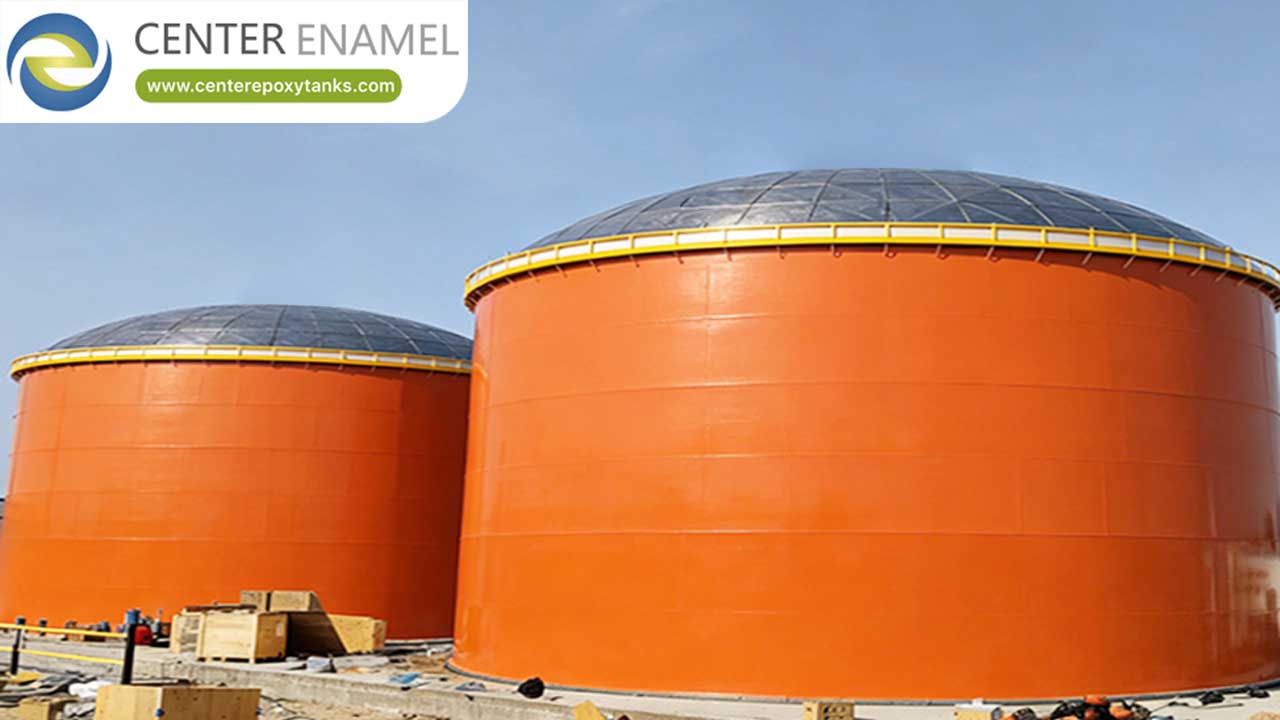
Oil Storage Tank: A Specifier's Guide to Materials and Standards
Every oil storage tank is a compromise between the product it holds, the climate it sits in, and the code it must satisfy. Specifiers who start from a catalog size rather than from the fluid chemistry and the local wind or seismic load usually discover the gap only after fabrication, when changing steel is no longer cheap.
An oil storage tank is specified by first fixing the standard (API 650 for welded tanks in the Americas and many export markets, EN 14015 with the Eurocodes in Europe), then matching shell and coating to the stored product. Welded carbon steel serves most fuels; enamel or epoxy linings protect against aggressive or food-grade oils where carbon steel would corrode or taint.
1. Picking the Governing Standard
The standard decides how the shell is calculated and which load cases are mandatory, so it is the first line of the specification, not a footnote. Most export projects name API 650 explicitly; European sites often require EN 14015 with Eurocode wind and seismic. Both reach safe shells by different math, so the choice is contractual, not a measure of quality.
· API 650: Welded tanks, shell by the one-foot method, with explicit wind and seismic appendices; the global default for oil storage.
· EN 14015: European welded vertical tank standard, paired with Eurocode actions for a consistent European basis of design.
· Site rule: The purchaser's location and export market usually dictate which standard the reviewer will accept, so name it in the enquiry.
· Equivalence: Both reach safe shells by different math; the choice is contractual, not a quality statement about either tank.
· Appendices: Wind, seismic, and internal floating-roof provisions are separate modules that must be invoked, not assumed present.
2. Matching Material to the Oil
Product chemistry, not product name, drives the material choice. A tank that is perfect for crude can fail inside a season on edible oil or on a sour service stream above 0.5 % sulfur. Carbon steel suits most fuels, while stainless or a glass lining protects food-grade and corrosive stocks where carbon steel would pit or taint the product.
· Carbon steel: The workhorse for crude, fuel oil, and most products; economic and well understood for welded construction.
· Enamel lining: Glass-fused-to-steel protects against internal corrosion and is inert to most oils, useful where carbon steel would pit.
· Epoxy / FBE: Fusion-bonded epoxy resists aggressive or variable streams and is common on chemical-adjacent oil service.
· Stainless: Chosen for food-grade or high-purity oils where taste and trace metals cannot be risked in carbon steel.
· Temperature: Warm or heated oils need shell and roof details that ambient tanks do not, independent of the base material.
3. Coatings, Site, and Code Factors
The coating decision and the site conditions are where apparently identical tanks diverge. Two tanks of the same capacity can carry completely different specifications because one sits on a seismic coast with 0.3-0.5 g ground acceleration and the other in a snow belt rated to 2-3 kPa. The coating DFT and the anchor detail follow directly from those local numbers.
· External coating: Shot-blast to Sa 2.5 and coat to a documented dry-film thickness to stop atmospheric corrosion on the shell and roof.
· Internal lining: Specify the lining against the actual product, not a generic oil, so compatibility is demonstrable.
· Wind and snow: Wind girder elevation and roof live-load are set by local climate and feed straight back into plate thickness.
· Seismic: Anchorage and base details change sharply in high-risk zones; this is a code requirement, not an upgrade.
· Foundation: Settlement tolerance bounds how flat the bottom must be laid and how the shell is anchored to the ring.
Design parameter | Typical value or range | Why it matters |
Shell method | One-foot / EN 14015 | Standard sets thickness |
Blast grade | Sa 2.5 | Pre-coat cleanliness |
Coating DFT | 0.25-0.40 mm | Atmospheric defense |
Capacity range | 20-60,000 m3 | Welded tank span |
Shell plate | 6-40 mm | Hydrostatic head by elevation |
NDE coverage | 10-100 % | Seam length examined |
Vapor loss | up to 99 % | Standing-loss reduction |
Service life | 30-50 years | Design target |
Operating temp | 20-60 °C | Product and climate |
Limitation to check | Lining vs real product | Generic oil label misleads |
Wind / seismic load | 0.5-1.5 kPa | Roof and shell load |
Foundation settle | 0.1-0.3 m | Controlled subgrade |
Throughput | 50-500 m3/d | Typical draw |
Operating temp | 20-60 °C | Product and climate |
Product density | 800-950 kg/m3 | Typical range |
Design margin | 10-20 % | Allowance in steel |
Specification Factor | API 650 Path | EN 14015 Path | Why It Changes the Tank |
Shell method | One-foot rule | EN 14015 formula | Plate schedule differs |
Load cases | Wind + seismic appendices | Eurocode actions | Anchor and girder |
Material | Carbon / lined steel | Carbon / lined steel | Product-driven |
Coating | Sa 2.5 + DFT | Sa 2.5 + DFT | Corrosion control |
Market | Americas, export | Europe | Reviewer acceptance |
Engineering Assurance and Project Support
Every welded oil tank delivered by Shijiazhuang Zhengzhong Technology Co., Ltd. (Center Enamel) is designed to API 650 with shell courses sized by the one-foot method and checked for wind, seismic and hydrostatic load cases, or to EN 14015 and the Eurocodes where the site is European. Shell plate is shot-blasted to Sa 2.5 and coated to a documented dry film thickness, longitudinal and annular plate welds are examined by radiography or ultrasonic testing to the acceptance level written into the purchase order, and every tank is hydrostatically tested and dimensionally surveyed before hand-over. Full calculation packs, coating specifications, and hydrostatic and dimensional surveys are delivered so the tank can be re-checked against either API 650 or EN 14015 at any later audit.
The standard you name on page one decides the plate thickness on page fifty; treat it as the first design input, not a closing certificate.
Frequently Asked Questions (FAQ)
Which standard should an oil storage tank follow?
Name API 650 for welded tanks in the Americas and most export markets, or EN 14015 with the Eurocodes for European sites. The standard sets the shell calculation and mandatory load cases, so it belongs in the enquiry, not the closing certificate.
How do I match tank material to the stored oil?
Let fluid chemistry decide: carbon steel for crude and fuel oil, enamel or epoxy lining where the oil is corrosive or food-grade, and stainless for high-purity edible oils. Match the lining to the actual product rather than to a generic oil label.
What coating and lining decisions actually matter?
Externally, blast to Sa 2.5 and coat to a documented dry-film thickness; internally, specify the lining against the real product. These choices, not the base steel, usually determine service life on aggressive or edible streams.
What site and code factors change the specification?
Local wind, snow, and seismic conditions set girder elevation, roof load, and anchorage, while foundation settlement tolerance bounds bottom flatness. Two same-size tanks can carry very different specs because of where they stand.
·


