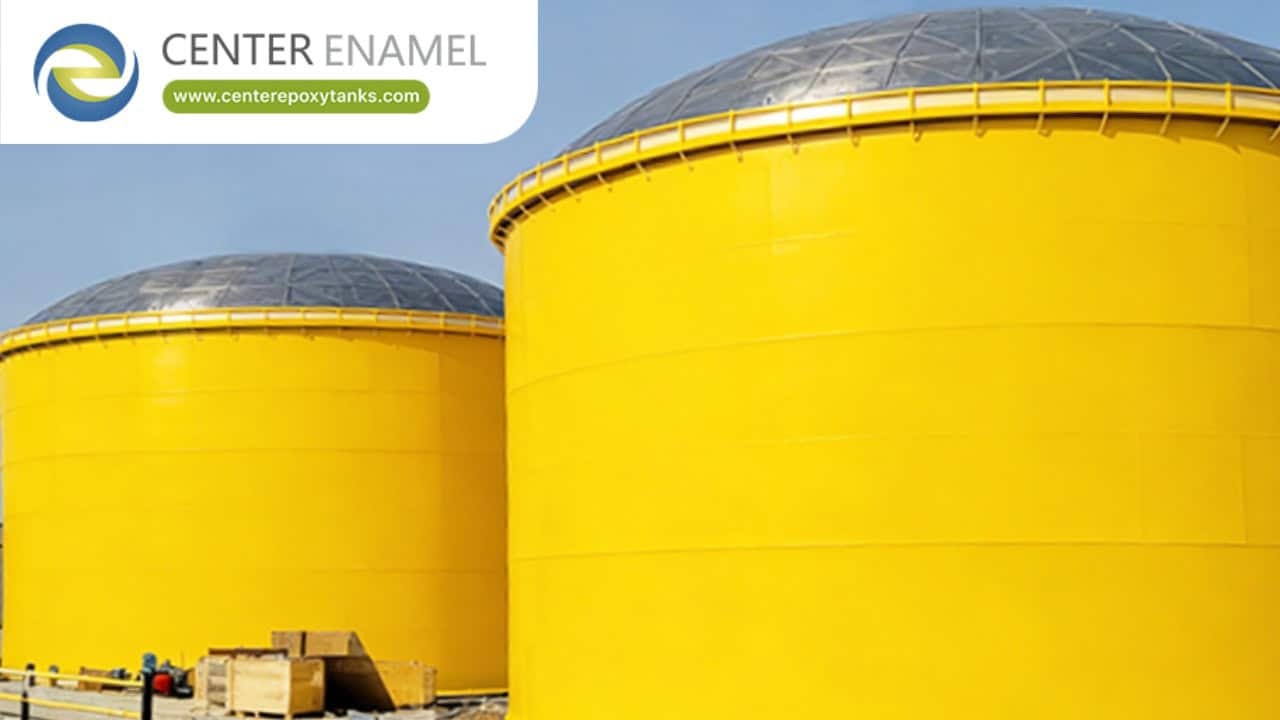
Oil Dome Roofs - Why Terminals Are Moving to Clear-Span Aluminium Covers
Walk any mature tank farm and the roofs tell the story: patched plate, streaked coating, a column line that has been reinforced twice. The shell is usually fine. It is the roof that has consumed the maintenance budget, because the vapour space above oil is one of the most corrosive environments on the site - humid, sulphide-bearing, thermally cycled, and invisible until the tank is opened. Add internal columns and you add a line of corrosion sites standing in whatever water and sediment have settled.
Dome roofs change that equation. Engineered by Shijiazhuang Zhengzhong Technology Co., Ltd. (Center Enamel), an aluminium geodesic dome roof carries all roof load to the shell compression ring through a triangulated frame, needs no internal supports, and is immune to the vapour-space corrosion that drives steel roof maintenance. For terminals planning twenty or thirty years ahead, it converts an unpredictable roof budget into a predictable one.
1. What Is an Oil Dome Roof?
A self-supporting, triangulated aluminium space frame that spans the tank diameter and is sealed with gasketed panels. It replaces the plate-and-rafter cone roof entirely, and can act as the fixed roof over an internal floating roof deck.
· Geodesic Geometry: Triangulated members share load in two directions, which is what allows the span without intermediate columns.
· Aluminium Structure: Extruded alloy members and cast or machined nodes are assembled with bolted, gasketed joints - no site welding.
· Sealed Skin: Panel gaskets produce a weather-tight, dust-tight envelope over the vapour space.
· Integrated Ancillaries: Vents, manways, gauge hatches, walkways, handrails and lightning protection are part of the roof scope.
· Retrofit-Friendly: The dome can be assembled over an existing tank once the compression ring is verified.
2. Why Are Terminals Switching to Dome Roofs?
Three reasons, in order of weight: no repainting, no internal columns, and faster return to service after any inspection or cleaning campaign. Together they change the roof from a liability into a fixed asset.
· No Repainting: Aluminium never needs blast-and-recoat, removing the largest single maintenance item on a conventional roof.
· No Columns: Removing columns removes column boots, deck penetrations and the corrosion sites that sit in water bottom.
· Faster Inspections: Clear interiors let inspectors see every plate and let cleaning machines coverage-spray the whole shell.
· Lower Weight: The lighter roof reduces shell and foundation demand, which is decisive on retrofits.
· Longer Predictable Life: Thirty years or more with inspection, without the deterioration curve of a coating system.
3. What Codes and Checks Apply to Oil Dome Roofs?
API 650 Appendix G governs structurally supported aluminium dome roofs on steel tanks. The load cases - dead, live, wind, snow, seismic and maintenance - come from the site, and the shell's ability to take the dome's thrust is verified before the design is frozen.
· API 650 Appendix G: The primary design reference for aluminium domes on steel storage tanks.
· Site Load Cases: Wind, snow, seismic and maintenance loads are taken from project data rather than assumed by the supplier.
· Shell and Ring Check: The top shell course and compression ring are verified for the thrust the dome delivers.
· Venting Compliance: Where the dome sits over a floating deck, fixed-roof space venting is sized to API 2000.
· Grounding and Bonding: The roof is bonded to the shell and included in the tank's lightning and static-earthing philosophy.
Evaluation Criterion | Aluminium Dome Roof | Steel Cone Roof |
Span without columns | Yes - full tank diameter | No - columns on larger tanks |
Vapour-space corrosion | Immune - aluminium | Progressive and hidden |
Repainting | Never required | Every 10-15 years |
Roof weight | Low | High |
Inspection speed | Fast - unobstructed | Slow - obstructed by structure |
Engineering Assurance and Project Support
Every welded oil tank delivered by Shijiazhuang Zhengzhong Technology Co., Ltd. (Center Enamel) is designed to API 650 with shell courses sized by the one-foot method and checked for wind, seismic and hydrostatic load cases, or to EN 14015 and the Eurocodes where the site is European. Shell plate is shot-blasted to Sa 2.5 and coated to a documented dry film thickness, longitudinal and annular plate welds are examined by radiography or ultrasonic testing to the acceptance level written into the purchase order, and every tank is hydrostatically tested and dimensionally surveyed before hand-over. Each dome is delivered with load calculations, material certificates, erection and torque records, and a written inspection schedule so the roof can be managed inside the terminal's integrity system.
Frequently Asked Questions (FAQ)
What is the difference between a dome roof and a cone roof?
A cone roof is plated steel supported by rafters and, on larger tanks, internal columns. A geodesic dome roof is a triangulated aluminium space frame that is self-supporting, so it spans the full diameter without any internal column. The dome also removes the need for coating maintenance, which a steel cone roof cannot avoid.
Can a dome roof be used with an internal floating roof?
Yes, and this is one of the most common configurations. The dome acts as the fixed roof, protecting the floating deck from rain, wind and sunlight, while the deck controls vapour loss. The two must be designed together so that deck suspension, guide poles and anti-rotation loads are carried by the frame.
How is a dome roof maintained?
By scheduled inspection rather than by periodic refurbishment. Gasket condition, sealant, fastener torque, panel alignment and drainage are checked from the walkway, and any individual gasket or fastener is renewed as needed. There is no whole-roof recoating event in the maintenance plan.
Can the dome be customised to our tank?
Yes. Diameter, rise, panel section, alloy and temper, gasket material, insulation, vents, manways, gauging platforms, walkways, handrails, lightning protection and floating-roof suspension loads are all engineered to your tank, product and site loads before fabrication.


