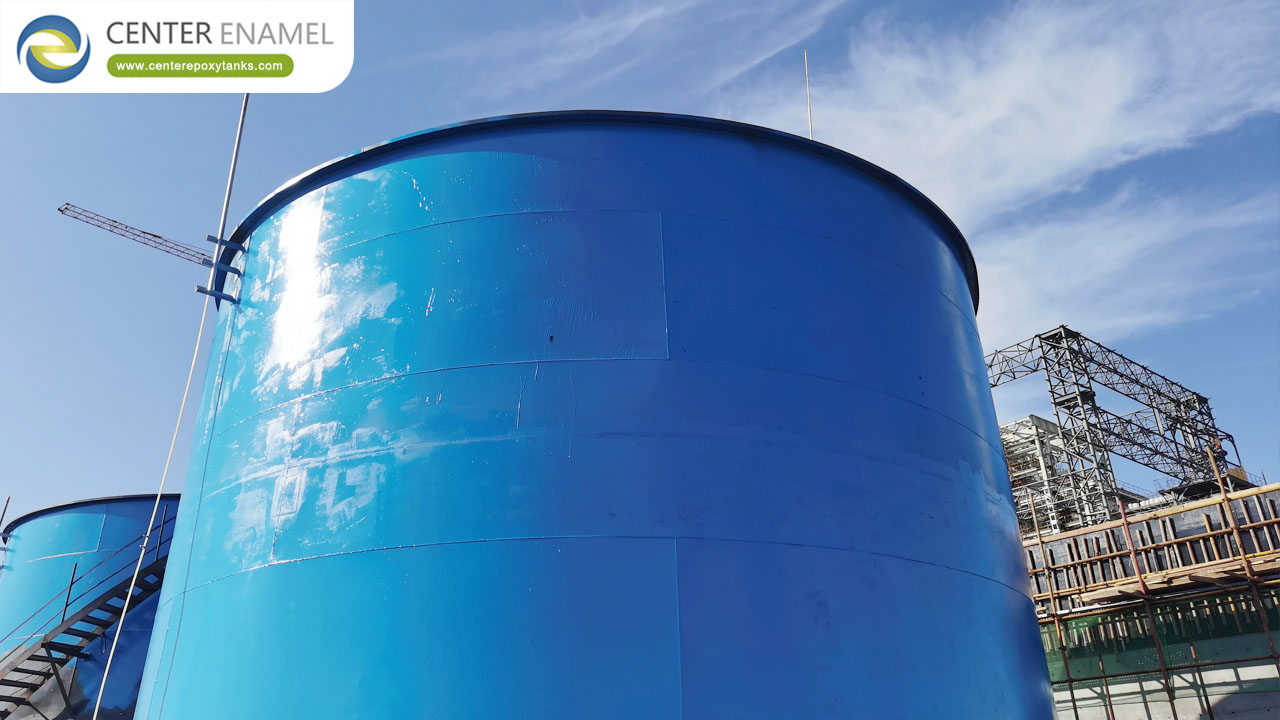
Monolithic Strength: The Evolution of Welded Carbon Steel Tanks
In the global industrial landscape, welded carbon steel tanks remain the gold standard for high-stakes containment where internal pressure, vacuum resilience, and monolithic integrity are paramount. As manufacturing technologies have evolved, so has the precision with which these massive structures are engineered. Shijiazhuang Zhengzhong Technology Co., Ltd (Center Enamel) has combined 30 years of material science with advanced automated welding technology to provide solutions for the world’s most demanding environments.
1. Why Choose Welded Construction?
While modular bolted tanks offer unmatched assembly speed for specific municipal uses, welded carbon steel tanks are the definitive choice for applications where structural continuity is a functional requirement.
Monolithic Integrity: Automated welding systems ensure consistent, full-penetration seams. Unlike mechanical joints, these seams eliminate the risk of "point failure," creating a single, leak-proof structure that behaves as one unit under load.
Pressure & Vacuum Resilience: Welded construction is the primary choice for industrial processes involving internal pressure or vacuum conditions that exceed the structural tolerances of modular, gasketed designs.
Biofuels & Volatile Storage: Welded tanks provide the secure, impermeable containment necessary for ethanol, biodiesel, and aviation fuels, where vapor retention, safety, and strict environmental compliance are non-negotiable.
2. Technical Standards: API 650 & Beyond
The reliability of a welded tank is defined by the engineering codes it follows. Center Enamel designs and fabricates in strict accordance with the most rigorous global benchmarks:
API 650: The industry standard for welded tanks used in oil, gas, and chemical storage. It defines the material, design, fabrication, and testing requirements for safe liquid storage.
AWWA D100: The established standard for welded carbon steel tanks utilized in water storage, ensuring seismic resilience and structural longevity.
Non-Destructive Testing (NDT): Every major seam at Center Enamel undergoes rigorous NDT, including ultrasonic or radiographic examination, to confirm 100% weld integrity.
3. Specialized Coatings for Carbon Steel
Carbon steel requires advanced surface protection to ensure a long service life. At Center Enamel, we apply specialized factory-controlled coatings that bridge the gap between steel performance and chemical inertness:
Fusion Bonded Epoxy (FBE): A high-performance, heat-cured coating that provides exceptional resistance to abrasion and chemical attack.
Specialized Liners: For highly corrosive agricultural or industrial waste, internal liners ensure the carbon steel substrate remains shielded from acidic or caustic degradation.
4. Comparison: Welded vs. Bolted Steel Tanks
Feature | Welded Carbon Steel Tanks | Bolted Steel Tanks (GFS/FBE) |
Integrity | Monolithic (Single Piece) | Modular (Jointed) |
Pressure Rating | High (API 650/620) | Atmospheric / Low Pressure |
Deployment | Field Welded (Slower) | Factory Fabricated (Faster) |
Maintenance | Requires Periodic Painting | Zero/Low Maintenance (Glass) |
Best Application | Biofuels, Petrochemicals | Wastewater, Municipal, Fire Water |
5. Why Partner with Center Enamel?
For EPC contractors and energy developers in over 100 countries, partnering with Shijiazhuang Zhengzhong Technology Co., Ltd (Center Enamel) offers strategic, measurable advantages:
Manufacturing Prowess: Our 150,000 m² "Smart Factory" utilizes CNC laser cutting and 3D automated welding robots to ensure precision at scale.
Global Compliance: From ISO 9001 to CE Mark and NFPA standards, our engineering ensures your project passes all international safety audits and regulatory inspections.
Comprehensive Service: We manage the entire project lifecycle—from custom engineering and material selection to on-site technical guidance.
Selecting a welded carbon steel tank is a strategic investment in industrial longevity and safety. By leveraging the engineering mastery of Shijiazhuang Zhengzhong Technology Co., Ltd (Center Enamel), project managers ensure their infrastructure is built to the highest global standards of monolithic performance.
Frequently Asked Questions (FAQ)
Q: Why is welded carbon steel preferred for petroleum storage over bolted alternatives?
A: Petroleum and volatile chemical storage often require the tank to handle specific internal pressures and vapor containment that exceed the structural limits of bolted, gasketed joints. The monolithic, fused nature of welded steel ensures there are no mechanical seams that could potentially weep or fail under cyclic pressure.
Q: Does a welded carbon steel tank require extensive maintenance?
A: Welded carbon steel tanks require proactive maintenance, specifically periodic inspection of the exterior coating and cathodic protection systems. However, with the application of high-performance coatings like Fusion Bonded Epoxy (FBE), the frequency and complexity of this maintenance are significantly reduced compared to traditional field-applied paints.
Q: How does Center Enamel ensure the quality of field welds?
A: We utilize a combination of automated welding robots in our smart factory to minimize human error and rigorous field procedures for the final assembly. All critical welds undergo Non-Destructive Testing (NDT)—including radiographic or ultrasonic testing—to verify that the joints meet or exceed API 650/AWWA D100 standards before the tank is commissioned.
Q: How can I receive a customized proposal for my industrial facility?
A: We invite EPC contractors and project managers to contact our global engineering department for a technical consultation. You can reach us at epoxytanks@cectank.com or call +86-020-34061629 to discuss your specific site requirements, volume needs, and design compliance standards.
Are you currently in the design phase for a bulk storage project, or are you looking for specific compliance documentation regarding API 650 standards?


