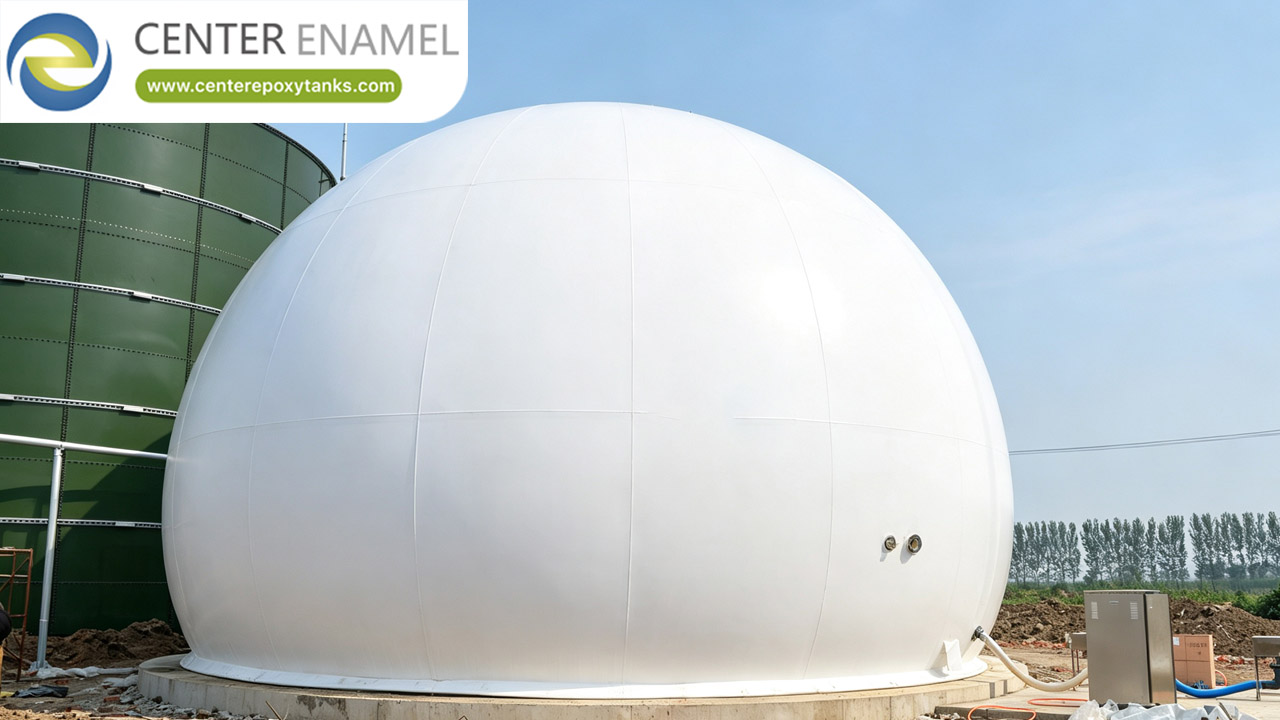
Membrane Gas Holder for Food Processing Wastewater Treatment Project: Engineering Renewable Biogas Efficiency
Food and beverage processing facilities—including breweries, dairies, meat-processing plants, fruit and vegetable packaging lines, and snack production facilities—generate massive volumes of industrial wastewater. Characterized by high concentrations of dissolved sugars, starches, animal fats, and organic residues, this effluent exhibits exceptionally high biochemical oxygen demand (BOD) and chemical oxygen demand (COD).
To achieve sustainable environmental compliance, modern food processing plants deploy advanced anaerobic digestion (AD) systems to break down organic pollutants. This biological process generates a valuable byproduct: renewable, methane-rich biogas. However, biological gas generation in food manufacturing fluctuates dramatically due to batch processing schedules, cleaning cycles, and seasonal crop harvests. To bridge the gap between irregular gas production and steady energy consumption, facilities rely on the advanced membrane gas holder for food processing wastewater management.
Operational Challenges in Food Processing Effluent Management
Treating food and beverage wastewater through anaerobic digestion introduces unique mechanical and chemical hurdles:
Volatile Organic Loading and Spikes: Rapid fermentation of high-sugar or high-starch waste can cause rapid fluctuations in biological activity, leading to unpredictable gas production surges that threaten downstream equipment if left unbuffered.
Corrosive Gas Composition: Biogas generated from food processing effluent often contains high concentrations of moisture, carbon dioxide, and hydrogen sulfide (H2S), which can rapidly induce stress corrosion cracking and pitting in unprotected metal infrastructure.
Strict Energy and Pressure Requirements: Downstream utilization units—such as boilers, thermal oxidizers, or combined heat and power (CHP) cogeneration engines—require a consistent, regulated gas supply pressure that raw, surging digester output cannot supply natively.
Architecture and Working Principle of Double Membrane Gas Holders
The industry standard for industrial wastewater gas management is the Double Membrane Gas Holder (DMGH). Engineered from high-strength, multi-layered architectural fabrics, the system relies on three distinct functional boundaries:
Bottom Membrane (Base Layer): Forms the foundational floor seal, anchoring the entire gas holder structure securely to a concrete foundation slab or directly onto the rim of a bolted steel or concrete anaerobic digester tank.
Inner Membrane: Directly confines the stored biogas. It dynamically expands and contracts within the outer shell based on immediate volumetric generation rates from the wastewater treatment reactor.
Outer Membrane: Maintained under continuous pneumatic pressure by a dedicated, spark-resistant air blower system. This outer dome provides structural shape, weather defense against wind and snow loads, and steady downforce (counter-pressure) on the inner gas chamber.
An automated pressure control cabinet manages the inter-membrane air space, ensuring that the stored biogas is delivered at a perfectly constant, stable operating pressure regardless of storage volume.
Technical Performance Matrix: Biogas Storage Technologies
Technical Parameter | Double Membrane Gas Holder (DMGH) | Fixed-Roof Steel Gas Tank | Wet-Seal Telescopic Gasholder |
Volumetric Buffer Flexibility | High and dynamic; inner membrane expands/contracts smoothly to absorb production surges | Rigid volume limit; highly vulnerable to over-pressurization during peak loads | Moderate capacity; bulkier structural footprint with limited expansion headroom |
Gas Pressure Stability | Constant, regulated operating pressure managed automatically via air-side blower controls | Fluctuates wildly depending on fill levels and structural gas displacement | Relies on water-seal counterweights; prone to water freezing, evaporation, and leakage |
Corrosion & Chemical Defense | Superior; specialized PVC-coated polyester fabrics resist moisture, UV rays, and high $H_2S$ (up to 8000 ppm) | Vulnerable to internal acid condensation and sulfuric pitting without expensive stainless steel linings | High maintenance overhead required to prevent chronic corrosion of steel lift guides |
Installation Velocity & Cost | Rapid modular assembly completed in days to weeks with minimal heavy civil investment | Slow, capital-intensive field construction requiring extensive welding, rigging, and painting | Complex mechanical assembly with high ongoing operational and inspection overheads |
Frequently Asked Questions (FAQ)
Q: Why is a membrane gas holder necessary for a food processing wastewater treatment project?
A: Food processing wastewater produces biogas at highly variable rates due to shift work, cleaning cycles, and seasonal production spikes. A membrane gas holder acts as a large-volume buffer that absorbs these fluctuations, ensuring a continuous, steady fuel supply for plant boilers or power generators.
Q: How does the double membrane system maintain a constant gas delivery pressure?
A: A dedicated support blower continuously maintains regulated air pressure in the space between the outer and inner membranes. This air pressure exerts a uniform downward force on the inner gas storage membrane, ensuring stable gas delivery pressure to your facility equipment regardless of stored volume.
Q: Can membrane gas holder fabrics withstand corrosive gases like hydrogen sulfide (H2S)?
A: Yes. Modern industrial gas holders are fabricated using specialized, multi-layered, PVC-coated polyester textiles that are chemically treated to resist moisture, ultraviolet radiation, and high concentrations of hydrogen sulfide (tested up to 8000 ppm) common in food waste digestion.
Q: Can a double membrane gas holder be mounted directly on top of an existing anaerobic digester tank?
A: Yes. Depending on the plant layout, these gas holders can be custom-engineered to mount directly onto the top rim of existing concrete or bolted steel anaerobic digester tanks, or installed as standalone floor-standing units on independent concrete foundations.


