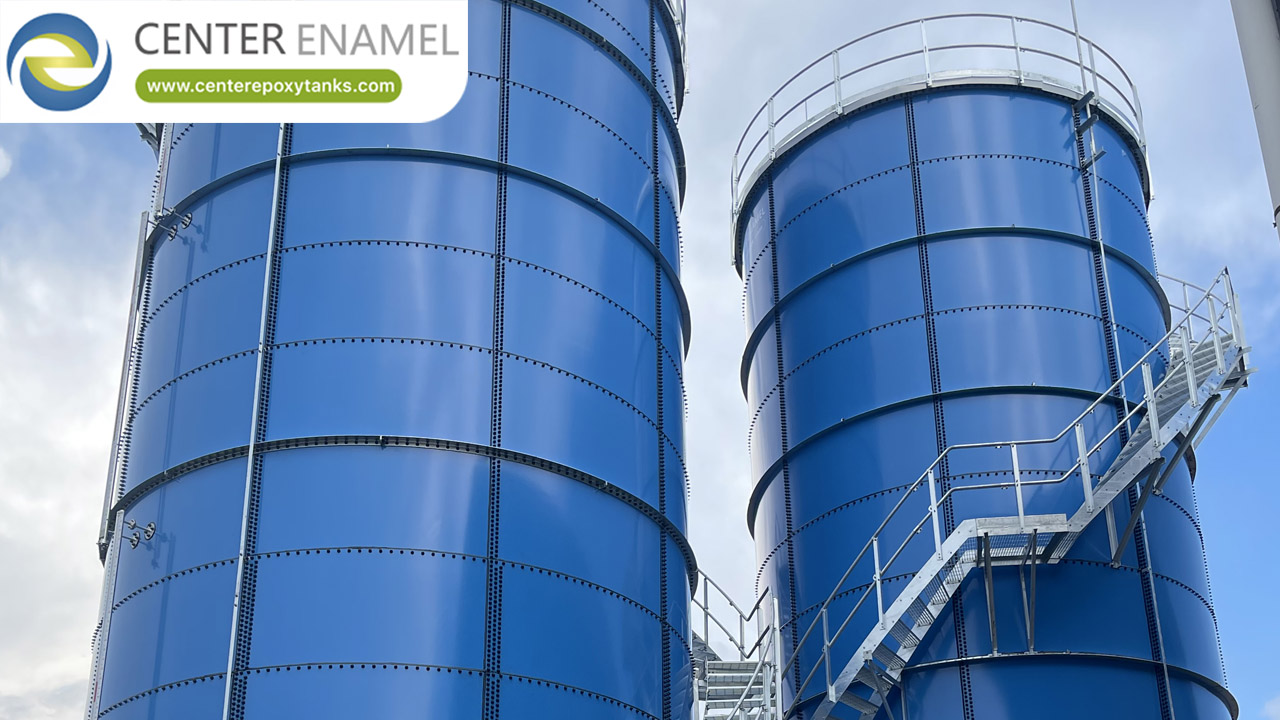
Makeup Water Tank for a Chilled Water System: Role and Specification
A chilled-water system is a closed loop, yet it still needs makeup for make-up on leaks, drain-and-refill, and chemical dosing. The makeup tank is the controlled point of entry for treated water.
A makeup water tank stores treated water that replaces the evaporation, drift, blowdown, and leakage losses of a cooling or process system. Make up water tank for chilled water system is sized from the system's make-up rate and the acceptable refill interval — commonly 10–20% of system volume or a calculated buffer — and is built from corrosion-resistant bolted materials such as GFS or FBE so the stored water stays clean and the tank survives a wet, often chemical environment.
Technical Explanation
Makeup water enters a cooling or process system to offset continuous losses. In an open cooling tower the dominant loss is evaporation, supplemented by drift (entrained droplets) and blowdown (controlled bleed to control concentration). In a chilled-water or process loop the losses are smaller but still real: seal leakage, valve packing weep, and planned drain-and-refill.
The tank itself is a simple atmospheric vessel, but the engineering choices matter. The lining must resist the treated water chemistry and any biocide, the level controls must fail safe, and the connection philosophy must keep the tank isolated from backflow yet always ready to top up.
Application Scenarios
Cooling towers for HVAC and industrial process, chilled-water plants, compressor jacket-water loops, and process rinse or wash systems all rely on a makeup buffer. The duty is similar but the water quality and turnover differ, which drives material selection.
In a data-center context the makeup tank feeds the cooling tower or evaporative unit that rejects IT heat; its reliability is part of the site's overall resilience, even though it is upstream of the chilled-water loop.
Selection and Sizing
Start from the loss rate. For a cooling tower, evaporate is roughly 1% of circulation per 5.6 °C of range; add drift and blowdown. Sizing the tank to cover the refill interval — often a few hours to a day of losses — gives a defensible buffer without overbuilding.
Material choice: GFS and FBE bolted tanks are preferred for their factory-applied, NSF-61 / WRAS-approved linings that keep stored water clean and resist corrosion; stainless suits smaller, hygiene-critical duties.
Makeup Tank Selection Factors
Factor | Guidance |
Loss source | Evaporation + drift + blowdown (tower); leaks (loop) |
Tank volume | 10–20% of system volume or refill-interval buffer |
Material | GFS / FBE bolted (corrosion-resistant lining) |
Level control | Fail-safe make-up valve, high/low alarms |
Technical Specifications
Parameter | Specification |
Tank / vessel type | Glass-Fused-to-Steel (GFS) bolted tank |
Primary design standard | AWWA D103-09 (bolted) / ASME Section VIII (pressurized) |
Coating / lining | GFS enamel or FBE epoxy, NSF-61 / WRAS approved for potable contact |
Typical diameter range | 4.6 m to 44 m (bolted modular panels) |
Typical height range | up to 34.8 m (verified single GFS tank) |
Operating temperature | 1 °C to 50 °C (chilled / ambient water service) |
Pressure class | Atmospheric (open/buffer) or pressurized (ASME, up to design code) |
Roof option | Aluminum dome / aluminum flat cover / internal floating |
Reference capacity | 21,099 m3 |
Certifications | ISO 9001, NSF 61, EN 1090, ISO 28765, WRAS, FM |
Verified Tank Engineering Reference
Center Enamel's verified record includes a 2025 Drinking water project in Indonesia — 1 unit(s), φ42.04*15.2m (H) 1 set, 21,099 m3 total, GFS (Glass-Fused-to-Steel) bolted tank. It is cited as direct evidence of the company's bolted-tank manufacturing capability; the application differs from this article's focus but uses the same GFS/bolted engineering family (AWWA D103, ISO 28765).
Project location | Indonesia |
Application | Drinking water |
Tank type | GFS (Glass-Fused-to-Steel) bolted tank |
Scale | 1 unit(s), φ42.04*15.2m (H) 1 set |
Total volume | 21,099 m3 |
Year | 2025-06 |
Note | Cited as manufacturing-capability evidence (same tank technology, related water-storage application). |
Center Enamel Capability
Center Enamel (Shijiazhuang Zhengzhong Technology Co., Ltd) has manufactured bolted storage tanks since 2008, with product lines spanning Glass-Fused-to-Steel (GFS), fusion-bonded epoxy (FBE) coated, stainless steel, and hot-dip galvanized bolted tanks, plus aluminum geodesic dome roofs. For the Glass-Fused-to-Steel (GFS) bolted tank technology discussed here, the company's verified delivery of large, code-compliant installations — including a 21,099 m3 project referenced above in Indonesia — demonstrates the fabrication, coating, and QA discipline a demanding water-storage duty requires.
The engineering and quality system follows AWWA D103-09, OSHA, ISO 28765, NSF/ANSI 61, NFPA and EN 1090, and the product range is certified to ISO 9001, NSF 61, EN 1090, ISO 28765, WRAS, FM, LFGB, BSCI, ISO 45001 and related standards. With approximately 200 enameling patents and export to more than 100 countries, Center Enamel supports specification, fabrication, and site erection for water-storage and thermal-energy-storage projects worldwide.
Frequently Asked Questions
Q: What is the difference between a buffer tank and a TES tank?
A: A buffer tank decouples flow and absorbs volume change at roughly the same temperature, while a TES (thermal energy storage) tank stores energy as a temperature difference — typically a stratified chilled-water column — for later cooling draw.
Q: How is a stratified chilled-water TES tank kept stable?
A: A low-velocity diffuser at the top and bottom maintains a sharp thermocline; the tank charges cold at the bottom and warm at the top, and the layering is preserved by limiting inlet velocity and avoiding mixing.
Q: Which material is most suitable for a data-center cooling water tank?
A: GFS and FBE bolted tanks are the common choice for large atmospheric duty because the factory-applied enamel or epoxy lining resists corrosion and is NSF-61 / WRAS approved; stainless is used where hygiene or pressure demands it.
Q: Does Center Enamel have a published data-center TES project?
A: Center Enamel's verified record does not include a published data-center or thermal-energy-storage tank installation. Its large bolted-tank and ASME vessel deliveries are cited as manufacturing-capability evidence for the duty, not as a data-center reference.
Q: What standards apply to a bolted water-storage tank?
A: Atmospheric bolted tanks are typically designed to AWWA D103-09 with coatings qualified to NSF/ANSI 61 and ISO 28765; pressurized vessels follow ASME Section VIII. Fire-water duty may add FM or local authority requirements.
Q: How large can a single bolted GFS tank be?
A: Center Enamel has fabricated single GFS tanks up to 32,000 m3 and 34.8 m in height, demonstrating the modular-panel capability needed for large cooling-water or TES volumes on a data-center site.
Makeup Water Tank for a Chilled Water System: Role and Specification comes down to matching the tank type, material, and code to the specific duty — makeup, buffer, TES, fire, or pressurized — and verifying the supplier's lining certification and references. With corrosion-resistant bolted construction and AWWA/ASME-aligned design, a data-center or industrial water-storage tank becomes a reliable, long-life node in the cooling strategy.
Suggested Next Step
Discuss your tank duty, capacity, and code requirements with a Center Enamel engineer, or request technical specifications and a reference list for a comparable project.


