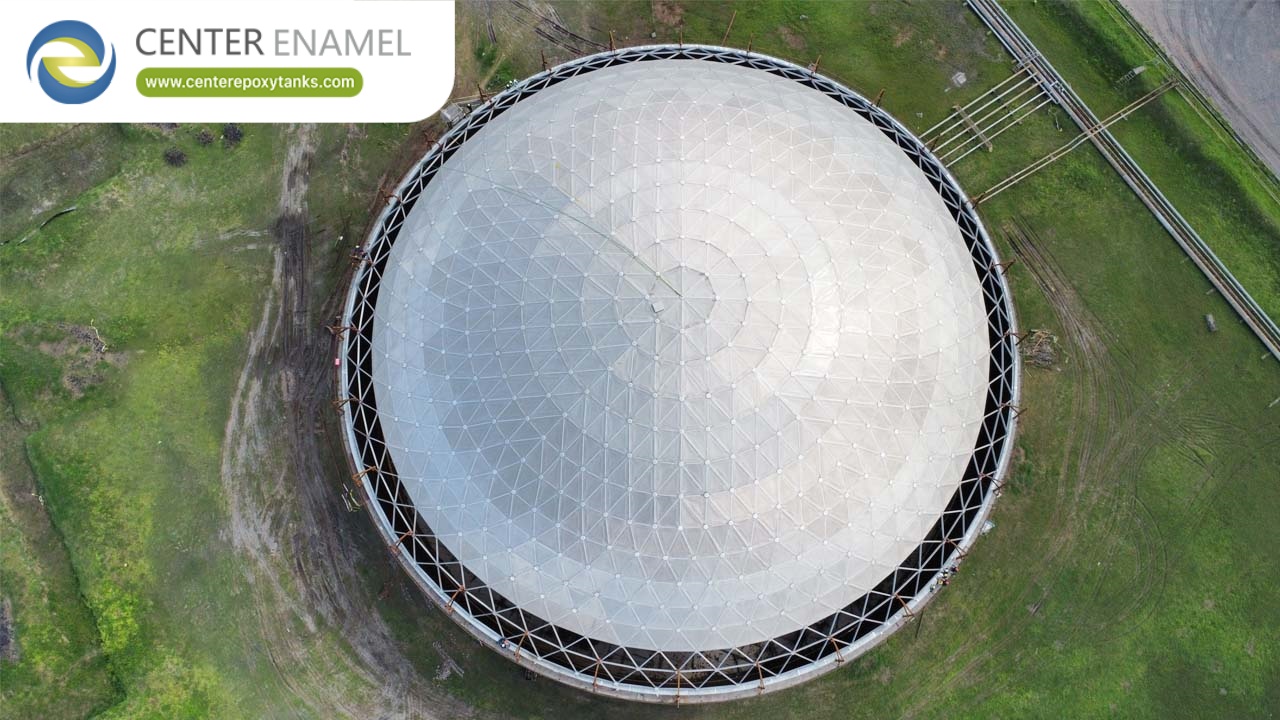
Aluminum Dome Roofs for Large Capacity Storage Tanks: Structural Engineering, Emission Control, and Durability
As global industrial sectors—including petroleum refining, bulk liquid logistics, water treatment, and chemical processing—scale up operations, the demand for large capacity storage tanks continues to grow. Larger tank diameters present unique structural engineering challenges, particularly regarding roof stability, environmental emission controls, and heavy wind or snow load management. Traditional heavy steel cone roofs and poured concrete domes require complex internal support columns, suffer from continuous atmospheric corrosion, and impose massive dead-weight loads on tank foundations.
To address these critical industrial limitations, aluminum geodesic dome roofs have become the gold standard for covering large-diameter aboveground storage tanks. Engineered on the principles of spatial triangulation, these lightweight, self-supporting structures deliver exceptional strength-to-span ratios, lifelong corrosion resistance, and superior emission control. As a global leader in advanced containment and cover engineering, Shijiazhuang Zhengzhong Technology Co., Ltd. (Center Enamel) delivers custom-engineered aluminum dome solutions built to maximize structural longevity and operational safety for large industrial assets.
1. The Engineering Science of Geodesic Geometry and Clear-Span Strength
The superior performance of aluminum dome roofs on large-capacity tanks stems from advanced structural physics and precision material engineering:
Self-Supporting Triangulated Lattice: By forming an interconnected network of rigid triangular elements, environmental forces (such as high-velocity winds, seismic activities, and heavy snow loads) are distributed uniformly across the entire structural grid and transferred directly to the tank periphery ring beam.
Complete Elimination of Internal Columns: Because the geodesic architecture is inherently self-supporting, it completely eliminates the need for internal support columns, rafters, or trusses. This prevents internal structural corrosion sites and allows for unobstructed liquid mixing, pumping, and skimming equipment operations in large-diameter tanks.
Strict Compliance with International Standards: Center Enamel’s aluminum domes are engineered in accordance with rigorous global codes—including ANSI/AWWA D108 for water and wastewater facilities, API 650 for petroleum storage, ASCE 7 for structural loads, and IBC frameworks—guaranteeing compliance across diverse geographical regions.
Data Table: Large Capacity Tank Roof Technology Comparison Matrix
Technical Parameter | Center Enamel Aluminum Geodesic Dome | Traditional Welded Steel Cone Roof | Poured-in-Place Concrete Dome |
Structural Framing | Self-supporting triangulated space truss | Rafters and support columns requiring internal pillars | Heavy concrete beams and central support pillars |
Clear-Span Capacity | Fully self-supporting across large diameters (100m+) | Requires internal support columns for large spans | Requires heavy internal columns and massive foundations |
Corrosion Resistance | Inherent, lifelong passivation without painting or coatings | Moderate to Low (Requires periodic sandblasting and recoating) | Variable (Prone to cracking, chemical attack, and rebar oxidation) |
Dead Weight Load | Extremely Lightweight (Minimizes foundation and wall stress) | Heavy (Imposes continuous structural stress on tank walls) | Extremely Heavy (Requires deep foundation piling and thick walls) |
Maintenance Profile | "Fit-and-forget" longevity with virtually zero maintenance | High ongoing maintenance to prevent rust and flaking | Moderate to High (Requires joint sealing and structural patching) |
Governing Standards | AWWA D108, API 650, ASCE 7, IBC | AWWA D100 / API 650 | ACI Structural Code Standards |
2. Emission Control, Vapor Suppression, and Ecological Safety
For large-capacity petroleum and chemical storage facilities, environmental regulations governing Volatile Organic Compound (VOC) emissions are increasingly stringent:
Vapor-Tight Containment: Precision-gasketed panel joints create a hermetic seal that traps hydrocarbon vapors, preventing fugitive emissions and minimizing valuable product loss through evaporation.
Reduced Thermal Solar Gain: The reflective nature of high-grade aluminum surfaces bounces off solar radiation, lowering headspace temperatures inside the tank. This significantly reduces breathing losses and preserves the quality of stored volatile fuels and chemicals.
Weather and Contamination Exclusion: The dome forms an impenetrable barrier that stops rainwater, dust, sand, bird droppings, and environmental debris from entering the tank, protecting the purity of stored water, chemicals, and fuel reserves.
3. Economic and Installation Advantages for Large Infrastructure
Deploying large-scale tank covers involves substantial capital investment, making operational efficiency a key priority:
Reduced Foundation Costs: Because aluminum domes are exceptionally lightweight, they place minimal dead load on the underlying tank walls and foundation ring, significantly lowering civil construction expenses for new large-capacity tank projects.
Safe and Rapid Retrofitting: Aluminum domes can be assembled on the ground next to existing tanks and lifted into place using a crane, or constructed using modular "jack-and-assemble" techniques while the tank remains partially in service, minimizing operational downtime.
Maintenance-Free Lifespan: Marine-grade aluminum alloys naturally form a self-healing oxide film that prevents rust and degradation, eliminating the need for recurring costly field painting and recoating cycles.
Frequently Asked Questions (FAQ)
Q: Why are aluminum dome roofs preferred for large capacity storage tanks?
A: Aluminum dome roofs offer an exceptional strength-to-weight ratio, self-supporting clear-span capabilities across massive diameters, and lifelong corrosion resistance without requiring internal support columns or periodic repainting.
Q: Do Center Enamel aluminum domes comply with international engineering standards?
A: Yes. All aluminum geodesic dome roofs are engineered and fabricated in strict compliance with global benchmarks, including ANSI/AWWA D108, API 650, ASCE 7, and IBC standards.
Q: How do aluminum dome roofs help reduce environmental emissions in large oil tanks?
A: The precision-gasketed panel joints create a gas-tight seal that suppresses Volatile Organic Compound (VOC) emissions, while the reflective aluminum surface reduces solar heat absorption to minimize breathing losses.
Q: Can an aluminum geodesic dome be installed on an existing large steel or concrete tank?
A: Yes. Due to their lightweight modular construction, aluminum domes place minimal dead load on existing walls and foundations, making them ideal for retrofitting aging or uncovered large-capacity reservoirs.
Q: What maintenance is required for an aluminum dome roof over its service life?
A: Aluminum domes require virtually zero maintenance. The natural aluminum oxide passivation layer protects the metal from atmospheric corrosion, eliminating the need for periodic surface recoating or rust remediation.


