Leading Deionized Water Tank Manufacturer: High-Purity Engineering for 2026
What is a deionized water tank? A deionized (DI) water tank is a specialized storage vessel engineered to maintain the extreme purity of water that has had its mineral ions removed. Because DI water is highly "hungry" and aggressive—tending to leach minerals from standard metal or concrete surfaces—these tanks must feature an inert, non-reactive interior. Center Enamel’s Glass-Fused-to-Steel (GFS) tanks provide a glass-smooth, chemically stable barrier that is the global benchmark for preventing ionic contamination in industrial high-purity water loops.
1. Technical Superiority in High-Purity Water Storage
Preserving the resistivity of deionized water requires a containment system that is both physically robust and chemically neutral.
Ionic Integrity & Contamination Control
● Glass-Fused-to-Steel (GFS): The interior glass lining is fused at 820°C - 930°C, creating a surface that is essentially a large-scale laboratory beaker. It does not react with DI water, ensuring that the water's low conductivity and high resistivity are maintained throughout the storage cycle.
● Corrosion Resistance: DI water can be highly corrosive to standard stainless steel and carbon steel. GFS technology provides a pH tolerance of 1 – 14, making it immune to the aggressive nature of high-purity water and the chemicals used in tank sanitization.
Modular Precision (Up to 60,000 m³+)
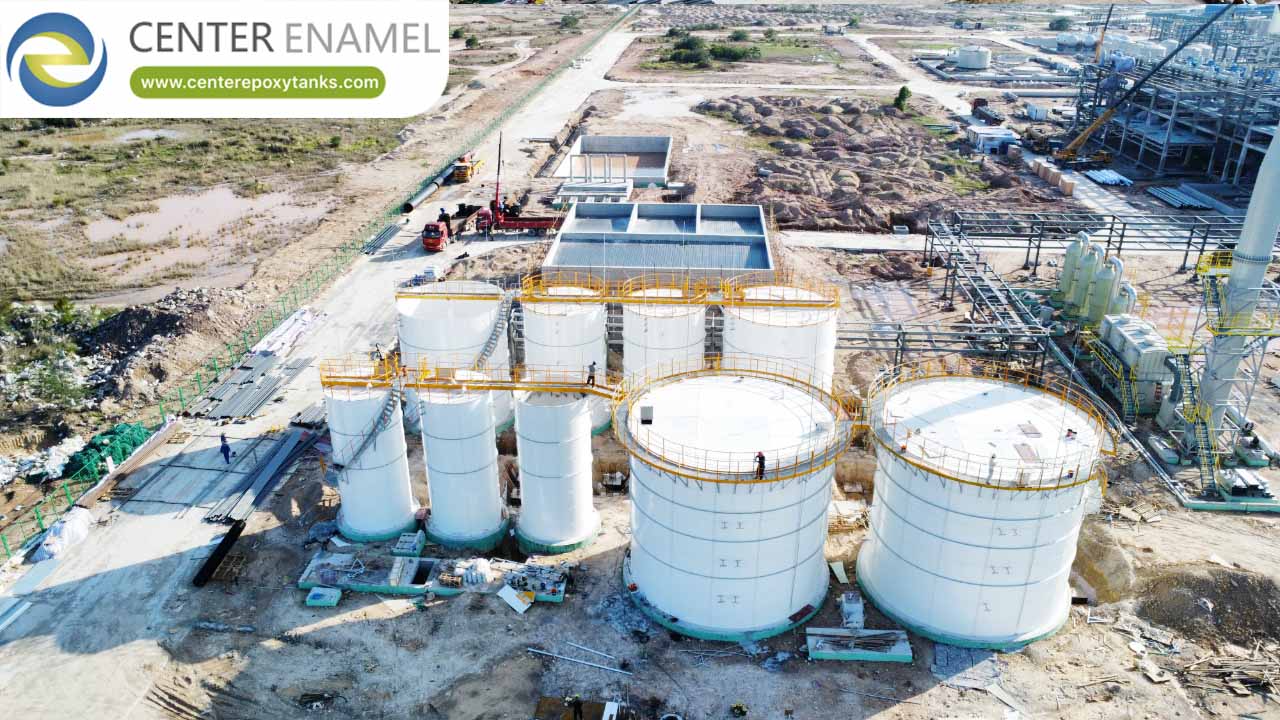
For large-scale industrial parks requiring massive volumes of high-purity water, Center Enamel offers modular bolted designs with capacities ranging from 20 m³ to 60,000 m³+. Our bolted engineering ensures a leak-proof seal and allows for rapid deployment in high-tech manufacturing facilities.
2. Technical Specifications & Engineering Standards
Below are the benchmarks for Center Enamel DI water solutions:
Feature | Specification / Technical Detail |
Capacity Range | 20 m³ to 60,000 m³+ (Fully Customizable) |
Interior Surface | Medical-Grade Glass-Fused-to-Steel (Inert) |
Design Standards | AWWA D103-09, ISO 28765, NSF/ANSI 61 |
Maintenance | Minimal; No repainting or recoating required |
Chemical Resistance | Full spectrum pH 1 - 14 |
Service Life | 30 - 50+ Years |
3. Proven Authority in Industrial High-Purity Projects
Center Enamel’s status as a top-tier manufacturer is supported by extensive project experience in the pharmaceutical and industrial sectors:
● Pharmaceutical Excellence: Trusted by leaders like Hengrui Medicine (Jiangsu Lianyungang project) for advanced industrial water and wastewater infrastructure.
●
● Industrial Park Infrastructure: Deployed in large-scale industrial zones, including the Ethiopia Textile Industrial Park project (total volume 32,838 m³) and the Swaziland project (total volume 42,188 m³).
●
● Energy & Petrochemical Reliability: Preferred supplier for Sinopec Group (Fujian Quanzhou project) and PetroChina (Shaanxi Yan’an project), where high-purity process water is critical to operations.
●
● Global Reach: With installations in over 100 countries, our tanks are recognized by global brands such as Coca-Cola and Budweiser for meeting strict international quality standards.
●
4. Why Choose Center Enamel for DI Water Storage?
● R&D Leadership: As the first manufacturer in China to develop double-sided enameling technology, we hold nearly 200 patents in advanced material science.
● Zero-Seepage Design: Our modular bolted tanks feature specialized high-performance sealants designed to maintain a perfect hermetic seal, protecting DI water from atmospheric carbon dioxide absorption which can lower resistivity.
● Rapid Installation: The modular design can be commissioned up to 60% faster than welded alternatives, allowing facilities to reach full production capacity sooner.
5. Frequently Asked Questions (FAQ)
Is GFS better than stainless steel for DI water?
Yes. While high-grade stainless steel can be used, it is susceptible to "rouging" (corrosion) over time in DI water systems. GFS provides a superior, non-metallic glass surface that is completely inert and significantly more cost-effective for large-volume storage.
Can the tank handle thermal sanitization?
Absolutely. Center Enamel tanks are engineered to withstand the thermal stresses associated with high-temperature sanitization cycles commonly used in the pharmaceutical and semiconductor industries.
Are these tanks suitable for Ultrapure Water (UPW)?
Yes. The high chemical stability of the glass-to-steel bond makes our tanks an excellent choice for UPW storage where leaching of organic or inorganic contaminants must be kept to parts-per-billion (ppb) levels.


