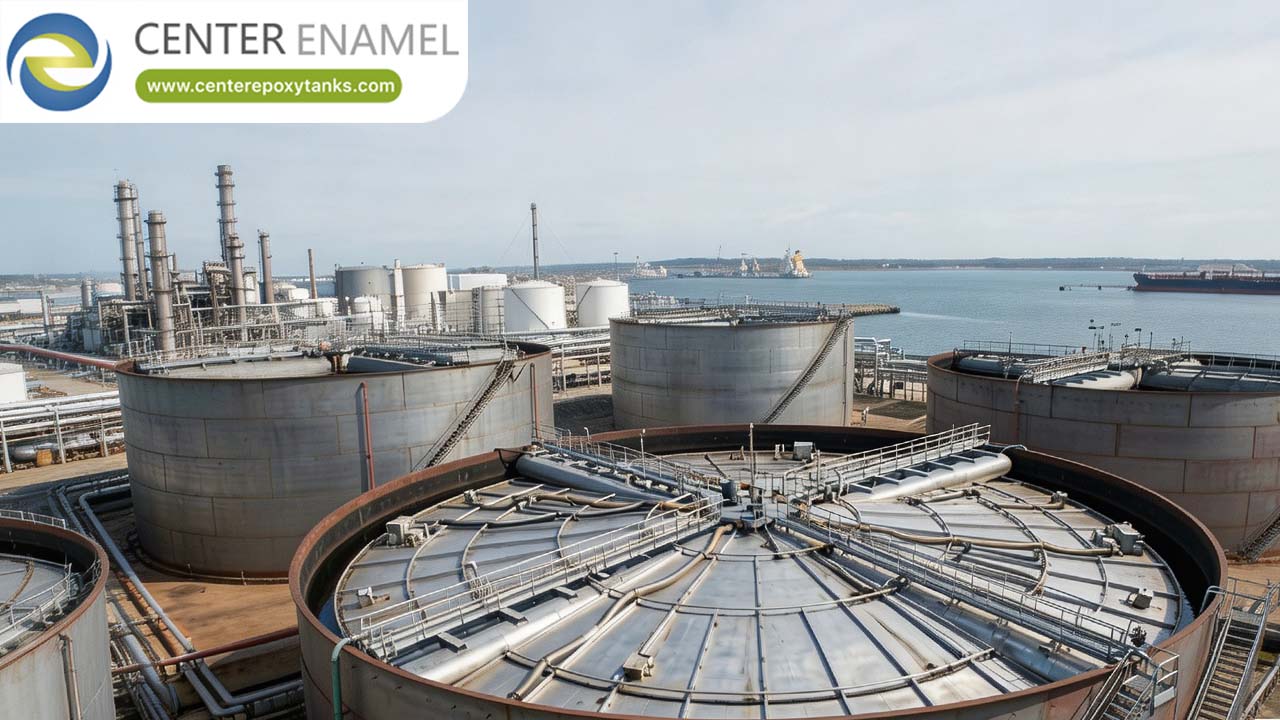
Internal Floating Roofs for Emission Control in Oil Storage
In the oil and gas sector, the "vapor space" above stored liquid is the primary source of Volatile Organic Compound (VOC) emissions, economic product loss, and fire risk. Internal Floating Roofs (IFRs) are the industry-standard solution for minimizing these risks. By floating directly on the liquid surface, IFRs eliminate the vapor-saturated headspace in fixed-roof tanks, achieving emission reductions of 90% to 99%. This guide covers the technical mechanics, sealing systems, and engineering standards (API 650) required for effective emission control.
1. The Physics of Emission Control
Internal floating roofs suppress emissions by tackling the two primary drivers of hydrocarbon loss:
● Elimination of "Ullage" (Vapor Space): In a standard fixed-roof tank, the space between the liquid and the roof accumulates saturated hydrocarbon vapors. The IFR floats directly on the liquid, reducing this headspace to near-zero.
● Suppression of Evaporation: By maintaining direct contact with the product, the roof deck prevents the liquid from reaching an equilibrium vapor pressure with the atmosphere, effectively "bottling" the product and preventing evaporation.
2. Design Architectures: Pontoon vs. Full-Contact
Choosing the correct IFR architecture depends on the volatility of the product and the required service life.
Feature | Pontoon-Type IFR | Full-Contact Honeycomb IFR |
Buoyancy Design | Sealed pontoons attached to a deck. | Solid, interlocking honeycomb panels. |
Vapor Space | Minimal (but exists between pontoons). | Zero (Direct liquid contact). |
Durability | High; standard for most fuels. | Superior; eliminates internal gas pockets. |
Best Use Case | General petroleum, stable hydrocarbons. | High-turnover products, aviation fuel, aromatics. |
3. The Criticality of Seal Technology
The "rim space" (annular gap) between the floating roof and the tank shell is the most vulnerable path for fugitive emissions. A multi-layer sealing strategy is mandatory for regulatory compliance in 2026.
Primary Seals
● Mechanical Shoe Seals: A metal plate (shoe) held against the tank wall by springs or weights. The industry gold standard for highly volatile products.
● Liquid-Mounted Seals: A flexible, fluid-filled tube that conforms to shell irregularities.
● Vapor-Mounted Seals: Less common in modern high-compliance zones as they allow a small gap; generally being phased out in favor of liquid-mounted options.
Secondary Seals
● Wiper Seals: Installed above the primary seal. These high-strength elastomer (EPDM/Viton) blades provide a redundant barrier, scraping vapors back into the tank and protecting the primary seal from debris.
Pro-Tip for Compliance: Ensure all seal materials are compatible with your specific product (e.g., FKM/Viton for high-aromatic fuels, EPDM for general hydrocarbon storage) to prevent chemical swelling and seal failure.
4. Regulatory Compliance & Standards
Engineering teams must ensure IFR systems meet the following benchmarks:
● API 650 (Appendix H): The global benchmark for IFR design, including buoyancy calculations (must support the roof weight plus specified live loads) and structural integrity under operational stress.
● API 19.2/EPA Standards: Facilities must adhere to specific VOC destruction efficiency requirements, often necessitating secondary seals and periodic leak detection and repair (LDAR) programs.
● NFPA 11: Defines rim fire protection requirements for tanks equipped with IFRs, often requiring foam dams to ensure fire suppressant effectively covers the annular space.
5. Engineering Checklist for Procurement
When specifying an IFR system for a new or retrofitted tank, verify the following:
1. Material Traceability: Request mill certificates for aluminum or stainless steel panels. Avoid carbon steel in highly corrosive environments.
2. Conductivity/Grounding: Ensure the roof includes integrated shunts or cables to provide electrical continuity from the roof to the tank shell, preventing static charge accumulation and rim-fire ignition.
3. Bypass Minimization: Confirm that all deck penetrations (columns, ladders, gauge poles) are equipped with high-efficiency seal sleeves. These "non-rim" areas are often the most overlooked sources of fugitive VOC emissions.
4. Inspection Accessibility: Ensure the roof design includes adequate manways for future tank inspections and maintenance without requiring a total system teardown.
6. Frequently Asked Questions (FAQ)
Q: Can an IFR be installed in a tank with existing internal support columns?
A: Yes. Modern modular IFRs are custom-engineered to fit around existing support columns using sophisticated column-seal designs. However, upgrading to a column-less dome roof is the preferred "best practice" for 2026 to eliminate these potential leak points and corrosion sites.
Q: How do I verify if my current IFR is compliant with 2026 emission regulations?
A: Conduct an annual gap-measurement survey. If the aggregate gap between the seal and the tank wall exceeds the limits defined by your local jurisdiction (e.g., EPA Subpart Kb), a seal upgrade or adjustment is required.
Q: Is full-contact honeycomb really better than pontoon?
A: For high-turnover products like aviation fuel or light aromatics, yes. The "full-contact" design eliminates the small vapor space found between pontoons, preventing vapor formation at the source and maximizing the product's shelf life.
Installing an Internal Floating Roof is the most effective operational step a terminal manager can take to minimize VOC emissions. By prioritizing full-contact honeycomb designs and dual-stage sealing systems (Mechanical Shoe + Wiper), you align your storage assets with international environmental standards, reduce financial loss from product evaporation, and enhance the overall safety of your facility.
Are you currently retrofitting an existing tank farm, and do you require structural buoyancy calculations or chemical compatibility matrices for specific fuel types like ethanol blends or biodiesel?


