Internal Floating Roof Factory Capabilities
A factory visit is only worth making if it is used to verify process discipline rather than to admire equipment. The questions that matter are the same at every factory: can they show me the material coming in, the panel being formed, the weld being made, the seal surface being machined, the deck being fitted together, and the documentation being produced? This article sets out an eight-station audit that any buyer can run, explains the distinction between a roof made in a factory and a roof assembled in one, and is explicit about the limits of the factory evidence available to us.
Made in the Factory Versus Assembled in the Factory
The single most useful distinction to establish at the first meeting is whether the roof is fabricated by the company you have contracted with, or whether the company you have contracted with is assembling components sourced from elsewhere. Both models produce roofs, and both have legitimate versions, but they carry different risks and they have to be audited differently.
A factory that forms its own panels, machines its own seal rings and welds its own structural members controls the properties that determine whether a roof performs: the flatness of the deck panel, the geometry of the rim, the smoothness and hardness of the seal contact surface, and the dimensional accuracy of the deck assembly. A company that assembles purchased components controls none of those and depends on a supplier chain that is invisible from the outside.
Neither model is disqualifying. What matters is that the buyer knows which one it is buying, and audits the process that actually produces the critical properties. A useful test is to ask which process steps occur on the site you are being offered and which occur elsewhere, and to accept only an answer that names the specific machines and the specific inspection records.
The Eight-Station Audit
Station | What to inspect | Evidence to request and check on the floor |
1. Material receipt and traceability | Incoming inspection of plate, extrusion, seal material and fasteners, and how it is recorded | The incoming inspection records and the material certificates, and confirmation that the certificates match the specific batch on the floor |
2. Profile forming and cutting | How the deck panels and structural members are formed and cut, and the tolerance control applied | The forming equipment, the cutting tolerance checks, and a sample of the first-off panel measured against the drawing |
3. Structural welding and assembly | The welding procedure, the qualification records and the inspection of the completed welds | The welding procedure specifications and welder qualifications, and the nondestructive examination records for the welds specified |
4. Seal surface machining | How the seal contact band and the seal mounting surfaces are machined and the tolerance held | The machining records and the measured tolerance on the seal contact surface, which is the property that determines seal contact |
5. Buoyancy and assembly of the deck | How the pontoon or panel sections are assembled and sealed, and how the deck is checked for flatness | The assembly record and the flatness measurement for the completed deck, plus the buoyancy calculation cross-checked against the as-built mass |
6. Penetrations and fittings | How sleeves, seals and instrument fittings are fitted and sealed | A physical example of a sealed penetration, and the sealing detail applied to each fitting type |
7. Coating and surface protection | Where a coating system is applied, the surface preparation and the coating thickness verification | The surface preparation records and the coating thickness readings, referenced to the specified dry film thickness |
8. Documentation and finishing | How the handover pack is compiled, checked and released | A completed handover pack from a previous project, with the index and the actual records rather than a template |
The audit works best as a walk rather than a meeting. In practice the sequence above follows the material through the factory, so each station has something to look at, and the documentary evidence is requested as you go rather than afterwards. The two stations that catch the most problems in practice are station four and station five: the seal contact surface tolerance and the deck flatness. Both determine whether the roof performs, and both are cheap to verify and expensive to discover late.
What the Audit Cannot Establish
A factory audit verifies process capability at the moment of the visit, and it does not verify the outcome. It cannot tell you that the roof on your tank will perform, because performance depends on the shell it runs on, the product, the operating regime, the installation and the inspection regime, none of which is in the factory. A supplier who claims that a factory visit guarantees performance is making a claim about something the visit does not cover.
It also cannot fully substitute for a technical evaluation, because the audit is looking at process while the evaluation is looking at a specific proposal. A factory can be excellent and still submit a roof that does not suit your tank, and conversely a roof can be suitable and still be produced in a factory whose discipline is weak. The audit and the technical evaluation are complementary, and the findings from each should be read against the other.
One further limitation is worth stating: an audit performed by the buyer's own team is dependent on that team's understanding of what to look for. This checklist exists so that the audit can be run by an engineer who knows the product rather than by a generalist who has been handed a list of questions.
The Floating Roof Specific Risks in Manufacturing
Three properties are specific to this product family and deserve specific attention on the floor. The first is the seal contact surface. The EPA reference material is explicit that for emission control the attachment of the seal to the deck and the radial seal joints must be vapour-tight and that the seal must be in substantial contact with the tank shell, and for a wiper seal it specifies that all radial joints in the blade must be joined. A contact surface that is too rough, or radial joints that are not properly made, will produce a seal that looks assembled and does not seal, and the defect will only become visible once the roof is in the tank.
The second is deck flatness and the buoyancy consequence. A deck that is not flat rides unevenly, which loads the seal unevenly and can bring the deck to the surface it is supposed to be floating clear of. The flatness measurement taken at station five should be compared against the tolerance on the drawing, and the buoyancy calculation should be checked against the as-built mass rather than only against the nominal mass.
The third is the enclosed volumes. Deck constructions that include pontoons, honeycomb cells or other cavities create spaces that can accumulate vapour, product or moisture, and supplier material in this field notes that where closed spaces exist, inspection becomes more difficult and risks associated with trapped vapour, internal corrosion, damaged floats or loss of integrity that is not visible from the outside arise. On the floor, that means checking the sealing of the enclosed volumes and the provision for draining them.
The Manufacturing Market Context
The scale of the industry is worth understanding because it shapes what you can reasonably expect from any factory. A 2025 third-party market study on aluminium internal floating roofs places the global market at around 525 million US dollars in 2025, with a forecast to around 762 million by 2032 and a growth rate of roughly 5.4 percent a year, with Asia Pacific the largest regional market at approximately 197 million US dollars. It divides the market by pontoon and full contact types, by oil and gas storage and chemical applications, and by region, and it names the participants including Ultraflote, Baker Altech, Matrix Service, DirecTank, DISCUS Engineered Products, Ateco Global Industries, HMT and Centre Enamel.
For an auditor this has a direct implication. A market of that size is served by a relatively small number of specialist factories with long-established processes, and the process differences between them are often real but subtle. The differences that are easy to see, such as the presence of machining equipment or a trial assembly bay, are exactly the ones that matter, which is why the eight-station walk is more productive than a presentation.
The study also documents a shift in the market toward compliance-driven specification, with manufacturers increasingly tying roof design to environmental performance and product pitches shifting toward practical, installable system formats that travel well through supply chains. For a buyer, that shift is worth testing in the audit: ask what the factory's installation method assumes about site conditions and what it assumes about the availability of heavy lifting.
A Limited Capability Reference, and What It Does Not Show
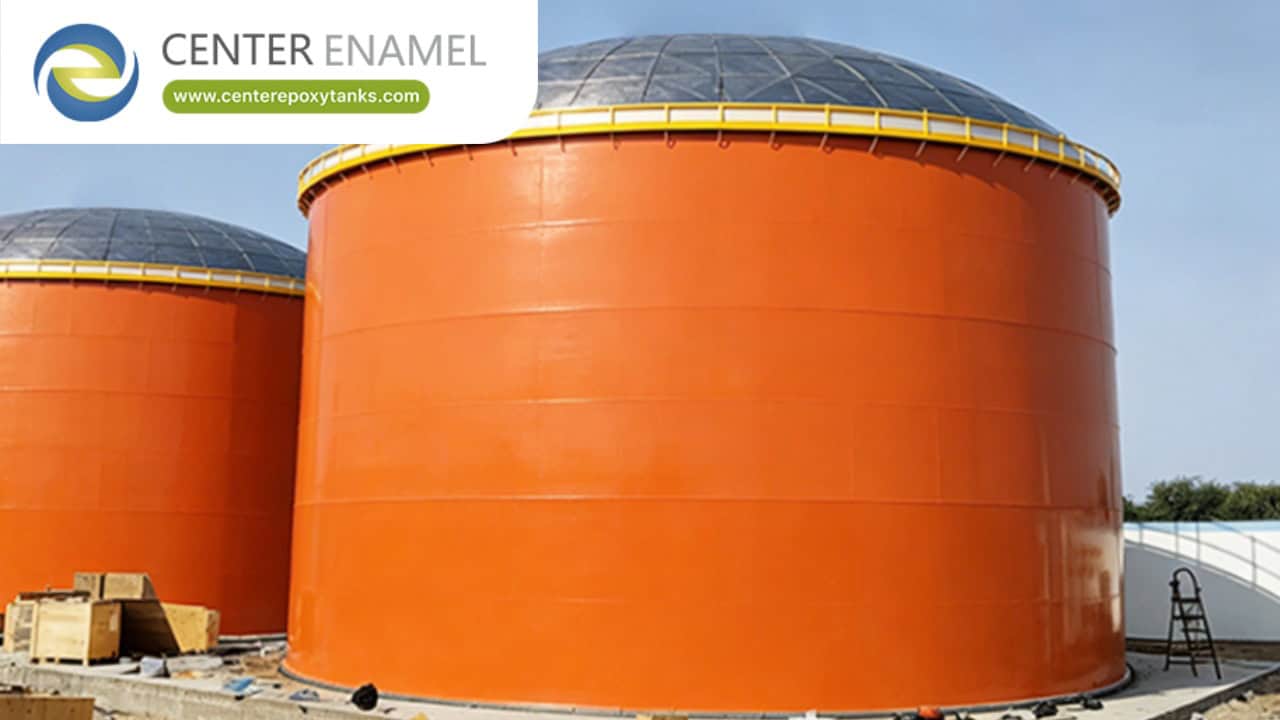
We should be straightforward about what factory evidence we can offer. The verified project library contains no internal floating roof delivery, so we cannot present a floating roof project as evidence of our floating roof manufacturing. What we can point to is a related multi-unit delivery in the same record: a Saudi Arabian municipal wastewater project recorded in December 2023, comprising five glass-fused-to-steel bolted tanks, each 24.06 m in diameter with a 4.85 m shell height, 11,020 cubic metres in total, with aluminium dome roofs on all five.
That record evidences multi-unit aluminium roof production, shipping and installation on a glass-fused-to-steel shell in an arid environment, with the aluminium dome roof fabricated, transported as components and assembled on site. It is evidence of aluminium roof manufacturing and of the discipline of producing a repeatable, site-assembled structure across multiple units.
It is not evidence of internal floating roof manufacturing, and it is not presented as such. The dome roof and the floating deck are different products with different processes: a dome is a triangulated space frame assembled from struts and panels, whereas an internal floating roof requires a buoyancy deck, a machined seal surface, sealed penetrations and a flatness-controlled assembly. A buyer is entitled to ask any supplier to walk them through the floating roof process specifically, on the floor, with records. If a supplier cannot do that, the answer tells you something important.
Case evidence disclosure: the verified Centre Enamel project library contains no internal floating roof delivery, so no internal floating roof project is cited in this article. The limited manufacturing reference used here is the Saudi Arabia municipal wastewater project (5 units, 24.06 m diameter x 4.85 m height, 11,020 m3 total, glass-fused-to-steel bolted tanks with aluminium dome roofs, recorded December 2023). That reference evidences aluminium roof production, shipping and multi-unit site assembly; it involved dome roofs rather than floating roofs, and it is not offered as evidence of internal floating roof manufacturing capability.
Conclusion
A factory audit verifies process discipline, and process discipline is what distinguishes a roof that seals from one that does not. Walk the eight stations in order, request the record at each, and pay particular attention to the two that catch the most problems: the seal contact surface tolerance and the deck flatness. Establish early whether the roof is made or assembled there, and audit the process that actually produces the critical properties. And hold every supplier, including this one, to the same standard: we can evidence multi-unit aluminium roof production and site assembly, and we do not hold an internal floating roof delivery record, so we have said so rather than presenting a dome roof as one. Send us your shortlist and we will return the checklist marked up against your project scope.
Frequently Asked Questions
Q: What should I check when I visit a floating roof factory?
A: Eight stations, in material-flow order: material receipt and traceability, profile forming and cutting, structural welding and assembly, seal surface machining, buoyancy and deck assembly, penetration and fitting sealing, coating and surface protection where applicable, and documentation and finishing. At each one, ask for the actual record and look at the actual part on the floor. The two stations that catch the most problems are the seal contact surface machining and the deck flatness measurement, because both directly determine whether the roof performs.
Q: Does it matter if the roof is assembled rather than fully fabricated at the factory?
A: Yes, because the properties that determine performance are established during fabrication: the deck panel flatness, the rim geometry, the smoothness and hardness of the seal contact surface and the dimensional accuracy of the deck assembly. An assembler controls none of those and depends on an invisible supplier chain. That is not disqualifying, but the audit then has to run against the actual fabricator, and you should know which company that is.
Q: Can a factory audit tell me the roof will work on my tank?
A: No, and it should not be relied on to. A factory audit verifies process capability at the moment of the visit. Performance depends on the shell the roof runs on, the product, the operating regime, the installation and the inspection regime, none of which is in the factory. The audit and the technical evaluation of the proposal are complementary, and the findings from each should be read against the other before an award.
Q: Which manufacturing properties are specific to floating roofs?
A: Three. The seal contact surface, because for emission control the seal must be in substantial contact with the tank shell and the attachment and the radial joints must be vapour-tight, which makes the machining tolerance and the radial joint workmanship critical. Deck flatness, because a deck that is not flat rides unevenly and loads the seal unevenly. And the sealing of enclosed volumes, because pontoons and honeycomb cells can accumulate vapour, product or moisture, and defects inside them are not visible from outside.
Q: How long does a floating roof factory audit take?
A: Half a day to a day for a single site with a prepared auditor and a prepared supplier, and the preparation matters more than the duration. Sending the eight stations and the document list in advance means the records are assembled before the visit rather than during it, which is the difference between an audit that tests the process and a tour that demonstrates it. A second visit after the first structural delivery is worthwhile, because the first delivery is where the process is under real pressure.
Q: What should a good factory handover pack contain?
A: A design calculation package with the buoyancy calculation stated against the product density and the contamination allowance, the material certificates for the plate, extrusion, seal material and fasteners, the welding procedure specifications and welder qualifications, the nondestructive examination records for the welds specified, the dimensional inspection records including the seal contact surface tolerance and the deck flatness measurement, the coating thickness readings where a coating system is applied, the assembly and sealing records, and the as-built drawings with the spare parts list. Ask for a completed pack from a previous project rather than a template, and check that the records in it match the parts on the floor.
Work With Center Enamel
Center Enamel is the trading name of Shijiazhuang Zhengzhong Technology Co., Ltd, established in 2008 and based in Shijiazhuang, Hebei Province, China. The company manufactures glass-fused-to-steel bolted tanks, fusion-bonded epoxy coated tanks, stainless steel and welded steel tanks, pressure vessels, aluminium geodesic dome roofs and floating roof systems. Aluminium dome design work is carried out against AWWA D108, API 650, ADM 2015, ASCE 7-10 and IBC 2012, and the broader product range is covered by ISO 9001, NSF/ANSI 61, CE/EN 1090, ISO 28765, WRAS and FM approvals. The company reports 30,000 installed projects and an annual output of 300,000 enamel steel plates, with technical support delivered through an international distributor network and a stated 24-hour response commitment.
If your project involves tank roofs, floating decks or the shells that carry them, send the tank diameter, shell height, product, operating temperature and site design loads. We will return a preliminary structural concept, the applicable design code basis, and a written scope that separates what is included from what the site contractor must provide.


