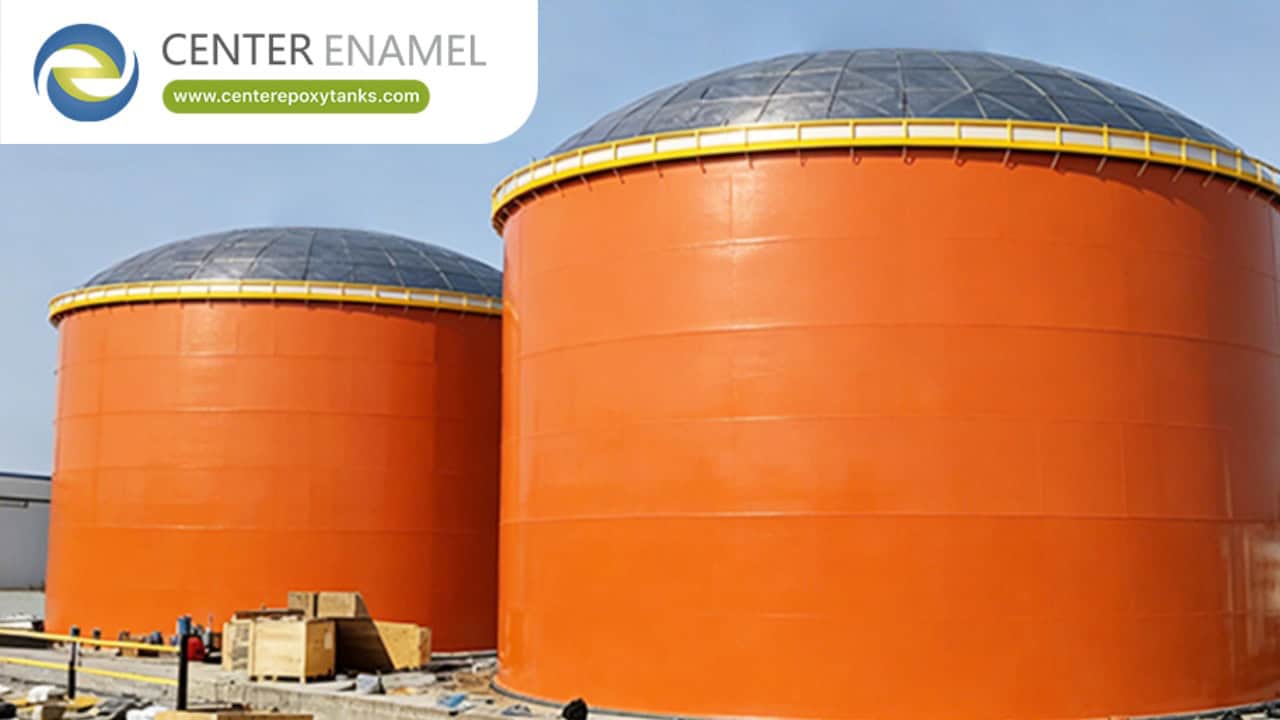
Installation Guidelines & Foundation Requirements for FBE Tanks in Complex Geological Conditions
The structural longevity of a Fusion-Bonded Epoxy (FBE) bolted tank is dictated by the interface between the tank shell and the subsurface. In "perfect" conditions, standard foundations suffice. However, in regions with complex geological conditions—such as soft clay, expansive soil, high water tables, or high-seismic zones—a generic approach is a recipe for failure. Shijiazhuang Zhengzhong Technology Co., Ltd. (Center Enamel) combines modular tank expertise with robust site-engineering principles to ensure your storage asset remains secure, level, and operational for decades.
1. Geotechnical Site Assessment
Before any tank is shipped, the foundation strategy must be defined by a comprehensive Geotechnical Investigation Report. In complex geology, this report is the "legal and structural compass" for your project.
Key Factors to Evaluate:
● Soil Bearing Capacity: Determines if the soil can support the hydrostatic load of the tank without excessive settlement.
● Settlement Analysis: Predicts differential settlement (uneven sinking), which is particularly dangerous for bolted, factory-sealed structures.
● Groundwater Level: A high water table requires specific drainage strategies to prevent buoyancy (uplift) or chemical degradation of the concrete foundation.
● Seismic Liquefaction Potential: In seismic zones, soil can lose strength during an earthquake, requiring deep foundation techniques like piles or stone columns.
2. Foundation Typologies for Challenging Geology
Choosing the right foundation is the primary method for mitigating geological risk.
Foundation Type | Best Geological Condition | Engineering Rationale |
Concrete Ring Wall | Moderate to Good Bearing | Distributes shell load to the perimeter; requires compacted backfill center. |
Reinforced Raft (Slab) | Soft or Non-Uniform Soil | Bridges localized weak spots; reduces risk of differential settlement. |
Pile-Supported Foundation | Poor / High Compression | Transfers load to deeper, stable strata; bypasses compressible layers. |
Pier/Column Foundation | Uneven/Sloping Terrain | Provides precise leveling capability when ground is not flat. |
3. Installation Strategies for Complex Geology
When site conditions are less than ideal, Center Enamel works with local civil engineers to apply the following mitigation strategies:
A. Managing Expansive & Soft Soils
If the soil is prone to swelling or excessive compression, we recommend:
● Over-Excavation & Replacement: Removing the problematic soil layer and replacing it with engineered, compacted structural fill.
● Geogrid Reinforcement: Using structural grids within the base material to distribute the tank’s weight over a wider footprint.
B. High Seismic Zones
In active seismic regions, anchorage is paramount.
● Engineered Anchors: FBE tanks must be bolted to the foundation using high-strength anchor bolts designed to resist overturning moments during a seismic event.
● Flexibility: Our bolted tank design inherently provides a degree of structural flexibility, which can dissipate seismic energy better than brittle, site-welded steel tanks.
C. High Water Table Protection
● Drainage Systems: Installing sub-surface drainage blankets or perforated piping to prevent hydrostatic pressure build-up under the foundation.
● Waterproofing: Ensuring the foundation concrete is treated to prevent capillary rise of moisture, which protects the tank's lower shell panels from corrosion.
4. Frequently Asked Questions (FAQ)
Q: How much "settlement" can an FBE tank tolerate?
A: All tanks experience some settlement, but bolted tanks have stricter tolerances than welded ones to maintain the integrity of the gasketed seals. Uniform settlement is generally acceptable, but differential (uneven) settlement must be strictly controlled per your regional building code (e.g., AWWA D103).
Q: Can we build an FBE tank on a slope?
A: Yes, provided the slope is properly terraced or a pier-style foundation is used. We do not recommend placing a tank on a sloped grade without first leveling the foundation footprint to ensure even stress distribution.
Q: Do I need a professional engineer (PE) to sign off on my foundation?
A: Absolutely. Regardless of our internal tank design specifications, the foundation is a permanent site structure. You must engage a local structural or geotechnical engineer to interpret your soil report and design the foundation to meet local safety and code requirements.
Engineering Certainty for Your Infrastructure
Center Enamel provides detailed "Foundation Load Data" for every tank we design. This data—including dead loads, liquid loads, wind loads, and seismic coefficients—allows your local civil engineer to design a foundation that perfectly matches our tank’s structural requirements. We are here to partner with your engineering team to ensure the "ground up" safety of your installation.
Are you currently reviewing the geotechnical report for your tank project, or would you like to discuss the foundation load requirements for a specific storage capacity?


