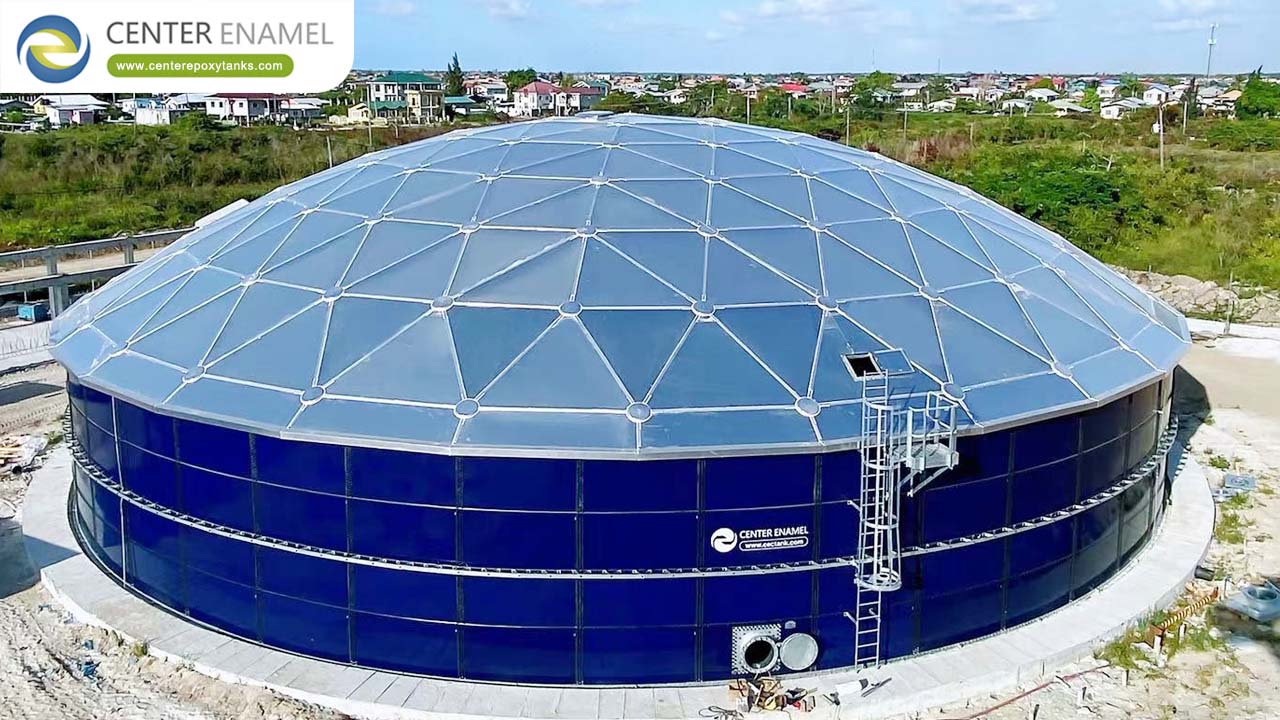
Industrial Water Tanks: Engineering High-Performance Infrastructure for Global Industry
Industrial water tanks are critical specialized vessels designed for process water, cooling systems, and hazardous effluent containment. Center Enamel engineers these tanks to AWWA D103, API 650, and ISO 28765 standards, utilizing premium Glass-Fused-to-Steel (GFS) and Fusion Bonded Epoxy (FBE) technologies. By providing a chemically inert, UV-resistant barrier with a 30-50 year service life, our modular bolted tanks support the thermal stability and environmental compliance of manufacturing, mining, and energy sectors in over 100 countries.
1. Technical Specification & Engineering Matrix
Feature | Technical Specification (2026 Standard) | Strategic Reliability Value |
Coating Systems | Glass-Fused-to-Steel (GFS) / FBE | pH 1–14 resistance; 100% pore-free dielectric barrier. |
Design Standards | AWWA D103, EN ISO 28765, NFPA 22 | Mandatory for global industrial, fire, and insurance audits. |
Material Grade | Titanium-Rich ART310 / ASTM A36 Steel | High-yield strength ($>400 MPa$) for hydrostatic loads. |
Testing Regimes | High-Voltage Holiday Detection | 100% verification of coating continuity and integrity. |
Sealing Protocol | EPDM / Viton / Silicon Gaskets | Chemically inert seals tailored to the stored medium. |
Installation | Modular Bolted (No Hot Work) | 60% faster deployment; ideal for volatile environments. |
2. Material Science: The GFS and FBE Advantage
Molecular Fusion vs. Surface Adhesion
Traditional painted or galvanized tanks rely on simple surface adhesion. Center Enamel’s Glass-Fused-to-Steel (GFS) involves firing steel at 820°C–930°C, creating a chemical bond.
● Hardness & Abrasion: With a 6.0 Mohs scale hardness, GFS resists the abrasive particulates often found in mining and raw process water.
● Corrosion Immunity: The glass-like finish is impervious to the high-sulfur and chloride environments typical of industrial wastewater treatment.
● Thermal Stability: Engineered to handle thermal cycling without cracking, making them ideal for high-temperature cooling water storage.
3. High-Impact Industrial Applications
● Energy & Power Generation: Essential for demineralized water storage and boiler feed systems, ensuring the high purity required for turbine longevity.
● Mining & Mineral Processing: Optimized for thickeners, clarification tanks, and tailing storage where high-viscosity and high-solid content are present.
● Fire Protection (NFPA 22): Our tanks provide the reliable, high-volume water reserves necessary for industrial sprinkler systems, featuring integrated vortex breakers and suction pipes.
● Wastewater & Effluent Treatment: Securely contains industrial runoff, facilitating chemical dosing, aeration, and sedimentation processes before discharge or reuse.
4. Why Partner with Center Enamel?
As a global "Top 5" manufacturer with over 30 years of expertise, Center Enamel offers a unique technological advantage for industrial projects:
● Advanced Structural FEA: Every tank is subjected to Finite Element Analysis (FEA) to simulate localized wind loads (up to 240 km/h) and seismic ground acceleration per ASCE 7 standards.
● Total System Integration: We pair our tanks with specialized roofing, including Aluminum Geodesic Domes for odor control and Double Membrane Gas Holders for anaerobic digestion projects.
● Certified Quality Standards: Our production lines are certified to ISO 9001, ISO 14001, and ISO 45001. Our tanks meet the strict hygiene requirements of WRAS and NSF/ANSI 61, ensuring safety for food and beverage process water.
5. Technical FAQ: Industrial Tank Implementation
Q: Can these tanks be relocated or expanded?
A: Yes. The primary advantage of our modular bolted design is flexibility. Tanks can be dismantled and relocated, or their capacity can be increased by adding additional rings (strakes) to the bottom using a jacking system.
Q: How do you prevent internal corrosion from aggressive chemicals?
A: For pH extremes (1–14), we utilize specialized GFS formulations. Every panel undergoes a high-voltage holiday test at the factory to identify microscopic pinholes, ensuring a zero-leakage, non-reactive interior.
Q: What is the maintenance requirement for a bolted steel tank?
A: Maintenance is minimal. Because the coatings are factory-applied and fusion-bonded, they do not require periodic sandblasting or repainting. Annual visual inspections and basic sediment removal are typically all that is required for a 50-year service life.


