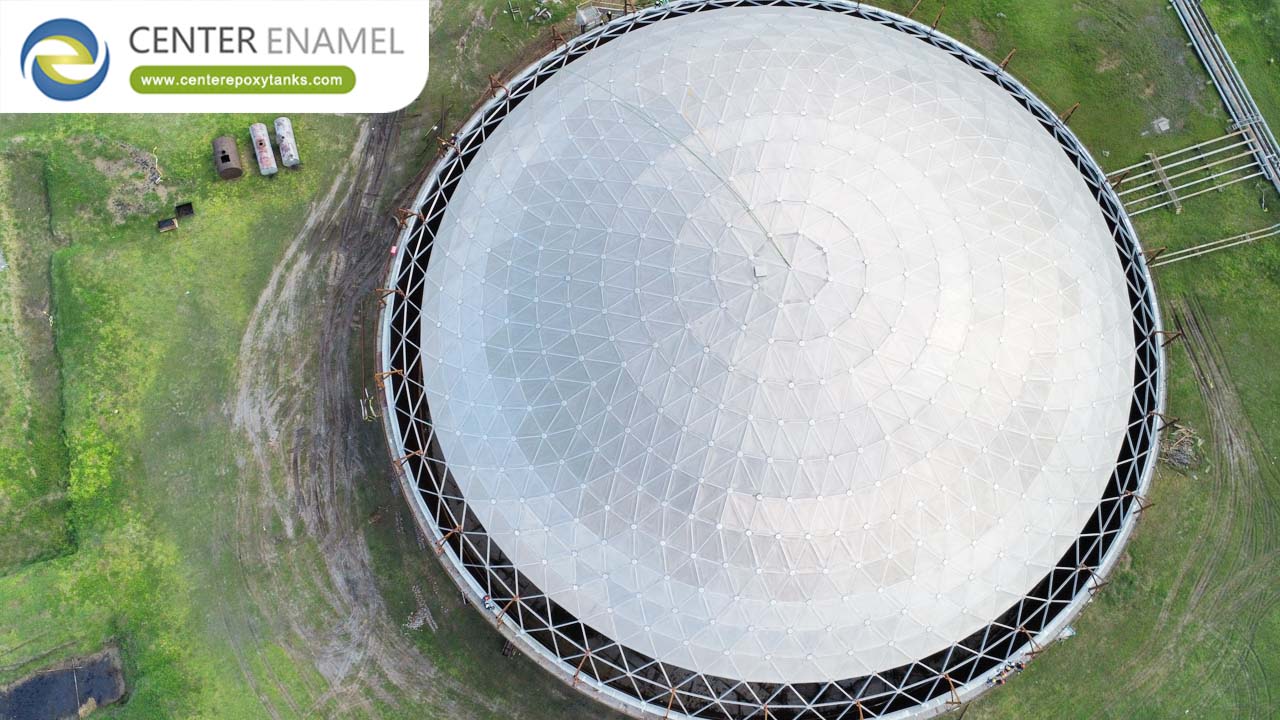
IFR vs. EFR: Technical Comparison of Floating Roof Storage Tanks
For liquid storage, the choice between an Internal Floating Roof (IFR) and an External Floating Roof (EFR) is primarily driven by climate considerations, environmental regulations regarding VOC (Volatile Organic Compound) emissions, and project budget.
● Internal Floating Roof (IFR): Features a fixed roof above the floating roof. It protects the product from the elements (snow, rain, wind) and is the superior choice for emission control and variable climates.
● External Floating Roof (EFR): The roof floats directly on the liquid surface, fully exposed to the environment. It is generally more cost-effective for extremely large-diameter tanks but requires more stringent maintenance regarding weather-related debris and drainage.
1. Internal Floating Roof (IFR) Tanks
The IFR design consists of a floating roof (usually an aluminum or steel pontoon/pan) inside a tank that also has a fixed roof (cone or dome).
Key Engineering Characteristics
● Weather Protection: Because the IFR is enclosed by a fixed roof, it is protected from rain, snow, and wind, which prevents the accumulation of water and debris on top of the floating roof.
● Emission Control: The combination of a fixed roof and a floating roof creates a dual barrier against evaporation, significantly reducing VOC emissions.
● Operational Stability: Less prone to "sinking" issues caused by snow or rainwater accumulation, reducing the frequency of emergency maintenance.
● Standard Compliance: Designed in accordance with API 650 Annex H.
2. External Floating Roof (EFR) Tanks
The EFR design consists of a roof that floats directly on the liquid, exposed to the open air. There is no fixed roof above it, only a primary and secondary seal system at the rim.
Key Engineering Characteristics
● Economic Scale: EFRs are often more cost-effective for very large-diameter tanks where constructing a massive fixed roof structure would be prohibitively expensive or structurally complex.
● Environmental Exposure: Requires an integrated drainage system (typically a flexible hose or articulated pipe) to remove rainwater from the roof surface.
● Operational Risk: In extreme cold climates, snow accumulation on the EFR can be a significant structural risk, potentially causing the roof to tilt or sink.
● Standard Compliance: Designed in accordance with API 650 Annex C.
3. Comparative Matrix: IFR vs. EFR
Use this table to align your storage requirements with the appropriate technology.
Engineering Factor | Internal Floating Roof (IFR) | External Floating Roof (EFR) |
Primary Advantage | Weather/Emissions Protection | Cost-effective for large diameters |
Emission Control | High (Dual barrier) | Moderate (Seal-dependent) |
Weather Impact | Low (Protected) | High (Requires drainage systems) |
Maintenance | Low (Minimal debris) | Moderate (Rain/Snow management) |
Climate Suitability | Versatile (Ideal for snow/rain) | Limited (Careful in heavy rain/snow) |
Ideal Capacity | Small to Medium | Large to Very Large |
API Standard | API 650 Annex H | API 650 Annex C |
4. Selection Logic: How to Choose
Selecting the correct tank design is a strategic project decision. Use these criteria to guide your engineering team:
1. Climate Sensitivity: If your site experiences heavy rainfall or frequent snowfall, IFR is the technical preference. It eliminates the risk of water ponding and roof sinking caused by weight accumulation.
2. Regulatory & Environmental Compliance: If you are operating in a jurisdiction with strict VOC emission limits (e.g., EPA/local environmental agencies), IFR offers superior emission containment.
3. Tank Diameter: For extremely large-diameter tanks where a fixed roof structure would require massive, expensive internal support columns, EFR may offer a more streamlined construction path, provided the climate allows for it.
4. Budget & Lifespan: While IFR tanks have a higher initial capital cost due to the fixed roof, they often have a lower Total Cost of Ownership (TCO) because they drastically reduce the maintenance labor associated with drainage cleaning and seal repairs.
5. Frequently Asked Questions (FAQ)
Q: Which tank design prevents "sinking" better?
IFR tanks are inherently more stable regarding sinking because they are shielded from rain and snow. EFR tanks rely entirely on their drainage systems to stay afloat during precipitation; if a drain clogs, the risk of sinking increases significantly.
Q: Do IFR tanks require ventilation?
Yes. IFR tanks must be fitted with fixed roof vents. This allows vapors to escape that would otherwise accumulate between the fixed roof and the floating roof, preventing the formation of an explosive atmosphere (LFL - Lower Flammable Limit).
Q: Can an EFR be converted to an IFR later?
Yes. It is possible to add an aluminum dome or fixed roof structure to an existing EFR tank to convert it to an IFR. This is a common upgrade for plants looking to reduce emissions or mitigate weather-related maintenance costs.
Engineering Consultation for Tank Design
Whether you are planning a new tank farm or retrofitting existing assets, selecting the right floating roof technology is essential for project safety and compliance. We provide full design reviews, seismic load calculations, and API-compliant storage solutions.
[Request a Technical Consultation]
Our team provides design support and engineering submittals to ensure your storage infrastructure meets your specific capacity, climate, and regulatory requirements.


