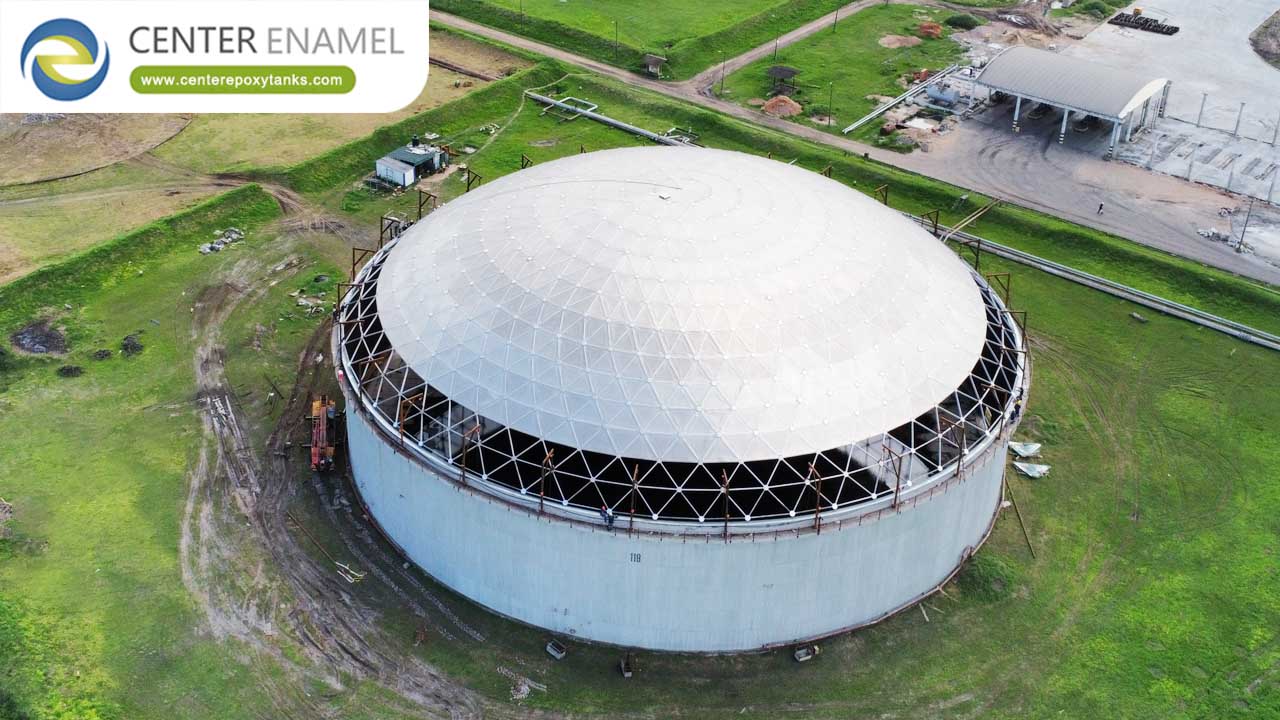
Aluminum Geodesic Domes for Oil Storage Tanks: Engineering Superior Containment, Emission Control, and Longevity
In the global oil and gas sector, aboveground storage tanks (ASTs) holding crude oil, refined petroleum, and volatile hydrocarbons face constant exposure to aggressive weather conditions, atmospheric corrosion, and strict environmental regulations. Traditional carbon steel fixed roofs require intensive, ongoing maintenance, while exposed external floating roofs (EFRs) remain vulnerable to rainwater accumulation, wind-driven evaporation, and severe solar degradation.
To address these critical challenges, the industry standard has shifted toward aluminum geodesic domes for oil storage tanks. Engineered as lightweight, self-supporting space frames, these advanced aluminum structures provide unmatched corrosion resistance, eliminate the need for internal support columns, and deliver dramatic reductions in volatile organic compound (VOC) emissions.
Structural Engineering Principles and API 650 Appendix G Compliance
The design, fabrication, and structural integrity of aluminum geodesic dome roofs are governed by rigorous international engineering standards, most notably API Standard 650, Appendix G (Structurally-Supported Aluminum Dome Roofs):
Fully Triangulated Self-Supporting Geometry: The dome utilizes a network of precision-extruded aluminum struts, hub nodes, and interlocking triangular panels that take advantage of the inherent strength of spherical geometry. This fully triangulated matrix distributes structural tension evenly across the entire frame, allowing the dome to span massive diameters (exceeding 100 meters) completely without internal support columns.
High Strength-to-Weight Ratio: Because high-strength aluminum alloys (such as 6000-series structural grades) are significantly lighter than carbon steel, the dome imposes minimal dead-load stress onto the underlying tank shell and foundation. This lightweight characteristic often bypasses the need for costly structural reinforcement when retrofitting older tanks.
Advanced Wind, Snow, and Seismic Resilience: Designed to withstand high-velocity wind loads (up to 45 m/s or higher), heavy snow loads, and seismic forces in compliance with ASCE 7 and regional codes, geodesic domes utilize advanced second-order, non-linear structural analysis to ensure complete safety under real-world combined load cases.
Environmental and Operational Advantages for Oil Terminals
Installing an aluminum geodesic dome on an oil storage tank transforms operational efficiency across multiple fronts:
Drastic VOC Emission Reduction: When combined with an internal floating roof (IFR) or utilized as a primary fixed cover, the dome seals the stored hydrocarbon product away from atmospheric drafts and direct solar heating, cutting evaporative losses and ensuring strict compliance with environmental emission limits.
Total Elimination of Water Ingress: Unlike open-top external floating roofs where rainwater pooling can sink the deck or contaminate product, a fully weather-tight geodesic dome completely blocks rain, snow, sand, and debris.
Maintenance-Free Longevity: Aluminum naturally forms a protective passive oxide layer that resists atmospheric oxidation, marine salt air, and sulfur-rich industrial fumes. Unlike carbon steel, aluminum domes require no periodic painting or abrasive blasting, offering a maintenance-free service life spanning decades.
In-Service Retrofitting: Geodesic domes can be rapidly assembled on-site and installed on existing operational tanks with minimal downtime, frequently allowing construction to occur while the tank remains full.
Data Table: Comprehensive Comparison of Oil Storage Tank Roof Options
Technical Parameter | Aluminum Geodesic Domes | Traditional Carbon Steel Fixed Roofs | Exposed External Floating Roofs (EFR) |
Corrosion Resistance | Excellent; natural aluminum oxide layer requires zero painting or coating | Poor to Moderate; highly susceptible to rust and chemical attack | Moderate; requires continuous inspection of deck seals and pontoons |
Weight & Foundation Load | Ultra-lightweight; places minimal structural stress on tank shells and foundations | Heavy steel plates require robust shell design and substantial foundations | Moderate dead-load; susceptible to rainwater accumulation weight |
Internal Support Columns | Clear-span structure; completely free of internal support columns | Requires internal columns and rafters for large-diameter spans | None required (open top design) |
Maintenance & Lifecycle Cost | Near-zero maintenance; exceptional long-term cost efficiency | High; demands regular sandblasting, recoating, and weld inspections | Moderate to High; seal replacements and drain maintenance required |
Frequently Asked Questions (FAQ)
Q: What is an aluminum geodesic dome roof for oil storage tanks?
A: It is a self-supporting, clear-span architectural dome constructed from high-strength aluminum alloy structural members and panels, designed to protect stored hydrocarbons, block weather elements, and control emissions.
Q: How do aluminum geodesic domes help reduce VOC emissions?
A: By providing a sealed, vapor-tight barrier over the stored crude oil or refined fuel, the dome shields the liquid surface from solar radiation and wind-induced evaporation, drastically suppressing volatile organic compound (VOC) releases.
Q: Do aluminum geodesic domes comply with API standards?
A: Yes. Aboveground storage tank aluminum domes are specifically engineered, fabricated, and tested in strict compliance with API Standard 650, Appendix G, adhering to the Aluminum Design Manual and non-linear structural analysis guidelines.
Q: Can an aluminum geodesic dome be installed on an existing oil storage tank?
A: Yes. Due to their modular, prefabricated components and lightweight design, geodesic domes can be easily retrofitted onto existing fixed-roof or external floating roof tanks, often while the tank remains in active service.


