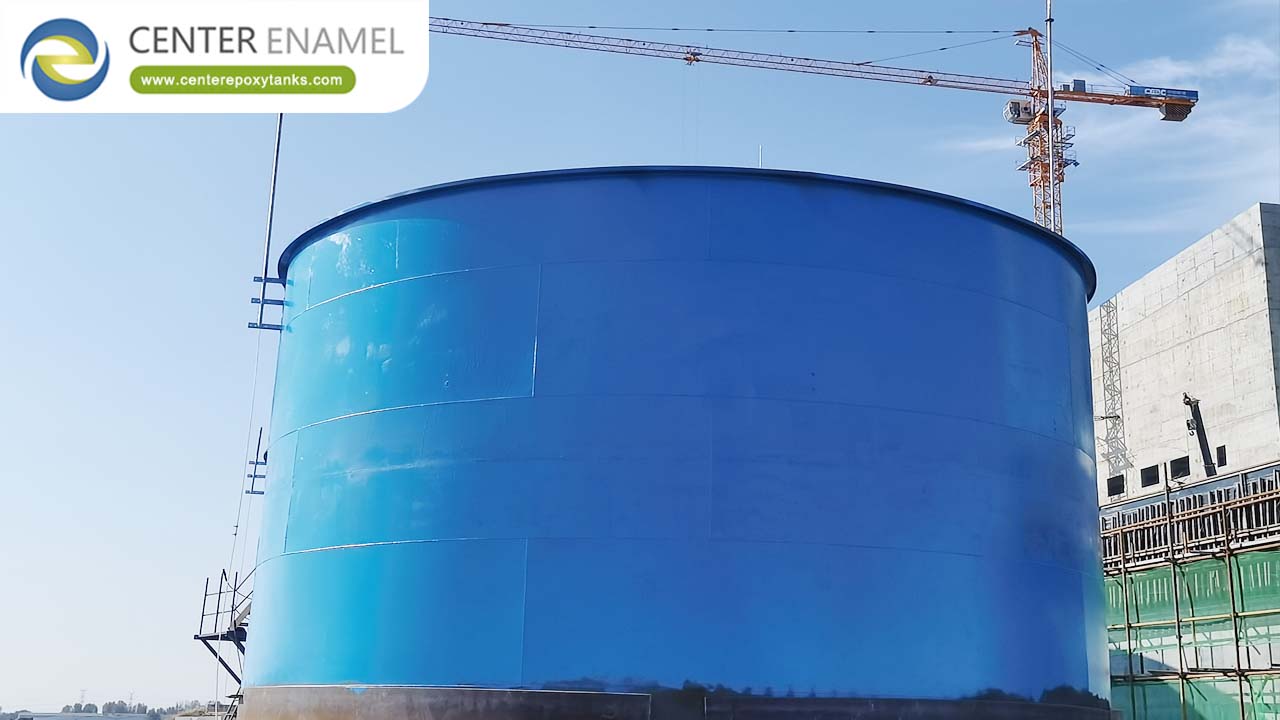
Global Design Standards of Oil Storage Tanks: An Engineering Authority Guide
How do the structural mandates of API 650 and the environmental requirements of NFPA 30 converge to ensure the safe, zero-leakage containment of volatile hydrocarbons in diverse seismic zones? In the energy sector, the design of an oil storage tank is governed by a rigorous hierarchy of international codes. These standards dictate everything from the metallurgy of the shell plates to the buoyancy of internal floating roofs, ensuring that infrastructure can withstand internal hydrostatic pressure, external wind loads, and chemical corrosion for a 30+ year lifecycle.
Shijiazhuang Zhengzhong Technology Co., Ltd (Center Enamel) engineers fuel storage solutions to the world’s most stringent codes. Below is an authoritative analysis of the primary design standards governing modern oil storage.
1. API 650: The Global Benchmark for Atmospheric Storage
API 650 is the most widely utilized standard for welded steel tanks for oil storage. It governs tanks that operate at internal pressures near atmospheric pressure (not exceeding 2.5 PSI).
● Material Selection: Dictates specific carbon steel and stainless steel (SS304/SS316L) grades based on the "Design Metal Temperature" to prevent brittle fracture.
● Shell Design: Utilizes the One-Foot Method or Variable-Design-Point Method to calculate the required thickness of each shell course based on specific gravity and allowable stress.
● Seismic Design (Appendix E): Provides formulas for calculating "overturning moments" and "sloshing wave height" to ensure the tank remains stable during earthquake events.
2. API 620: Large, Welded, Low-Pressure Storage
For tanks requiring higher internal pressures (up to 15 PSI), API 620 provides the necessary engineering framework. This is typically applied to liquefied gas or high-volatility product storage.
● Pressure Management: Unlike the flat-bottomed API 650 tanks, API 620 tanks often feature complex geometries (such as spheroids or dome roofs) to distribute internal pressure loads more evenly across the shell.
● Welding & NDT: Requires more rigorous Non-Destructive Testing (NDT) than API 650, including 100% radiography for many critical seams to ensure gas-tight integrity.
3. UL 142 and NFPA 30: Safety and Fire Protection
While API codes focus on structural integrity, UL 142 and NFPA 30 focus on fire safety and secondary containment.
● UL 142 (Steel Aboveground Tanks): Standard for shop-fabricated tanks. This is the definitive code for Double-Wall Tanks, ensuring the secondary shell can contain 110% of the primary volume.
● NFPA 30 (Flammable and Combustible Liquids Code): Governs the "setback" distances, venting requirements, and emergency relief venting to prevent tank rupture during a facility fire.
4. Technical Comparison: Key Design Parameters
Feature | API 650 (Atmospheric) | API 620 (Low Pressure) | UL 142 (Shop Fabricated) |
Internal Pressure | 2.5 PSI | 15 PSI | Atmospheric |
Common Application | Crude Oil / Refined Fuel | LNG / Volatile Chemicals | Diesel / Standby Fuel |
Standard Size | Unlimited (Field Welded) | Large Scale | Small to Mid (Shop Built) |
Joint Design | Lap or Butt Welded | Full Penetration Butt Welds | Fillet or Butt Welds |
Leak Detection | Optional (Appendix I) | Mandatory | Interstitial Monitoring |
5. Environmental & Emission Standards: API 650 Appendix H
Modern design standards now mandate the reduction of Volatile Organic Compounds (VOCs).
● Internal Floating Roofs (IFR): API 650 Appendix H governs the design of floating roofs. These systems must be engineered for "buoyancy redundancy," ensuring the roof stays afloat even if multiple pontoons are punctured.
● VOC Abatement: When properly engineered to these standards, IFRs can reduce product evaporation and emissions by up to 99%.
6. Why Partner with Center Enamel?
As a global leader in storage technology, Center Enamel provides a turnkey, certified engineering solution that bridges the gap between these complex standards.
● Advanced FEA Modeling: We utilize Finite Element Analysis (FEA) to verify that our tank designs exceed the structural requirements of API and AWWA standards under site-specific wind and seismic loads.
● Verified Project Authority: Our expertise is proven by large-scale energy deployments, such as our 2,240 m3 industrial oil project in Uzbekistan and aggressive wastewater/produced water reactors in Inner Mongolia.
● Global Logistics: Our modular designs allow for high-specification tanks to be shipped and assembled globally while maintaining the precision of factory-controlled fabrication.


