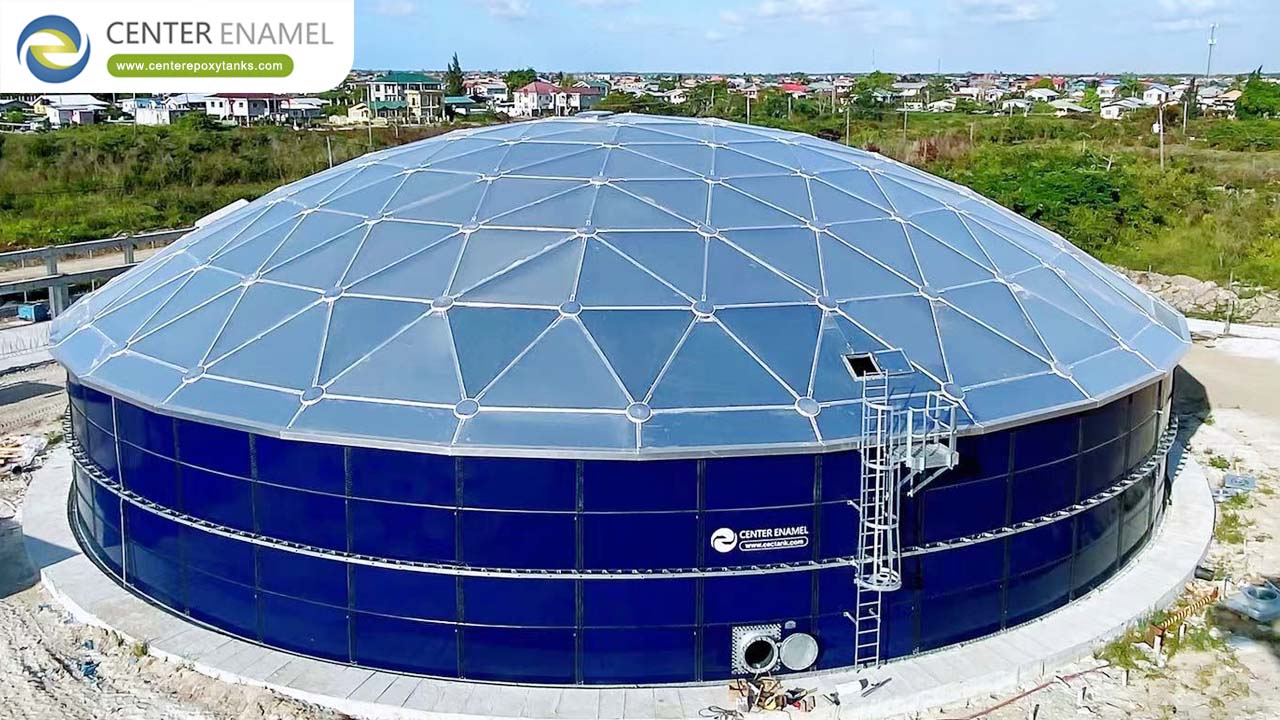
Glass-Fused-to-Steel (GFS) Tanks for Wastewater Storage: Technical Authority Guide
Glass-Fused-to-Steel (GFS) tanks are the industry-standard solution for wastewater storage, engineered by chemically fusing porcelain enamel to high-tensile steel at temperatures between 800C and 900C. This creates a robust, inert, and glass-like surface that provides unparalleled corrosion resistance against acidic and alkaline wastewater. Unlike porous concrete or field-welded steel, GFS technology offers a non-porous, "holiday-free" barrier that prevents microbial growth, resists abrasion, and ensures a 30+ year service life with minimal maintenance. Their modular, bolt-together design enables rapid, cost-effective deployment in both municipal and industrial treatment environments.
Why Wastewater Infrastructure Prefers GFS Technology
Wastewater is a chemically hostile medium. It contains high levels of sulfates, chlorides, and organic pollutants that rapidly degrade traditional infrastructure. GFS tanks mitigate these risks through advanced material science:
Chemical Inertness: The vitreous glass surface is inherently inert, making it resistant to a wide pH range ($2–12$). It prevents the chemical leaching often seen in concrete and stops the oxidative "pitting" common in unprotected carbon steel.
Clear-Span Architecture: GFS tanks are modular and bolted, allowing for clear-span structures that eliminate internal support columns. This prevents "dead zones" where sludge and debris can accumulate, significantly simplifying facility cleaning and maintenance.
Factory-Controlled Quality: Every panel is manufactured in an ISO-certified facility under strict QC protocols. Unlike concrete, which is subject to site-specific curing conditions and human error, GFS panels are uniform, standardized, and ready for immediate assembly.
Technical Comparison: GFS vs. Alternative Containment
Feature | Glass-Fused-to-Steel (GFS) | Reinforced Concrete (RCC) | Welded Carbon Steel |
Corrosion Resistance | Superior (Inert Glass) | Low (Porous/Acid Attack) | Low (Needs frequent painting) |
H₂S/Gas Resistance | Excellent | Poor (Spalling/Cracking) | Moderate |
Installation Speed | Fast (Modular/Bolted) | Very Slow (Curing time) | Moderate (Field-welded) |
Maintenance | Minimal (Zero painting) | High (Structural repair) | High (Recurrent recoating) |
Relocatability | Possible | None | None |
Key Performance Benchmarks for EPC Procurement
Municipal and industrial buyers should verify the following specifications to ensure long-term asset reliability:
Holiday-Free Certification: Demand that all panels have undergone 1500V high-voltage holiday testing to ensure 100% defect-free glass coverage.
Adhesion Strength: Verify that the glass-steel bond strength exceeds standard requirements, ensuring the coating won't delaminate under thermal shock or hydraulic loading.
Bolting & Sealing Integrity: Ensure the tank utilizes high-grade, food-contact-safe mastic sealants and corrosion-protected bolt heads to maintain an airtight, leak-free seal.
Seismic Compliance: Ensure the tank design is FEA-certified to handle local seismic, wind, and liquid-load requirements.
Frequently Asked Questions (FAQ)
Q: Are GFS tanks suitable for high-acidity industrial wastewater?
A: Yes. The inert nature of the glass coating makes GFS ideal for industrial effluent storage, provided the specific pH and chemical concentration levels are accounted for in the engineering phase.
Q: How do GFS tanks handle sludge accumulation?
A: The glass surface is exceptionally smooth (low friction), which prevents sludge from adhering to the tank walls and promotes efficient discharge during maintenance or operational cycles.
Q: How long can I expect a GFS wastewater tank to last?
A: With proper maintenance and correct operational usage, GFS tanks are designed for a 30+ year service life, often outlasting the mechanical equipment they contain.
Partnering for Reliable Infrastructure
Your wastewater treatment capacity is a mission-critical asset. Investing in Glass-Fused-to-Steel technology ensures environmental compliance, reduces operational downtime, and provides the lowest total cost of ownership (TCO) in the industry.
Are you evaluating containment solutions for a municipal or industrial wastewater project?
[Contact our engineering team] to request a structural feasibility study, review our chemical resistance test results, or obtain a comprehensive proposal for your storage volume requirements.
Would you like a detailed technical brief on how GFS technology integrates with specific sludge-thickening and odor-control systems?


